
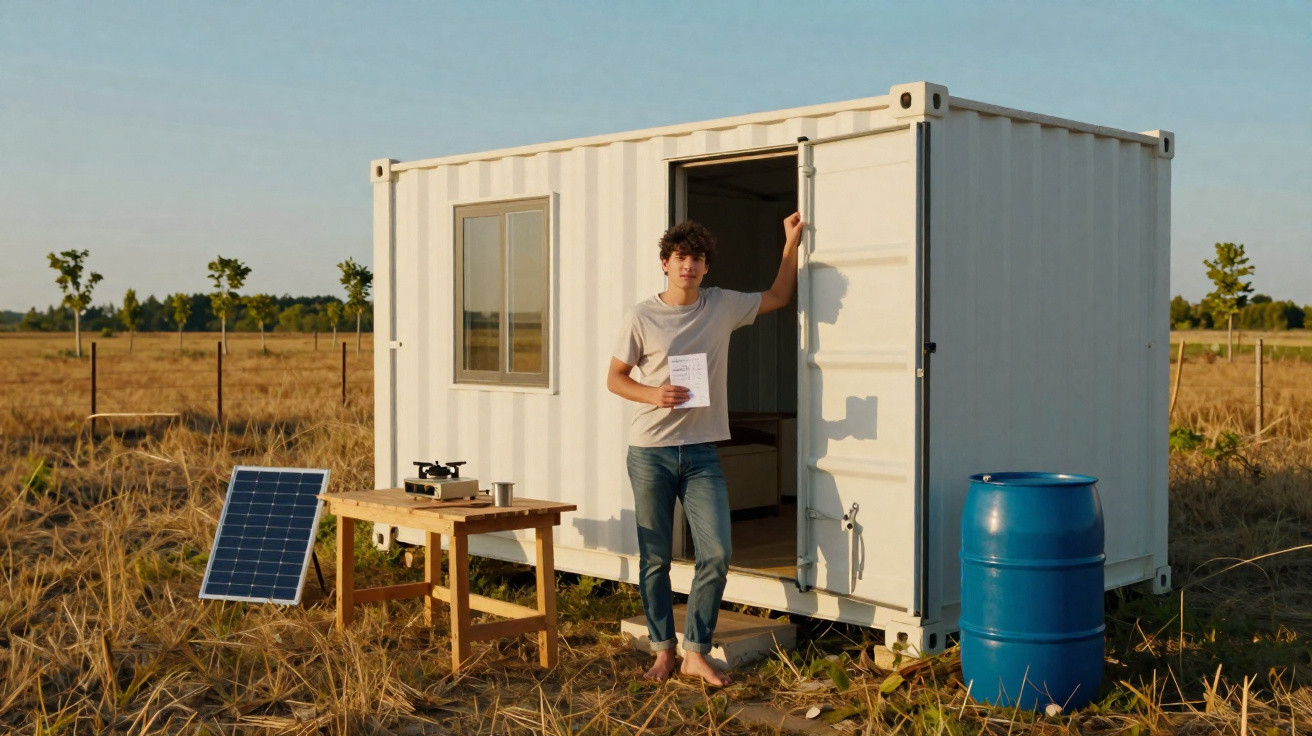
One winter morning, aged 28, he opens the metal door of his container, puts a saucepan on a small camping stove and looks out across the 20,000 m² of land in front of him. No rent leaving his account, no three-figure mortgage payment, no letterbox stuffed with bills. His decision surprises people, occasionally amuses them and often worries those close to him: he bought rural land for €15,000, placed a shipping container bought for €1,300 on it, then learned to live with almost nothing. His monthly outgoings are said to have fallen to around €20, mainly for his phone and a few unavoidable needs. It may look like a tiny life on paper, yet it feels vast when you look towards the horizon. This story is less about a survival fantasy than a very modern question: what does it truly cost to live somewhere?
At 28, he swaps rent for 20,000 m² of land
We all know the feeling: the rent payment is taken before the month has properly begun. For this young man, it eventually became unbearable. Working to fund four walls he did not own no longer felt like a life plan. So he looked beyond the big cities, at neglected rural plots where the price per square metre bears no resemblance to that of a flat. The 20,000 m² - two hectares - cost him €15,000. That may appear negligible beside the property market, but it was, above all, an isolated plot with no ready-made comforts and plenty of work ahead.
The shipping container, found for about €1,300, was nothing like a show home. When it arrived, it was a large steel box marked by its journeys, smelling of cold metal and with walls that condensed at the slightest change in temperature. It needed cleaning and insulating, openings had to be made, a sleeping area arranged and the installation secured. In some versions of this kind of project, water is collected or brought in, electricity comes from solar panels, and composting toilets take the place of conventional facilities. The purchase price is alluring, but the days spent doing DIY do not come free. They require time, tools and a considerable amount of patience.
His outgoings fall to €20 a month not simply because the land is cheap. It comes from breaking with an entire daily system: energy-hungry subscriptions, heating a large home, impulse purchases to furnish it and journeys imposed by an urban address. He uses few appliances, consumes little energy and keeps his needs to what he can genuinely manage. For him, the real luxury becomes room to manoeuvre. Let us be honest: hardly anyone lives like this every day. This self-sufficiency means accepting the cold, unforeseen problems, mud after rain and a kind of solitude that glossy videos do not always show.
The €1,300 container: savings that come with very real constraints
Before attempting to copy this model, the first step is to check exactly what the plot allows. Agricultural, natural or wooded land is not necessarily suitable for building, even when it is sold cheaply and a container seems easy to put in place. The local development plan, council rules, protected areas, emergency-service access and wastewater arrangements can all alter the situation entirely. You also need to decide whether you intend to live there year-round or merely spend time there. A low-cost plot can become a financial trap if it is inaccessible, prone to flooding or impossible to connect to services.
A common mistake is to compare €1,300 with €150,000 as though an empty container were the equivalent of a habitable house. It is not, and that is not a problem: the project does not need to be dismissed in order to be assessed realistically. Insulation, ventilation, windows and doors, foundations, delivery by lorry-mounted crane, heating, water, insurance and administrative procedures can quickly push up the bill. The inexpensive container is only the starting point. Many people also discover too late that steel becomes scorching in summer and freezing in winter if the thermal envelope has been poorly designed. Enthusiasm helps, but a contingency budget helps even more.
His approach rests on a simple principle: cut fixed costs before trying to earn ever more. He moves forward in stages, upgrades his installation whenever he can afford to and refuses to take on debt just to recreate the comfort of a conventional detached house in the middle of the countryside.
“I did not want to live without money; I wanted to stop living solely to spend it,” he explains when discussing his choice.
- Check the land’s status and all permissions before making any purchase.
- Cost the transport and fit-out, not merely the price of the container.
- Plan a dependable solution for water, cold weather, heat and emergencies.
- Try a low-consumption lifestyle for several weeks before leaving everything behind.
Living on €20 a month does not mean living without a safety net
The €20 figure is striking because it overturns our usual assumptions, but it needs to be understood with nuance. It may refer to the minimum recurring expenses for the place he lives, excluding food, repairs, healthcare, property taxes, a vehicle and one-off purchases. A failed solar battery, a broken pump or access damaged by bad weather is enough to show that self-sufficiency does not remove costs: it makes them less predictable. The story remains inspiring because it presents one possible path, not a magic formula that can be copied to the cent.
What makes his journey so compelling is not just the prospect of living in a container. It is his refusal to assume that a successful life must involve an ever-larger home, an ever-longer loan and ever-heavier outgoings. Two hectares away, there may be no bakery on the corner and no central heating controlled remotely. There are everyday jobs, some of them difficult, and silence when night falls. Yet there is also a rare feeling: taking back control of his pace, his needs and his money. Many will see a restriction; others will see breathing space.
| Key point | Detail | Benefit for the reader |
|---|---|---|
| Low-cost land | 20,000 m² bought for €15,000 in a rural area | Understand why location completely changes the cost of a project |
| Shipping container | Purchase price stated at around €1,300, before fitting out | Avoid confusing the purchase price with the true cost of living there |
| Reduced outgoings | About €20 per month for the minimum costs mentioned | Consider your own fixed expenses and whether they are useful |


Comments
No comments yet. Be the first to comment!
Leave a Comment