
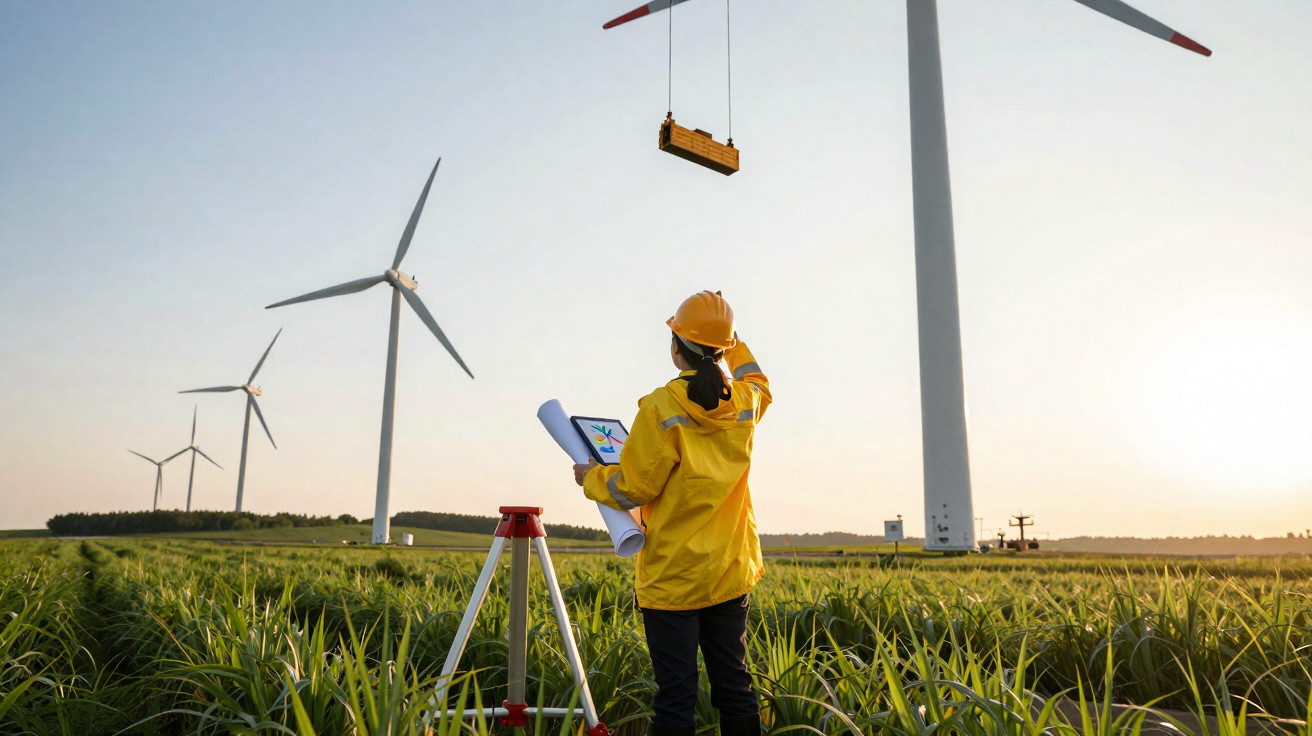
Along a country road, they can suddenly appear behind a line of trees: a slim white tower, topped by a rotor that seems to trace an enormous circle across the sky. Some wind turbines now stand more than 200 metres tall to blade tip, exceeding the height of several French skyscrapers. Their scale raises questions, makes an impression and also fuels conversations in village cafés and on social media. So why have wind turbine blades become so enormous?
On a clear morning near a wind farm, the contrast is immediately striking: cars look tiny, houses seem low, and the blades move with surprising steadiness. From the road they are barely audible, yet they can be seen from a great distance, particularly when sunlight catches their white surfaces. At that elevation, the wind behaves somewhat differently. Engineers do not build these giants simply for visual impact: every extra metre serves a practical purpose, linked to the energy available in the air. That principle is less straightforward than it may seem.
Higher and wider: the rule that changes everything
When looking at a wind turbine over 200 metres tall, people often focus first on the tower height. Yet the blades do much of the work. They sweep out a vast circular area, equivalent to several football pitches on the largest models. Longer blades pass through a far greater volume of air with every rotation. From the ground, their movement appears calm and almost slow, although a blade tip can travel at several hundred kilometres per hour. This contrast between their apparent gentleness and the power they generate is part of what makes them so compelling.
A modern onshore wind turbine may have a rotor diameter of 150 to 170 metres, and sometimes more depending on the project. With a 160-metre rotor, the swept area is close to 20,000 m²: this is where the difference is made. Extending the blades by a few metres does not merely add a narrow strip around the circle; it significantly enlarges the whole area from which energy is captured. Engineers refer to power being linked to the cube of wind speed, but the rotor’s swept area also carries considerable weight in the final output. Huge blades can therefore harvest more energy without necessarily increasing the number of turbines across the landscape.
Overall height matters too. Close to the ground, buildings, hedgerows, hills and trees disrupt air flows; higher up, wind is often stronger and more consistent. A tall turbine can therefore generate electricity even when the breeze feels slight across a field or car park. The real aim is not to turn quickly, but to turn frequently. A large, well-sited machine improves its capacity factor: its ability to deliver electricity over a year. Let us be honest: few people calculate that every day while watching a wind turbine through their window.
Giant wind turbine blades, but not installed at random
Before considering a very tall wind turbine, project teams assess the land for months, and sometimes for several years. They put up measuring masts or use sensors that record wind strength, direction and turbulence. The principle is simple: they need to understand the site’s actual wind patterns, season after season, rather than rely on an impression. An exposed plateau, an open plain and a coastal area do not provide the same conditions. A turbine with exceptionally long blades may work very well in an area with moderate, reliable winds, but be less suitable on a poorly selected site.
A common misconception is that a larger wind turbine will automatically be noisier or more intrusive for nearby residents. The reality is more complex. Manufacturers refine blade shape, trailing edges and rotational speed to reduce aerodynamic noise, while projects must also comply with separation distances and siting requirements. For local people, the sight of a 200-metre machine can still be a sensitive issue, and that reaction deserves to be heard rather than dismissed. Clear information about a project often helps to prevent concerns from taking over the discussion.
Engineers must strike a balance: increasing output, withstanding gusts, reducing material use and making maintenance easier. The blades are made from lightweight yet robust composites, designed to flex slightly rather than break under wind loads.
“A longer blade is not simply a ruler added to a machine: it changes the loads, transport, foundation and the entire way the wind turbine is controlled,” industry specialists often point out.
- A larger swept area captures more energy.
- Greater height provides access to winds that are generally more stable.
- Sensors continually adjust the turbine’s direction and the pitch of its blades.
What these giants reveal about our energy landscape
The outline of a 200-metre wind turbine rarely goes unnoticed, and perhaps its purpose is not to disappear into the background. It embodies a question we all recognise, even if we do not express it: how far are we prepared to alter the landscape in order to generate electricity that is less reliant on fossil fuels? One large machine can replace several smaller models in terms of installed capacity, while creating its own challenges for transport, construction work and local acceptance. The debate is therefore not simply a matter of being for or against. It often starts with a map, a distance, a skyline and a conversation between neighbours.
These enormous blades also show that innovation is not confined to laboratories. It involves abnormal-load convoys passing through villages at dawn, spectacular cranes, technicians working dozens of metres above the ground, and farmers who may still cultivate the land at the base of the towers. A wind turbine is never simply an object placed in a field. It becomes part of everyday life, visible from a school playground, a terrace or a train window. Sharing a photograph, a local resident’s experience or a specific question can often bring a sense of reality back to a highly charged subject.
| Key point | Detail | Value for the reader |
|---|---|---|
| Blade length | It greatly increases the area of air swept by the rotor. | Understand why a larger machine can generate more electricity. |
| Tower height | It makes it possible to reach winds that are often steadier and less turbulent. | Better understand the value of wind turbines exceeding 200 metres. |
| Site selection | Wind measurements, distances, terrain and grid connection shape the project. | See why size alone does not guarantee performance. |
FAQ:
- Why are wind turbine blades so long? Because they sweep a larger area and therefore capture more of the energy contained in the wind.
- Is a wind turbine over 200 metres tall unusual? No. Recent onshore models frequently reach this overall height to blade tip, depending on their capacity and location.
- Do the blades rotate very quickly? The rotor looks slow from the ground, but a blade tip moves at high speed. Rotation is controlled to optimise output and safety.
- Why not install only small wind turbines? Large turbines can generate much more electricity on the same site, especially where available winds are moderate.
- What happens during a storm? Sensors detect excessively strong winds. The blades then change angle, and the wind turbine can stop automatically to protect itself.




Comments
No comments yet. Be the first to comment!
Leave a Comment