
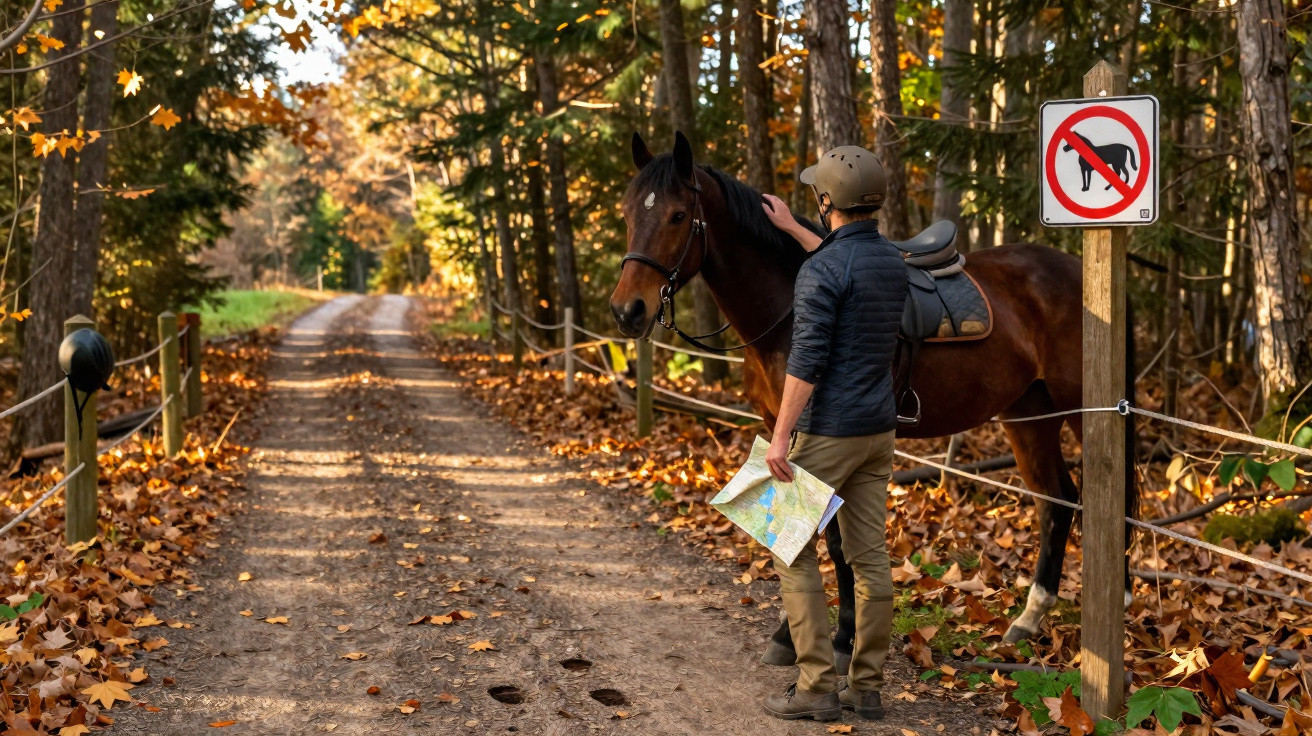
At first light, the horsebox pulls up beside a still-damp forest edge. The rider climbs down, reads the sign at the start of the track and pauses: the route where she regularly set off at a walk with her horse now bans equines from September. Nothing about the trail itself looks different, and the ferns remain in place, yet the ride will no longer be the same. Across several state forests, seasonal restrictions are being tightened or reinstated each year, often as forestry work, hunting or periods of high soil vulnerability approach. It is a reality that still catches many owners off guard and can spoil an outing planned days in advance.
Why some state forests close paths to horses from September
From the saddle, it is easy to notice the contrast between a dry track and one beginning to absorb autumn rain. Hooves leave their mark, can deepen ruts already made by machinery and make certain sections slippery for every user. From September onwards, forest managers may therefore restrict access to specific routes, for just a few weeks in some cases and for longer in others, depending on the condition of the plots.
This is not a blanket ban across all French state forests. Rules differ between administrative departments, forest areas, local orders and works scheduled by the National Forestry Office or local authorities. An adult horse commonly weighs between 450 and 600 kilograms: on waterlogged ground, repeated passage leaves a far more noticeable impact than an ordinary walk on foot.
September to November also bring together several potential sources of conflict: timber extraction, the opening of the hunting season, maintenance of fire-access tracks and the protection of sensitive areas. Riders can sometimes feel they are being singled out, although walkers, cyclists, vehicles and dogs may also be affected by closures. A forest is a place for recreation, but it is never a park without restrictions.
What riders can do before setting off
The simplest habit is to check access before loading a horse into the horsebox. Websites run by local councils, prefectures, the National Forestry Office or local equestrian associations can sometimes provide useful details, but a sign displayed on site remains the immediate point of reference. Taking a photograph of the waymarking before leaving can also prevent unclear discussions when several riders meet at the same junction.
Many riders have followed the same route for years and genuinely assume their right of way will never change. That is a common mistake, particularly after timber felling or heavy rainfall. Let us be honest: nobody checks local authority orders every day before a thirty-minute ride. Even so, five minutes spent checking can prevent a fine, an awkward turn-around or a dangerous encounter with forestry machinery.
Where a prohibition is displayed, it is best not to bypass it via a neighbouring ride or through the undergrowth. Respecting the site also protects the reputation of riders, who are often watched closely in heavily used areas.
“A closed path is not an invitation to look for a hidden way through: it usually indicates that a risk exists, even if it cannot yet be seen.”
- Identify officially authorised equestrian routes before departure.
- Seek advice from the riding school, local council or local tourist office.
- Avoid muddy tracks after several days of rain.
- Plan a fallback route, particularly during hunting weekends.
Restrictions that raise questions about the horse's place in the forest
For many owners, the forest is far more than a place to ride. It is where the horse unwinds, where the rider leaves dusty arenas behind and rediscovers that distinctive quiet, broken only by the sound of branches. Seeing access reduced can be genuinely frustrating, especially in suburban areas where suitable routes are already scarce. Freedom to ride on horseback is never guaranteed everywhere.
Forest managers, meanwhile, point out that they must accommodate different uses without causing lasting damage to the ground or putting the public at risk. A temporary closure may make it possible to repair a track, secure a felling operation or protect a regeneration area where young trees are trying to establish themselves. Local dialogue often makes the difference: a signed alternative route or information published early enough can prevent many misunderstandings.
The situation also raises a broader issue: how can the forest be shared without turning it into an off-limits space through an accumulation of rules, or weakening it through insufficient care? Riders can contribute by reporting damaged paths, staying on authorised routes and speaking with other users. Horses draw attention; they can also become ambassadors for a considerate, calm and better understood way of riding.
| Key point | Detail | Benefit for the reader |
|---|---|---|
| Local prohibitions | Closures do not apply to every state forest and often depend on specific orders or works. | Avoid assuming there is one nationwide rule. |
| September is a sensitive period | Returning rain, forestry operations and the hunting season can alter access conditions. | Plan a ride without putting horse or rider in difficulty. |
| On-site checks | Signs, barriers and waymarking take priority over habits or old GPS tracks. | Reduce the risk of turning back, conflict or penalties. |
FAQ
- Are horses banned from all state forests from September? No. Restrictions are local and often temporary. They may apply to a particular track, plot or forest area. Check the signs and the decisions in force for the area concerned.
- Why can access be closed in autumn? Soil becomes more vulnerable as it gets wetter, forestry operations may begin, and some areas host organised hunts. Safety and path protection often explain these decisions.
- Can you pass through if no sign is visible? If in doubt, it is better to ask the local council, the National Forestry Office or a local representative. The absence of a clearly visible sign does not always mean a route is open to riders.
- What does a rider risk by ignoring a prohibition? They may be told to turn back, receive a penalty under local regulations or, above all, find themselves in a dangerous area. There is no room for improvisation around forestry work or an organised hunt.
- How can authorised equestrian routes be found? County equestrian tourism committees, riding schools, tourist offices and local associations often know suitable circuits. Recent maps remain more reliable than old routes saved on an app.





Comments
No comments yet. Be the first to comment!
Leave a Comment