
A prehistoric sea beneath Egypt's desert
Egypt's desert sands have remained dry for millennia. Yet it is hard to imagine that much of this arid landscape was once beneath a sea spanning a large part of Africa's northern margin.
Nor was this an empty sea. Evidence indicates that, during the Cretaceous period, it may have been a tropical haven where upwelling currents carried nutrients into the water column and sustained a flourishing ecosystem.
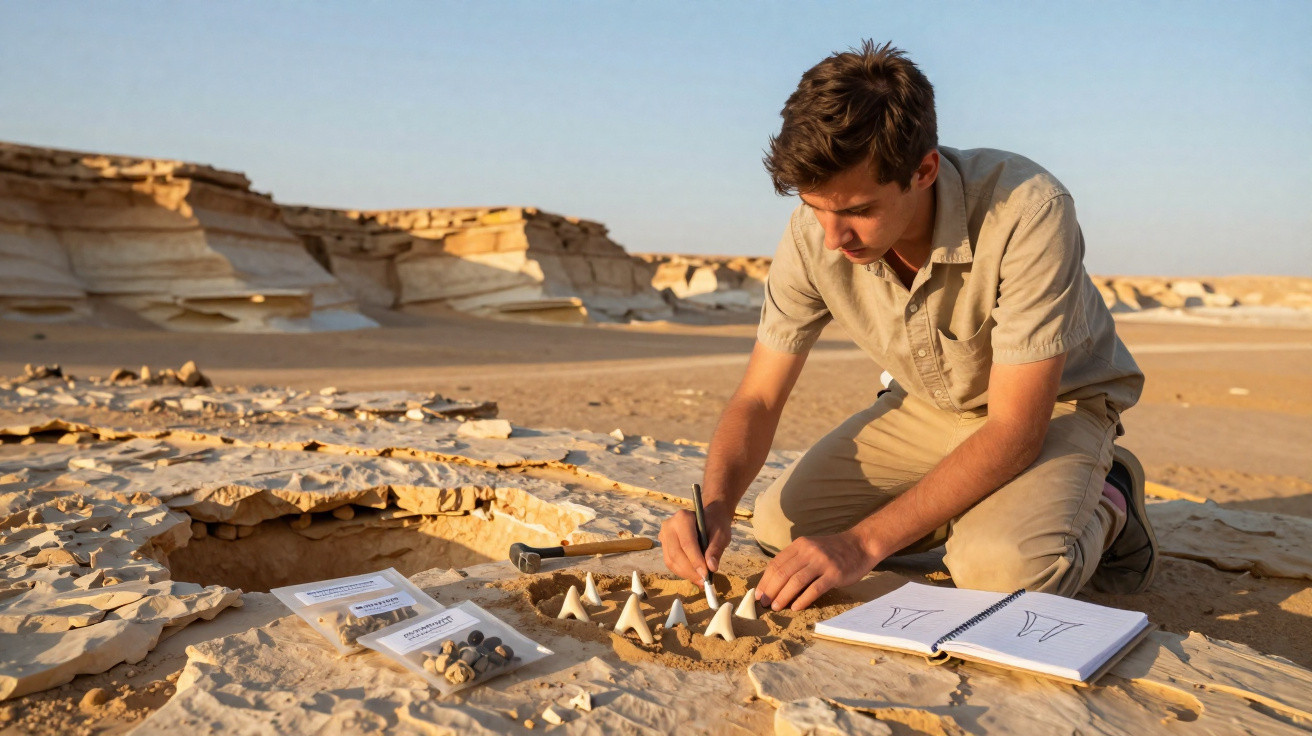
Palaeontologists have now uncovered signs of that abundance in the Abu-Tartur Plateau, buried within what was once the bed of this ancient sea: shark teeth from animals that would have prospered among plentiful fish.
The find involves more than a single shark. At least seven distinct species have now been identified from this layer of the Duwi Formation, providing a window onto the diverse marine ecosystems that once thrived along Africa's northern edge.
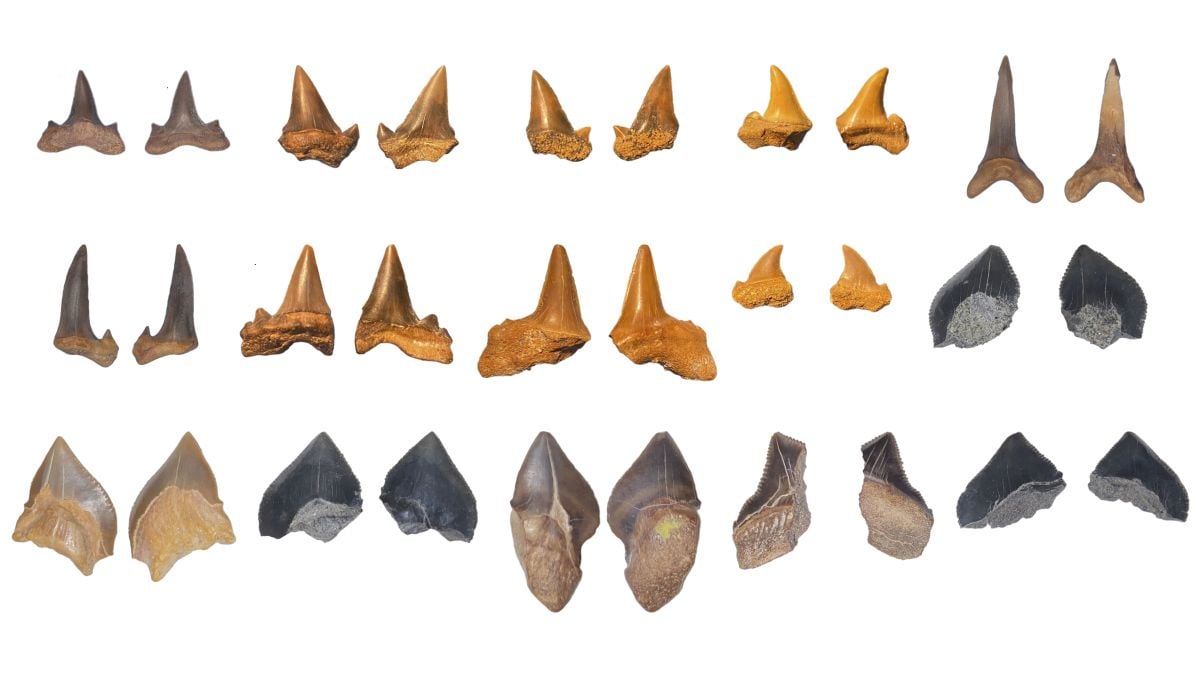
The 14 teeth represented five species. (Yassin et al., Cretac. Res. 2026)
"Collectively, this assemblage highlights a nutrient-enriched, high-productivity marine ecosystem along a phosphogenic shelf margin," writes a team led by Cairo University palaeontologist Tarek Yassin in a paper published in Cretaceous Research.
The Duwi Formation's productive Cretaceous waters
Between roughly 145 and 66 million years ago, during the Cretaceous period, Earth was a markedly different world. Tectonic activity drove a greenhouse climate, making the planet warmer and leaving little or no polar ice. Higher sea levels submerged much of the land now inhabited by people, including northern Africa.
Phosphate offers part of the evidence for this past. Phosphorite deposits often develop in highly productive marine settings, where phosphorus is vigorously recycled and concentrated.
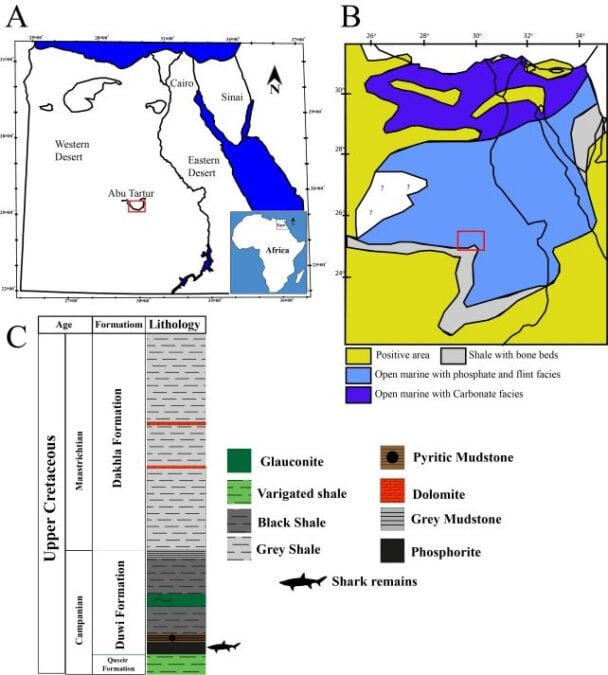
A diagram illustrating how oceans once covered the region. (Yassin et al., Cretac. Res. 2026)
The Duwi Formation's widespread phosphate deposits thus retain both remnants of this former sea and indications of how productive its waters were.
In earlier work, Yassin and colleagues identified two shark species from a small set of teeth recovered from the fossil bed. This was an intriguing clue, because an ecosystem able to sustain several large predators must have a productive food web below them.
The team therefore returned to Abu-Tartur to learn more.
The black and yellow strata of Duwi phosphate delivered. Researchers recovered a further 14 shark teeth, representing five additional shark species, none previously recognised at Abu-Tartur.
Shark teeth reveal five newly recorded species
When teeth are the only fossils available - as is usually true for ancient sharks - minute distinctions may be the only basis for diagnosing a species.
For the Duwi teeth, though, the contrasts were not invariably minor.
Some teeth were long and narrow, resembling needles. Others were wide and serrated, likely designed more for slicing than piercing. One was distinctly curved like a karambit. Several bore small, fang-like lateral projections known as cusplets, whereas others lacked them.
Drawing on fossil evidence from elsewhere in the world, the scientists assigned the teeth to five extinct species: Cretalamna cf. maroccana, Scapanorhynchus cf. raphiodon, Serratolamna cf. serrata, Squalicorax bassanii, and Squalicorax pristodontus.
Each of the five is a new record for Abu-Tartur.
Two - Serratolamna cf. serrata and Squalicorax bassanii - were entirely new records for Egypt.
One discovery was especially remarkable. Scapanorhynchus cf. raphiodon, the shark with needle-like teeth, may be its first known occurrence in Africa. The researchers also said it could be the youngest fossil-record example, as every other specimen is considerably older.
Yet these identifications reveal a far more compelling story than "a bunch of sharks".
As the tooth forms suggest, these animals may have occupied separate ecological niches rather than competing directly within a rich marine environment.
"The presence of *Squalicorax *could suggest an input from nearshore/inner shelf settings, while the occurrence of *Scapanorhynchus *reflects deeper-water conditions on the outer shelf and slope," the researchers write.
"Lamniform taxa such as *Cretalamna *and *Serratolamna *further support stable open-shelf conditions."
Why the ancient shark graveyard is not a single event
The scientists think upwelling may hold the key to this exceptional richness.
Nutrient-laden water rising from the deeper ocean would have supplied phosphorus and other nutrients to sunlit surface layers, fuelling intense primary productivity as plankton gathered to feed.
This would in turn have sustained small fish and invertebrates, followed by predators including Squalicorax and Cretalamna, with Cretoxyrhina and marine reptiles occupying higher positions in the food web.
The shark "graveyard" becomes particularly interesting at this point. Very little sediment built up while these sharks were alive, meaning the phosphate bed captures a more compressed interval of time than a location containing more mud would.
Related: World's Biggest Glowing Vertebrate May Be Using Its Own Light as a Hunting Tool
The teeth consequently form a time-averaged collection from several ecological niches, rather than showing that all seven shark species existed simultaneously and died there together.
Even so, the find adds to evidence that such ecosystems were widespread along northern Africa during the Late Cretaceous. Phosphate deposits in places including Morocco and Syria also preserve large numbers of shark species, implying that the whole region was an excellent place to be a shark.
Little survives today of that shark paradise. The Tethys has disappeared, its seabed has turned to desert, and the predators that roamed its waters died out millions of years ago.
Still, a scattered handful of teeth set in rock can, like a projector from the past, bring an entire vanished world into view.
The findings have been published in Cretaceous Research.
This article was fact-checked and edited by Rebecca Dyer. Although we take pride in our process, we are only human. If you notice an error, please let us know.



Comments
No comments yet. Be the first to comment!
Leave a Comment