
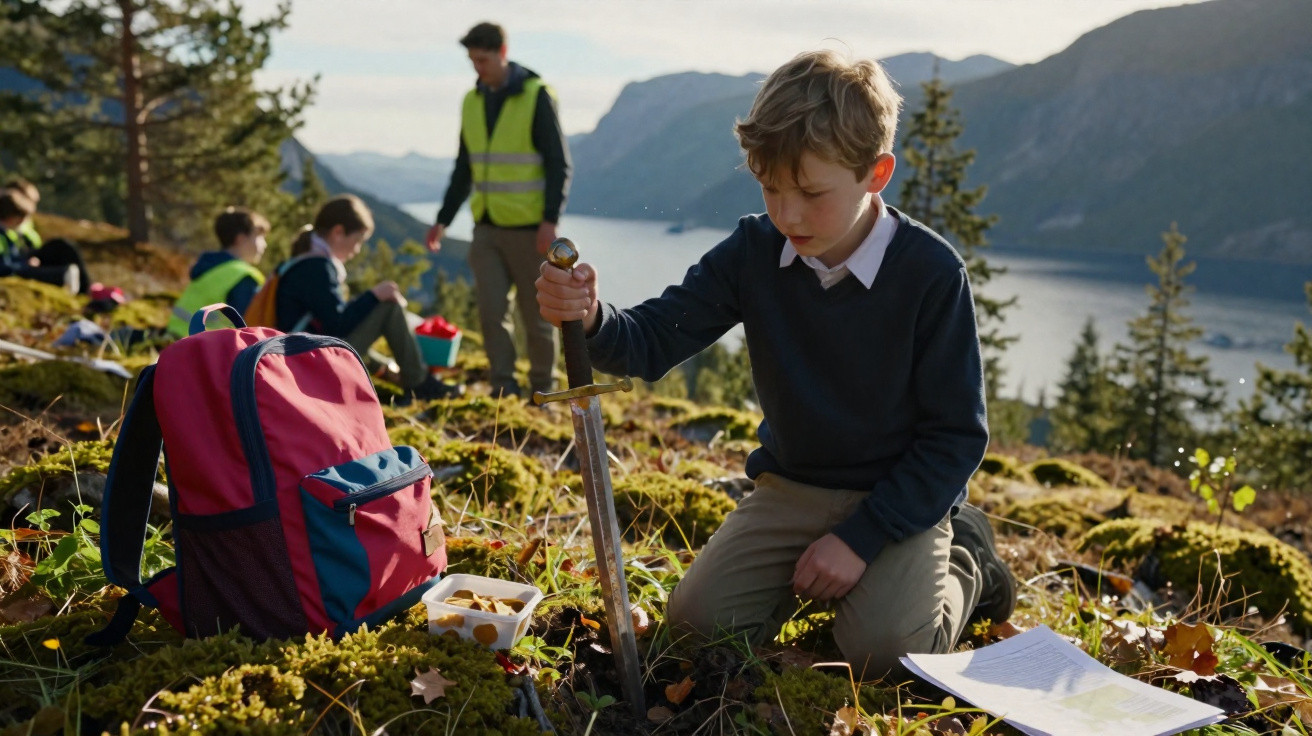
A straightforward countryside school activity became a significant moment for European archaeology. While looking for ordinary stones for a children’s project, a boy uncovered a remarkable ancient sword that had lain buried for centuries in Norway.
How did this remarkable archaeological discovery happen?
During an outdoor practical lesson in the village of Brandbu, in Gran municipality, six-year-old Henrik Refsnes Mørtvedt was searching across the ground. The pupil had simply been seeking craft materials when he spotted the object beneath the damp earth.
When he pulled out the partly buried item, the child realised that its metal form was unusually heavy and unlike anything he had expected. Recognising the artefact’s importance, the teachers immediately contacted local specialists to assess the relic recovered from that Nordic soil.
What ancient secret had been concealed beneath the stones?
The boy thought he was gathering stones for school, but instead unearthed a treasure that changed the history of… Read more
What is the true age of this iron artefact?
Researchers have confirmed that the find is an ancient weapon made from robust iron. Initial assessments indicate that it remained underground for roughly twelve centuries, retaining key features of its original manufacture from that period.
Chronological estimates place its production between 1,200 and 1,300 years ago. This historical era saw crucial social changes across the region, giving the discovery considerable value to science.
Below is a Facebook post from the Kulturarv i Innlandet page that explores the points discussed about the find in greater depth:
How does the sword find relate to the Viking Age?
The weapon’s dating aligns precisely with the transition from the Merovingian period to the early era of the Norse seafarers. This historical interval brought major technological developments in metalworking, making the weapon a living testament to a past marked by battles.
Specialists note that few items from this transitional phase survive centuries underground with such structural integrity. Understanding how these warriors made their equipment broadens knowledge of the cultural formation of Scandinavian society before maritime expansion.
Highlights of the Historic Discovery
Key elements of the relic
Here are the most important aspects identified in the blade found in Norway:
- Forged from iron during the transition from the Merovingian Age to the Viking Age;
- Estimated to be between 1,200 and 1,300 years old;
- Accidentally discovered by a six-year-old pupil in Brandbu.
Which institutions took responsibility for preserving the item?
Kulturarv i Innlandet was called in to manage the technical procedures at the discovery site. Professionals cordoned off the area to investigate whether other archaeological traces were present near the rural school in the municipality of Gran.
The Museum of Cultural History in Oslo later received the object to carry out meticulous anti-corrosion treatment. Laboratory work aims to stabilise the oxidised metal and prepare it for future public display with complete safety and heritage care.
The organisations’ work involved essential stages in protecting the heritage:
- Detailed inspection of the ground where the accidental discovery occurred;
- Use of conservation techniques to slow the iron’s oxidation;
- Controlled transfer for scientific analysis at the capital’s museum.
Why are chance finds so important to archaeology?
Many major archaeological discoveries happen entirely by chance in people’s everyday lives. When members of the public identify something unusual and report it to qualified authorities, valuable opportunities emerge to recover information about the way of life of peoples across the European continent.
The young pupil’s alert response, together with the educators’ swift action, made it possible to save an invaluable millennia-old artefact. Preserving this weapon enriches shared knowledge of antiquity and encourages new generations to value the memory of their own territory.



Comments
No comments yet. Be the first to comment!
Leave a Comment