
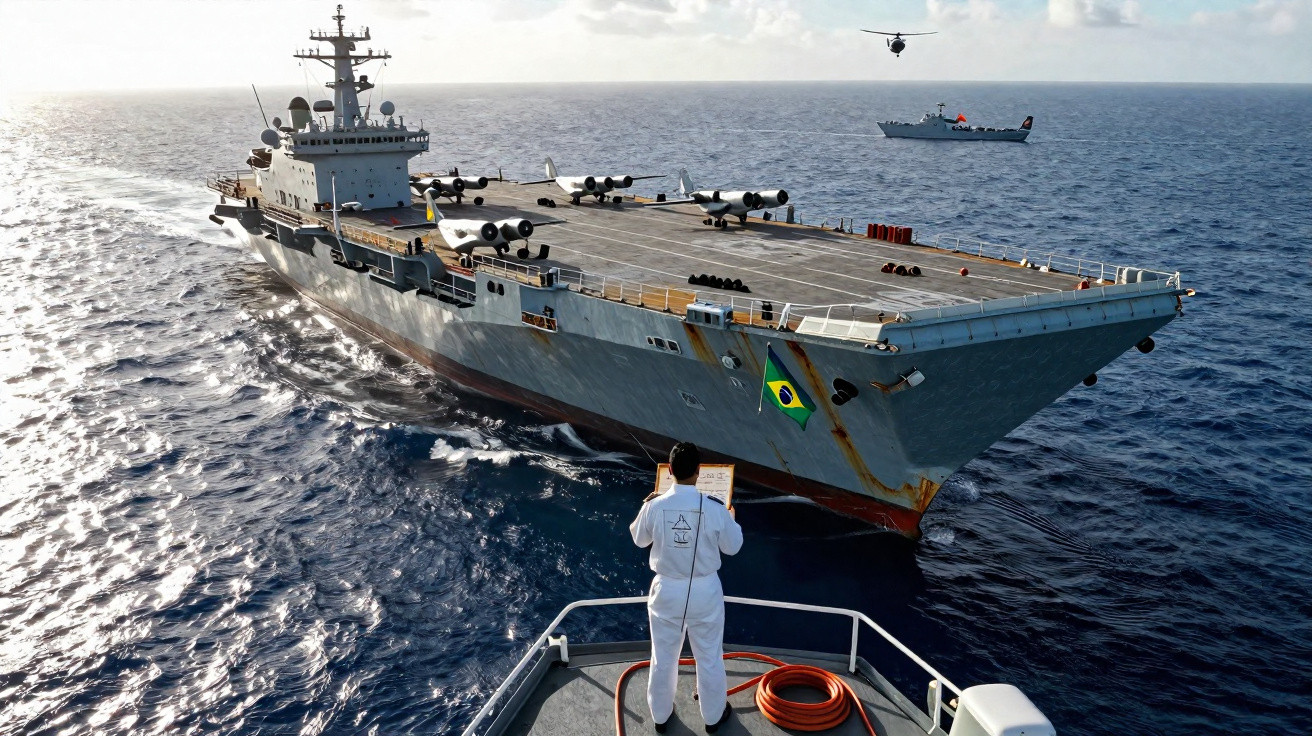
On 2 February 2023, off the Brazilian coast, a weary giant vanished beneath the Atlantic. As it descended towards a depth of almost 5,000 metres, the old aircraft carrier São Paulo took with it a history that had begun far away, in Brest and Toulon, under another name: Foch. Bought by Brazil for 12 million dollars in 2000, this warship was meant to give the Brazilian Navy a prestigious second life. Twenty-three years later, it was neither destroyed in a dramatic accident nor sunk during a military exercise. It was deliberately scuttled because no accepted solution could be found for dismantling it. Its end was almost quiet, yet intensely controversial.
From the French Foch to Brazil’s São Paulo: the dream of a major naval power
When Foch left the French Navy in the late 1990s, it was no ordinary vessel. Commissioned in 1963, it had carried aircraft, sailors and missions across distant seas, embodying the distinctive image of an aircraft carrier: a floating city in which every action matters. In 2000, Brazil purchased it for 12 million dollars and renamed it São Paulo. On paper, the deal looked attractive: acquiring a symbol of power for what appeared to be a relatively modest price.
Yet the purchase price revealed only a small part of the story. Refitting, maintaining and modernising an ageing aircraft carrier costs vast sums, far beyond the original cheque. São Paulo was intended to replace Minas Gerais, another ageing aircraft carrier bought from the United Kingdom, and to allow Brazil to retain its carrier-based aviation with AF-1 fighters, the Brazilian version of the American Skyhawk. A ship may be sold as a bargain, but it never becomes a minor expense.
Problems soon emerged: fires, boiler failures, lengthy periods out of service and expensive repairs. In 2012, a fire in the engine room killed two people, starkly demonstrating that an aircraft carrier is also a concentration of industrial hazards. The Brazilian Navy eventually decommissioned it in 2017, following a Brazilian career far shorter than expected. The irony was harsh: bought to remain visible at sea, the vessel became better known for its long spells alongside.
The real issue was not the hull, but what was inside it
For a military vessel at the end of its life, the obvious response may seem to be selling it for scrap. In practice, its onboard materials must first be identified precisely, a yard able to handle them has to be found, and the necessary approvals must be secured. São Paulo contained asbestos, PCBs and other hazardous waste inherited from its older design. Let us be honest: hardly anyone deals with this every day, especially not for a vessel more than 260 metres long.
The aircraft carrier was sold in 2021 to a Turkish shipbreaking company. In the summer of 2022, it left Brazil under tow for the yard at Aliağa, near Izmir, a site known for ship recycling. Turkish authorities ultimately refused it entry, citing concerns over toxic substances. After weeks at sea, the convoy had to turn back. We all know the moment when a solution that seemed settled reveals, far too late, a problem much larger than expected.
The position then became untenable: no port would accept this deteriorating giant for any length of time, while Brazilian authorities feared that its hull could break apart or drift away. The Brazilian Navy opted for controlled scuttling in an area around 350 kilometres from the coast, outside the exclusive economic zone according to its statement, and in very deep water.
“The only alternative to disposing of the vessel was to sink it in waters under Brazilian jurisdiction,” the Brazilian Navy said in a statement translated from English.
- 2000: Foch becomes São Paulo for 12 million dollars.
- 2017: the aircraft carrier is officially withdrawn from service.
- 2023: it is deliberately sunk, with its waste still on board.
A controlled sinking that leaves an unanswered question
São Paulo therefore did not sink under enemy fire, nor because of an unexpected breach in its hull. It was sent to the seabed because dismantling it had become an industrial, health, legal and political puzzle. Environmental organisations condemned a decision that, in their view, effectively turned the ocean into a storage solution. The Brazilian Navy, meanwhile, defended it as a safety measure in response to a deteriorated vessel with no viable port destination.
This story extends far beyond the fate of a former French aircraft carrier. It raises questions about how states prepare for the end of life of military equipment, often built to last several decades but rarely designed from the outset to be dismantled cleanly. Foch had represented French power, then Brazil’s maritime ambition. Its final image is less glorious: that of an enormous hull left to the contradictions of the modern world, caught between immediate safety and lasting pollution.
There is also a very practical lesson for readers: the advertised price of an object, however spectacular, never tells the full story of its real cost. An aircraft carrier priced at 12 million dollars may look like a bargain. Years of maintenance, repairs, human constraints and the environmental bill ultimately tell a very different tale. São Paulo now lies in the darkness of the Atlantic, but its story continues to surface in debates over toxic waste, sovereignty and the responsibility of major navies.
| Key point | Detail | Value for the reader |
|---|---|---|
| Purchase of Foch | Brazil bought the French aircraft carrier in 2000 for 12 million dollars and renamed it São Paulo. | Understand why a low purchase price can conceal considerable future costs. |
| End of service | It was withdrawn from service in 2017 after breakdowns, fires and periods of inactivity. | Assess the operational limits of an ageing military vessel. |
| Scuttling in 2023 | Rejected by Turkey for dismantling, the vessel was sunk with polluting materials on board. | Grasp the environmental and political issues surrounding ships at the end of their lives. |






Comments
No comments yet. Be the first to comment!
Leave a Comment