
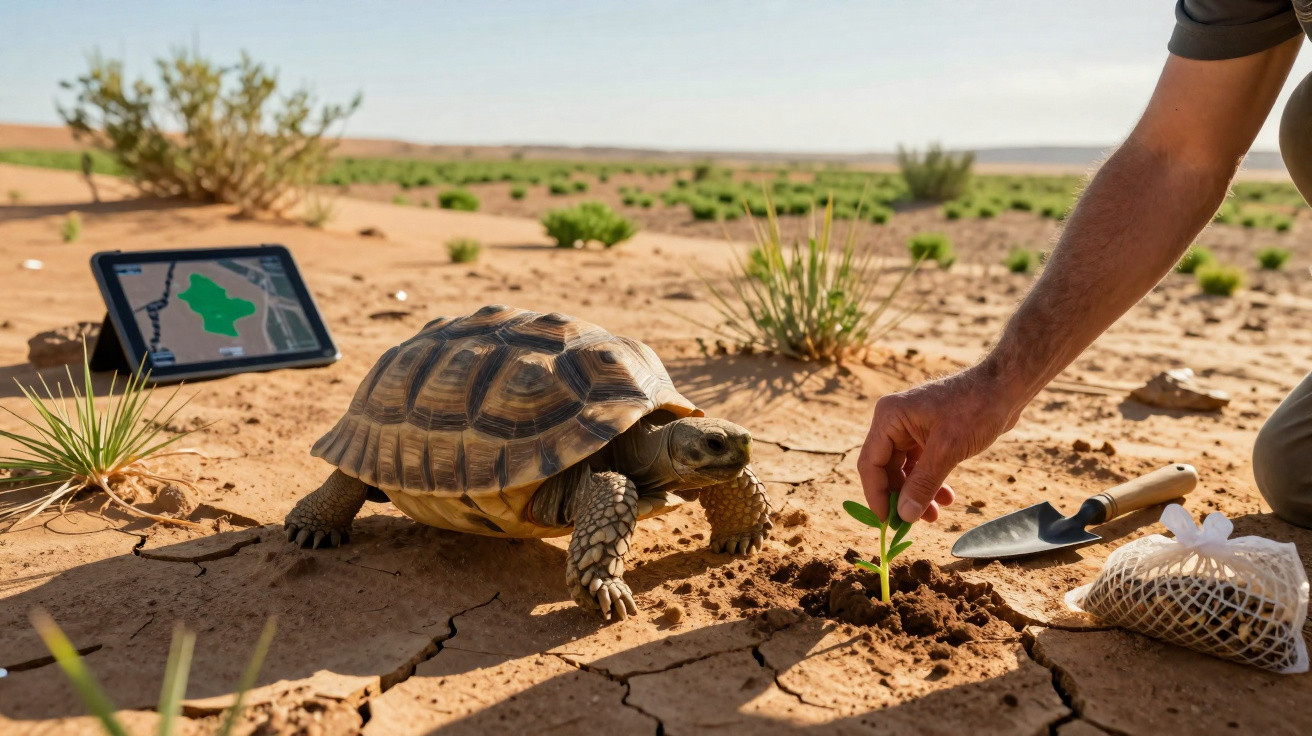
At first light, the desert seems motionless. Sand, pale rocks and the occasional outline of a dried-out shrub make it appear that nothing could ever truly return to life here. Yet for years, teams planted thousands of trees, watered them, protected the young shoots and replaced dead saplings. It required enormous effort and was often followed by quiet disappointment. Then 400 tortoises were released into this arid area. Gradually, with no machinery or dramatic intervention, they began to reshape the landscape. A few years later, satellite imagery revealed a green trace where almost nothing had been visible before: a small, shell-covered revolution.
When planted trees are no longer enough to revive a desert
Researchers working on site quickly realised that the issue was not simply a shortage of trees. In a degraded desert environment, soil can become as hard as cement, contain few seeds and be almost unable to hold water when rain eventually falls. Young plantings may survive for a few weeks before weakening. We all know the feeling of making a great deal of effort without seeing the hoped-for outcome; for these teams, it was the same experience on a vast scale.
Over successive restoration campaigns, thousands of saplings had been planted. Some were safeguarded by fencing, while others received occasional watering, an expensive measure that was difficult to sustain in such a remote region. Survival rates remained low. Researchers then noticed something that maps did not always show: seeds were still present in the environment, but they were no longer being dispersed sufficiently. The desert was not entirely empty; it had lost its messengers.
The 400 released tortoises did not make trees grow by magic. Instead, they set an ancient process in motion again: they eat fruit, carry seeds through their bodies and deposit them farther away alongside organic matter that supports germination. As they move, they lightly compact some patches of soil, open routes through low vegetation and create favourable micro-sites. Their slowness then becomes an ecological strength. Over the course of a year, their movements form a kind of living network.
Why 400 tortoises can transform an entire landscape
The immediate instinct might be to assume that more trees must always be planted. This experience points to a more nuanced approach: restore relationships between species before attempting to restore landscapes alone. Here, the tortoises act as unwitting gardeners. Their diet selects certain seeds, their journeys take them away from the parent tree and their droppings provide nutrients. For a local project, the most useful action is often to identify the animal that has disappeared, or become too scarce, despite having once performed this role.
A common mistake is to treat planting as a complete, almost automatic solution. That does not mean it is pointless: planting remains necessary in many places. However, a lone tree placed in exhausted soil and separated from the species that support it has little prospect of creating a lasting forest. Let us be honest: hardly anyone spends years observing insects, birds, herbivores and seeds before taking action. Yet this is often where success is decided.
Scientists stress one vital precaution: releasing tortoises can only work within their natural range, or in a habitat very similar to the one they occupied before disappearing. Introducing a species in the wrong place can have the opposite effect. Ecological restoration is never a copy-and-paste formula.
“Tortoises do not restore plants alone: they re-establish exchanges that the landscape had lost.”
- Study the species that were once present at the site;
- Assess soil quality before undertaking large-scale planting;
- Monitor seeds, water and animal movements over several years;
- Compare field observations with satellite imagery.
The green visible from space also tells a very terrestrial story
When the first satellite images showed a change in colour across the restored area, the result made a strong impression. From space, vegetation appears as a denser, less dusty shade, at times almost unexpected amid the ochre tones. This interpretation must still be handled carefully: an image cannot replace botanical surveys or site visits. Even so, it provides powerful, almost moving evidence that the combined effects of hundreds of animals can become visible on a very large scale.
What makes this story compelling is not only the scientific success. It is also the idea that a damaged environment can sometimes respond as soon as a missing component is returned. Tortoises are neither fast nor impressive in the usual sense. They move, eat, digest and begin again. This ordinary action, repeated day after day, eventually changes the fate of a territory. Nature often works quietly.
This experiment encourages a different view of reforestation projects. Planting remains a practical, reassuring act that is easy to photograph. Repairing an ecosystem also means protecting animals, allowing nature time and accepting that results may not always resemble what was initially imagined. Perhaps, in some landscapes believed to be lost, the best help is not a spade or a lorry full of saplings, but the patient return of a species that had vanished.
| Key point | Detail | Added value for the reader |
|---|---|---|
| Planting alone failed | Degraded soil and the lack of seed dispersal limited regrowth | Understand why planting more does not always solve the problem |
| 400 tortoises restarted a natural cycle | They move seeds and enrich the areas they pass through | Discover the overlooked role of animals in landscape restoration |
| The change was observed from space | Satellite imagery shows more vegetation in the monitored area | Gauge the tangible scale of an ecological action carried out over several years |


Comments
No comments yet. Be the first to comment!
Leave a Comment