
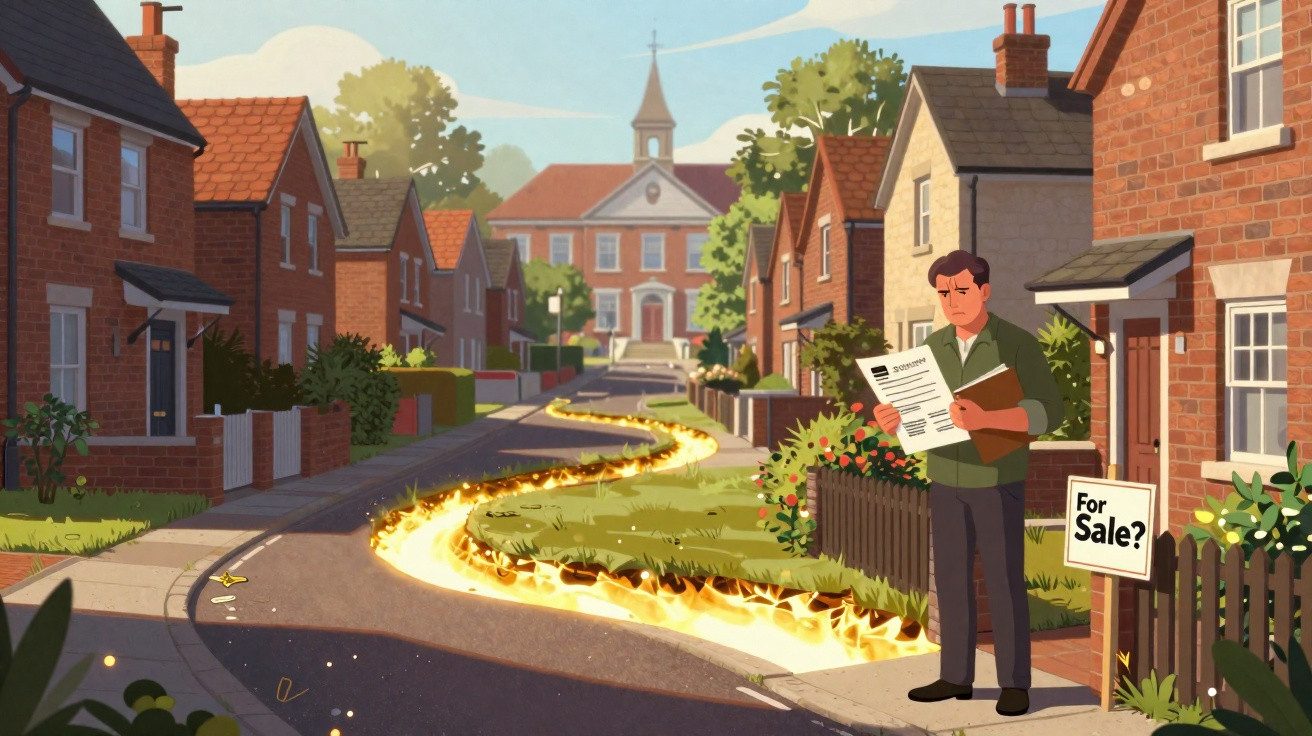
On a Tuesday morning outside the town-centre estate agency, talk was no longer about mortgage rates or the next neighbourhood celebration. In this town of around 22,000 residents, an estimate shared on social media had changed the conversation: the ground beneath the area could contain a theoretical gold deposit valued at €38 billion. The council will not, however, give the figure official status, as no full mining study or administrative approval exists. For property owners, the news immediately altered how they viewed a plot, a garden or even an old family field. Between hopes of a windfall and fears of an industrial development, uncertainty has taken hold. No one truly knows what their land is worth.
€38 billion beneath homes: an estimate that unsettles an entire town
At first, the story seems almost implausible. An ordinary town, complete with housing estates, shops, schools and farmland, is suddenly linked to an extraordinary figure: €38 billion in possible gold, more than the annual budget of many major cities. In cafés, some are already talking about a “new Klondike”, while others remain deeply sceptical. The difficulty is that a geological trace and a profitable mine are worlds apart. Minerals may be present within a local authority area without anyone being able to claim that a commercially viable deposit lies beneath its streets.
The estimate reportedly comes from older geological analyses, supplemented by theoretical calculations based on the potential gold content of the ground and the international price of gold. Multiplying assumed tonnages of mineralised rock by a high price for the yellow metal can soon produce a dizzying total. Yet that calculation excludes extraction costs, technical losses, environmental restrictions and areas where digging would simply be impossible. A €38 billion deposit “in the ground” therefore does not mean €38 billion can be recovered. The distinction is substantial.
The council, for its part, will not turn a hypothesis into a public promise. Its duty is to safeguard the local balance, oversee planning and provide residents with cautious information, rather than certify mineral wealth without independent expertise. Formal recognition of a resource would require drilling, feasibility studies, assessments of the effects on water and landscapes, followed by approvals that are often lengthy and disputed. The ground beneath the surface is not sold like a flat. This restraint frustrates those hoping for an immediate rise in property prices, but it also prevents a surge driven by rumour.
Property owners caught between hopes of capital gain and practical concerns
Before reaching any conclusions, the most useful step for owners is to establish the exact status of their plot. The land register shows a property's boundaries and classification, but it is not enough to establish a right to mineral resources; in many legal systems, underground rights are governed separately and may belong to the state. Owners should check the local development plan, any mining exploration zones, and public documents held by the council or geological services. It may sound laborious. Let us be honest: nobody really does this every day.
The most common mistake would be to assume that a house above a potentially gold-bearing area automatically becomes an exceptional property. Property value also depends on peace and quiet, transport links, schools, the building's condition and the absence of future disturbance. The prospect of mining may draw speculative buyers, but it may repel others concerned about noise, lorries, vibrations or dust. Families considering a sale would be wise to seek several opinions rather than yield to pressure from the first impatient investor. A spectacular figure can never replace a sound valuation.
Residents would also do well to demand information that is dated, sourced and understandable instead of rapidly circulated screenshots. A former local councillor sums up the mood prevailing in the town: “We cannot build the future of a neighbourhood on a calculation made without core drilling, without permits and without knowing whether the gold can be extracted cleanly.” Before any decision is made, a few habits can help people stay level-headed:
“A presumed source of wealth can make a town dream. Verified information allows it to choose.”
- Ask for the precise source of the €38 billion valuation.
- Check whether exploration or extraction permits actually exist.
- Consult a solicitor before signing an unusual agreement to sell.
- Compare property surveys with those for similar homes outside the affected area.
- Attend public meetings and retain official documents.
Why the council will not “recognise” the gold despite pressure
A local council does not always have the legal power to declare a deposit commercially exploitable, even where geological indicators are known. It may issue warnings, seek safeguards, amend certain planning documents or organise local discussion, but recognising a mine involves far more demanding national and technical procedures. In this case, the word “refusal” may therefore be misleading: the council is not necessarily denying the presence of gold, but is chiefly declining to endorse a value that has not been proven. That stance protects both residents and local finances.
The possible arrival of a mine is never merely a financial windfall. It raises questions about roads, water, agricultural land, natural heritage and public health. We all know the moment when good news appears perfect, until one detail complicates the picture. Here, that detail could be a storage basin, heavy-goods traffic or declining appeal for visitors. Elected representatives also fear legal disputes: announcing wealth too quickly could leave the authority facing expectations it cannot meet.
Above all, the debate exposes two competing views of the area. Some residents see gold as an opportunity to create jobs, fund facilities and keep young adults from leaving to work elsewhere. Others do not want their town to become an open-cast industrial site, even in return for compensation. The true value of land may not lie solely in what its rock contains, but in the life it enables day after day. Between these two positions, there remains room for transparent expertise, conducted without haste and open to challenge.
Waiting for the gold estimate could permanently reshape the local market
At this point, perhaps the most striking aspect is not the supposed gold itself, but the immediate effect of the announcement on behaviour. Some owners are postponing a sale in the hope of receiving more in a few years' time. Neighbours are comparing plot boundaries, while certain buyers already ask whether land is “affected” before discussing the heating system or roof. This atmosphere of waiting may be enough to stall the local property market. Homes stay listed for longer, negotiations become tense, and rumours can sometimes override notarial deeds.
The experience of this town of 22,000 people is a reminder of an uncomfortable reality: a natural resource can be an opportunity, but it can also create collective uncertainty. The €38 billion estimate will remain a fascinating figure until it is tested against rigorous studies, clear rules and the views of residents. Property owners are right to ask questions, and the council is right not to improvise certainty. Between dreams of buried treasure and the protection of a way of life, every plot of land now tells a different story.
| Key point | Detail | Value for the reader |
|---|---|---|
| Unofficial estimate | The €38 billion figure is based on theoretical potential, not on an approved mine. | Avoid confusing geological value with actual financial gain. |
| Underground rights | They do not automatically follow ownership of a house or plot of land. | Better prepare for a sale, purchase or request for information. |
| Council caution | The council cannot by itself certify that a deposit is commercially exploitable. | Understand why the lack of official recognition is not necessarily a denial. |
FAQ:
- Does a property owner automatically own the gold beneath their land? Not necessarily. Rules concerning underground rights and mineral resources are often separate from surface ownership and must be checked under the relevant legislation.
- Why can an estimate of €38 billion be challenged? It may represent a gross theoretical value calculated without including costs, technical constraints, losses and environmental effects.
- Can the council prevent mining on its own? It has planning and political levers, but mining permissions generally fall to competent authorities at another level.
- Should owners sell their property quickly in an affected area? No. It is better to obtain official information, compare valuations and consult a legal or property professional.
- Would a mine necessarily push up property prices? Nothing is automatic. The activity may create jobs, but disruption and uncertainty may also weigh on demand.




Comments
No comments yet. Be the first to comment!
Leave a Comment