
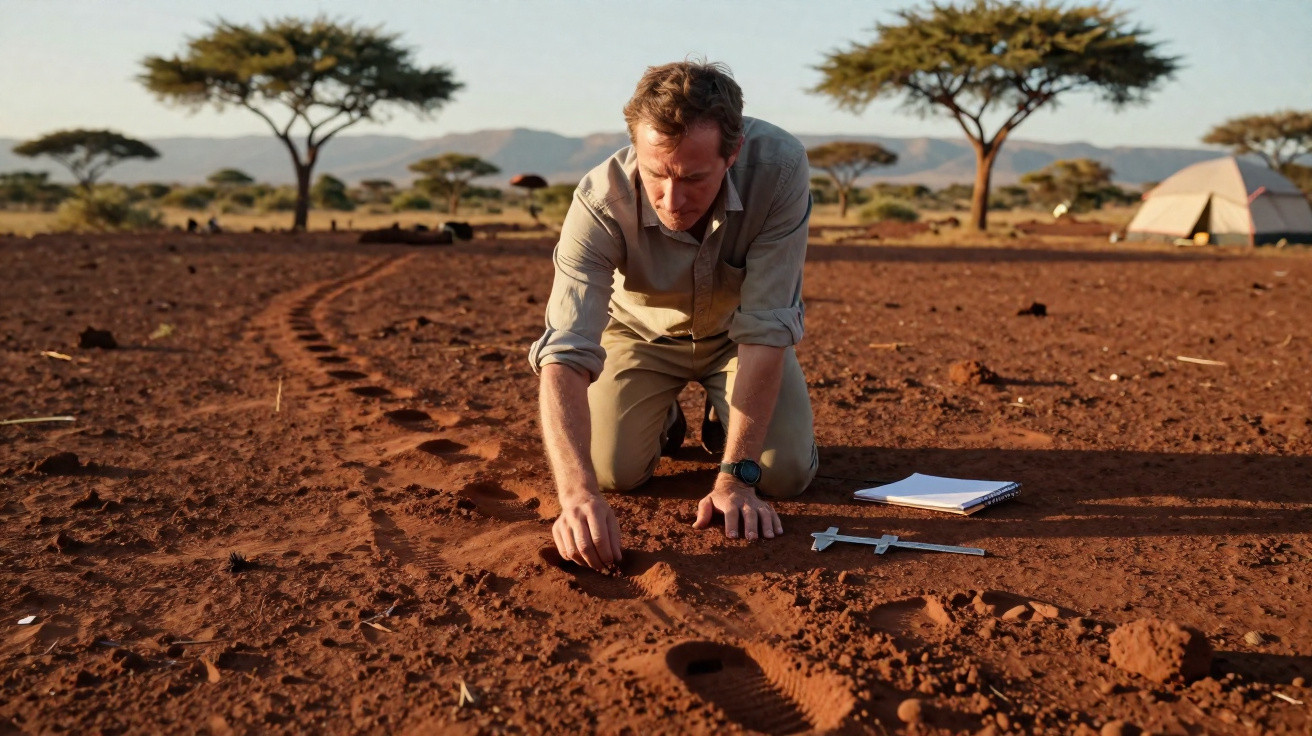
The discovery of fossilised footprints in northern Kenya provides a compelling record of prehistoric life. These remarkable traces show how human ancestors walked and interacted within an ancient landscape, supplying valuable evidence for researchers studying evolution and palaeoanthropology.
How were the fossilised footprints in Kenya preserved?
At the GaJi10 palaeontological site, near Lake Turkana, researchers uncovered foot impressions embedded in muddy surfaces. Sediments of volcanic origin rapidly covered the material, allowing it to remain exceptionally preserved for 1.43 million years in this African region.
Unlike conventional bone fossils, which accumulate over thousands of years, mud impressions capture precise moments from the past. These marks offer a direct view of individuals’ movement and their interactions within the same prehistoric ecosystem.
Which human lineage first left Africa?
Homo erectus led the first major migration beyond the African continent, adapting to new environments… Read more
What do the 21 footprints reveal about group movement?
Detailed examination of the 21 footprints suggests that around 8 individuals crossed the same shoreline within a brief period. The arrangement of the trackway points to organised, continuous movement, supporting theories that ancestors had structured social behaviour.
The evidence indicates that adults made up most of the group, with no apparent signs of children along the analysed route. Footprints from animals including hippopotamuses were also found at the location, showing that the setting was shared and broadening knowledge of ancient locomotion and habitat.
Below is a video from the Smithsonian’s National Museum of Natural History YouTube channel exploring the points discussed in this subject in greater depth:
Which hominin species are linked to the footprints?
The anatomical features of the tracks have prompted debate over which species produced the Kenyan footprints. Estimates link the impressions to Paranthropus boisei, although their size has raised further questions about the individuals’ build and height.
If these measurements are confirmed for this lineage, the discovery will revise the physical limits previously calculated from fossils. Differences in body size point to significant complexity in the anatomy and diversity of ancient human relatives.
Analysis of the findings
Footprint elements
Key aspects observed during the investigation of the fossilised surfaces:
- Examination of the depth and width of the footsteps;
- Assessment of the continuous sequence of movement;
- Comparison of proportions with those of other hominins.
How do fossilised footprints complement bone fossils?
Isolated bones provide information about skeletal structures, but they rarely document dynamic behaviour. Fossilised footprints fill essential gaps by making it possible to estimate weight and assess bipedal walking during movement across natural terrain in prehistory.
Studying these preserved surfaces also allows researchers to determine whether several individuals walked in synchrony. This body of evidence reshapes scientific understanding of communal living and the survival strategies of ancient groups.
The principal factors revealed by the study of fossilised marks include:
- Identification of hominins’ bipedal form of locomotion;
- Estimates of weight and height based on the dimensions of the impressions;
- Evidence that adults moved together along the lake shore.
What is the impact of this discovery on palaeoanthropology?
The find at the GaJi10 site shows that the history of evolution followed more varied paths than previously assumed. Evidence from Kenya encourages reassessment of how different lineages coexisted and occupied territories across the geological periods of the Earth.
Further excavations in the Lake Turkana basin are expected to broaden analyses of prehistoric social behaviour. Continued field research will help strengthen conclusions about patterns of locomotion and the organisation of communities among our ancestors.





Comments
No comments yet. Be the first to comment!
Leave a Comment