
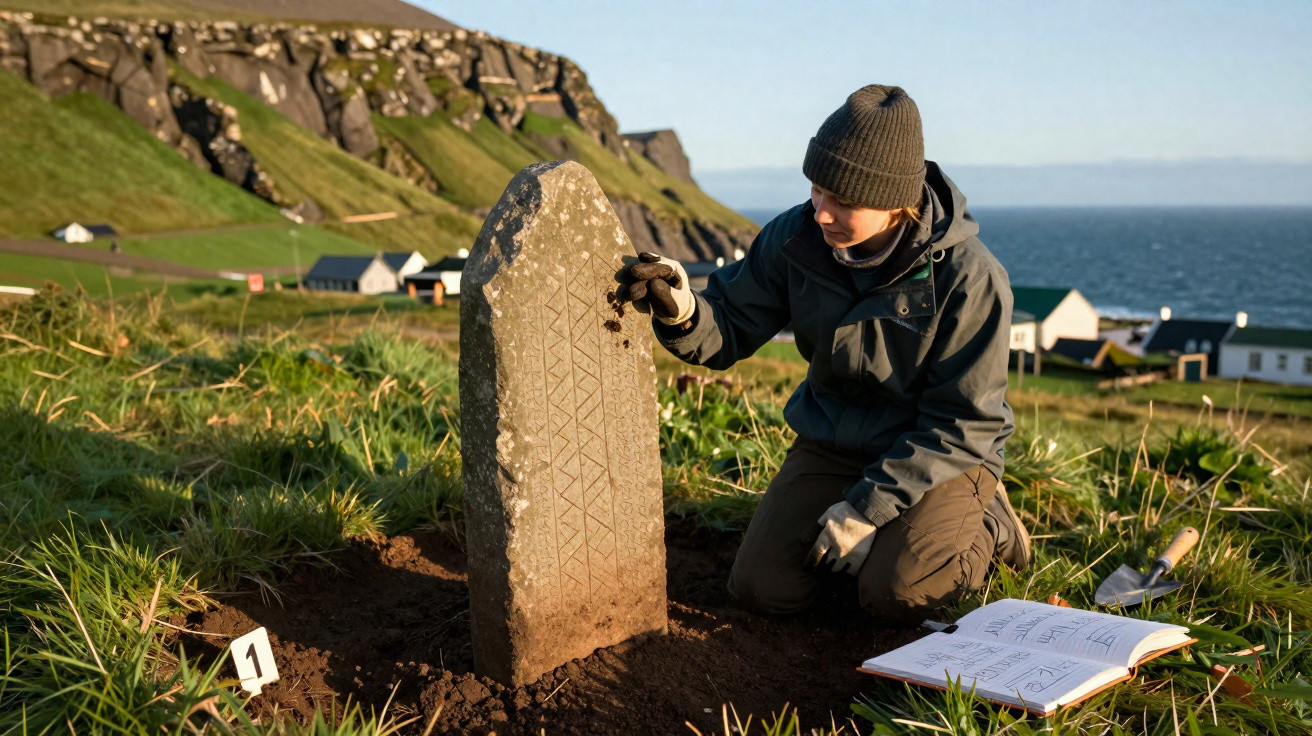
Beneath the floor of a small medieval structure in the Faroe Islands, archaeologists have uncovered a message that has endured for roughly a thousand years without being fully understood. A rune stone bearing Old Norse inscriptions was found during excavations on Sandoy and may identify someone who lived, died or was commemorated there.
Where was the mysterious rune stone found?
The discovery was made at the Á Sondum archaeological site on the island of Sandoy, during excavations carried out by the National Museum of the Faroe Islands alongside Aarhus University and Denmark’s Moesgaard Museum. The stone had been built into the floor of an old religious structure.
Archaeologists believe the building may have served as a small medieval chapel or oratory. The find is especially significant because surviving runic inscriptions are rare in the Faroe Islands, a North Atlantic archipelago shaped by Norse settlement and the spread of Christianity.
What does the thousand-year-old stone say?
Although its surface has been damaged over the centuries, some markings can still be recognised. The preliminary reading points to the Old Norse words “Her hvílur…”, an expression that may be translated as “Here lies…” or “Here rests…”, raising an intriguing question about the stone’s original purpose.
- The surviving text appears to begin with wording linked to memorials or burials.
- Significant areas of the surface have been broken or worn away over time.
- A runic-inscription specialist will inspect the remaining marks in greater detail.
- A 3D scan will support further examination without the need to handle the object repeatedly.
The phrase suggests that the object may have been used as a gravestone or memorial, though researchers have not yet reached a firm conclusion. According to the National Museum of the Faroe Islands, the scarcity of such inscriptions makes the discovery particularly valuable for understanding the archipelago’s medieval society.
Why did the other objects found attract attention?
The stone was not the only discovery. At the same site, the team recovered fragments of a small image depicting the Virgin Mary with the infant Jesus, as well as a small oil lamp. Together, these objects strengthen the interpretation that the structure had a function connected with Christian worship.
The building’s architecture provides another clue. It was aligned east to west and had an entrance on its western side, features consistent with medieval religious buildings. Comparable oratories have already been identified elsewhere in the Faroe Islands, allowing archaeologists to compare the sites.
How will researchers decipher the remaining runes?
The stone has been transferred to the National Museum of the Faroe Islands to protect it from further damage. In addition to assessment by specialists in runic inscriptions, the artefact is due to undergo three-dimensional scanning, which can record surface irregularities and details that may be difficult to detect with the naked eye.
Faroe Islands broadcaster KVF has also reported on the use of this technology in the investigation. The digital model will allow the markings to be enlarged and viewed from different angles without subjecting the original object to frequent handling, an important consideration for an artefact that is fragile and worn by centuries of exposure.
What medieval secret could the rune stone still reveal?
The central question remains unanswered: who was the person named in the inscription? If the reading of “Here rests” is confirmed, archaeologists may be looking at a memorial connected to someone who lived on Sandoy during the medieval period, when Norse and Christian traditions coexisted on the islands.
Every newly identified letter could reshape understanding of the site and the people who passed through it. Technology and runic analysis may now restore a voice to someone forgotten for almost a thousand years, turning a stone concealed beneath a floor into one of the most intriguing clues to the Faroe Islands’ past.





Comments
No comments yet. Be the first to comment!
Leave a Comment