
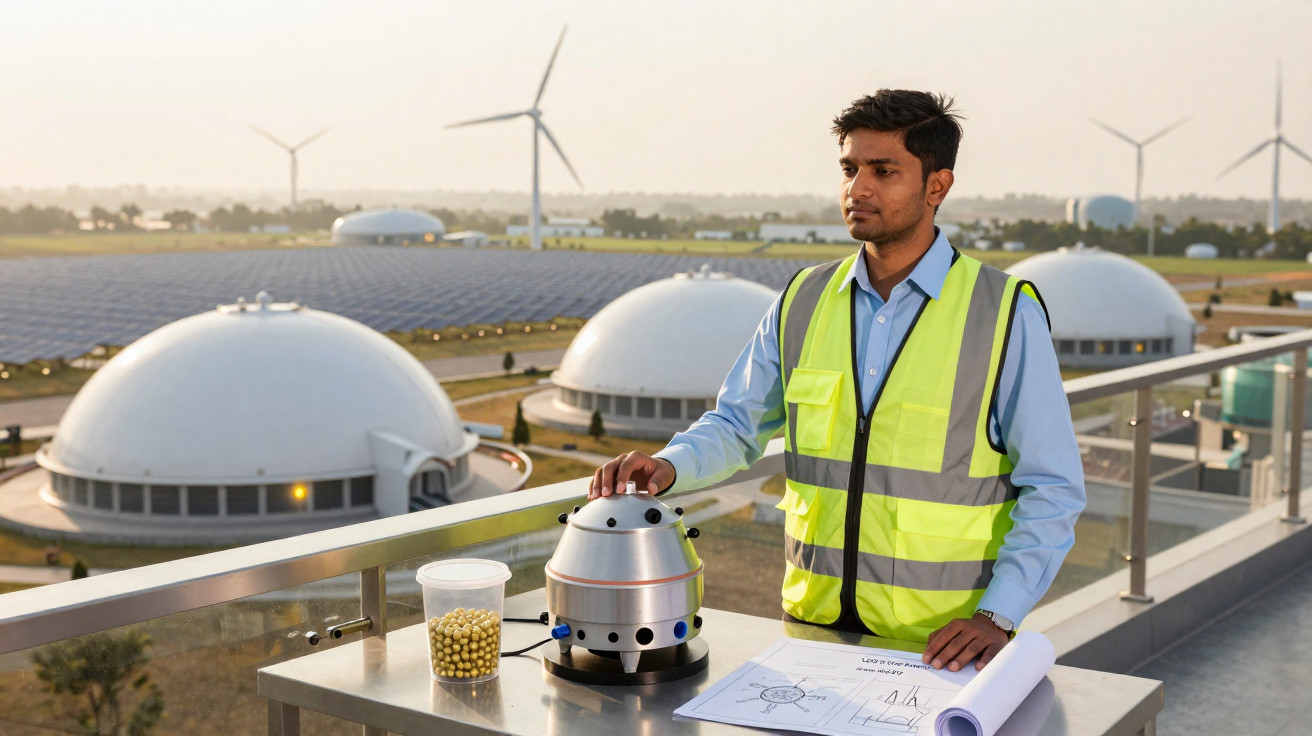
At dawn near an Indian power station, high-voltage lines already cut across the grey sky. Workers arrive on scooters, families open their stalls, and fans begin to spin inside homes. Yet this everyday scene reflects an immense challenge: supplying a country of more than 1.4 billion people, where electricity demand is rising as cities spread and air conditioning becomes essential. New Delhi is now backing nuclear power on an unprecedented scale, with a stated target of 100 gigawatts of installed capacity by 2047. At the centre of this strategy, a home-grown technology could turn India’s resources into electricity for a very long time. It is a promise that is as compelling as it is delicate.
India speeds up its race against the energy clock
In India’s major cities, the lights scarcely ever go out: advertising screens, metros, data centres, workshops and entire blocks of flats all require power around the clock. India wants to meet this energy appetite without relying solely on coal, which still underpins its electricity system and weighs heavily on the country’s carbon footprint.
The Indian government has said it intends to reach 100 GW of nuclear capacity by 2047, compared with just over 8 GW currently in operation. This increase would amount to one of the country’s most ambitious atomic programmes to date, involving new reactors, regulated private projects and a determination to build more facilities within India itself.
The strategy is not based solely on the scale of construction. It also relies on pressurised heavy-water reactors, or PHWRs, a reactor type India has mastered for decades and which uses natural uranium. This technological independence matters greatly in a world where energy has also become an issue of national sovereignty.
Thorium, India’s resource that could change the equation
To understand India’s ambition, it is necessary to look beneath the ground. The country has extensive thorium reserves, particularly in mineral-rich sands in coastal parts of Kerala, Tamil Nadu and Odisha. Thorium is not a ready-to-use fuel in its own right, but it can be converted into uranium-233 in suitable reactors.
India’s approach follows a three-stage nuclear programme: first using natural uranium, then recycling the plutonium produced, before gradually opening the way to thorium. The Prototype Fast Breeder Reactor, built at Kalpakkam, has a symbolic role in this pathway. It is intended to help generate more fissile material than it consumes.
On paper, the potential is staggering. Thorium reserves could support electricity generation for a very long period, provided every industrial stage is controlled, from reprocessing to the operation of future reactors. Let us be honest: hardly anyone does this routinely, even among the major nuclear powers.
What the programme shows beyond the headline figures
When faced with striking announcements, the sensible approach is to separate power stations already connected to the grid from projects that remain on the drawing board. Building a reactor often takes more than ten years, from approvals and financing through construction and testing to grid connection. The 2047 timetable is therefore a political direction, not a plug that can be switched on tomorrow morning.
It would be a mistake to portray nuclear power as a magic answer to all of India’s needs. The country will also have to reinforce its grid, expand solar and wind power, train thousands of technicians and earn the trust of people living near the sites. A dependable power station cannot replace a reliable electricity line in a village or an overcrowded neighbourhood.
Indian authorities summarise their ambition in a simple phrase:
“100 GW of nuclear capacity by 2047”.
Behind that statement, several realities must progress together:
- the construction of standardised, safe reactors;
- rigorous management of spent fuel;
- the expansion of the thorium sector;
- acceptance from communities living close to the sites.
An energy strategy designed for the decades ahead
We all know the moment when even a brief power cut disrupts an entire day: no fan, no charging, no network, and sometimes no pumped water. On India’s scale, this vulnerability becomes enormous. Nuclear power aims to provide continuous electricity that can support renewables when the sun sets or the wind drops.
The real innovation lies in the long-term perspective. Through domestic reactors, fuel recycling and its thorium horizon, India is seeking to build a system less vulnerable to imports and geopolitical upheavals. Here, nuclear power is becoming a tool for autonomy, as well as a way to gradually reduce coal’s role.
One question remains that announcements cannot remove: will this acceleration be fast enough, safe enough and transparent enough to secure lasting support? Past accidents have left a persistent global memory, while the climate emergency is pushing governments to act quickly. Between industrial caution and energy pressure, India is testing a path that could inspire other emerging countries.
| Key point | Detail | Value for the reader |
|---|---|---|
| Indian target | Reach 100 GW of installed nuclear capacity by 2047 | Assess the true scale of the announced programme |
| Domestic technology | PHWRs and the development of breeder reactors | Understand the drive for energy independence |
| Role of thorium | An abundant resource in India, usable over the long term | See why the country is planning across several decades |
FAQ:
- Why does India want to build so many nuclear power stations? The aim is to meet sharply rising electricity demand while ultimately reducing dependence on coal and imported fossil fuels.
- What is India’s nuclear target for 2047? New Delhi is targeting 100 gigawatts of installed nuclear capacity, compared with just over 8 GW in service in the mid-2020s.
- Can thorium generate electricity immediately? No. Thorium must first be converted into uranium-233 through a specific nuclear cycle. The technology is promising, but large-scale deployment remains complex.
- What is a breeder reactor? It is a reactor capable of producing more fissile material than it consumes, by converting certain materials, such as uranium-238, into plutonium.
- Will India’s nuclear programme replace solar and wind power? No. India is instead considering an energy mix: nuclear power for stable generation, and renewables for plentiful low-carbon electricity when weather conditions allow it.






Comments
No comments yet. Be the first to comment!
Leave a Comment