
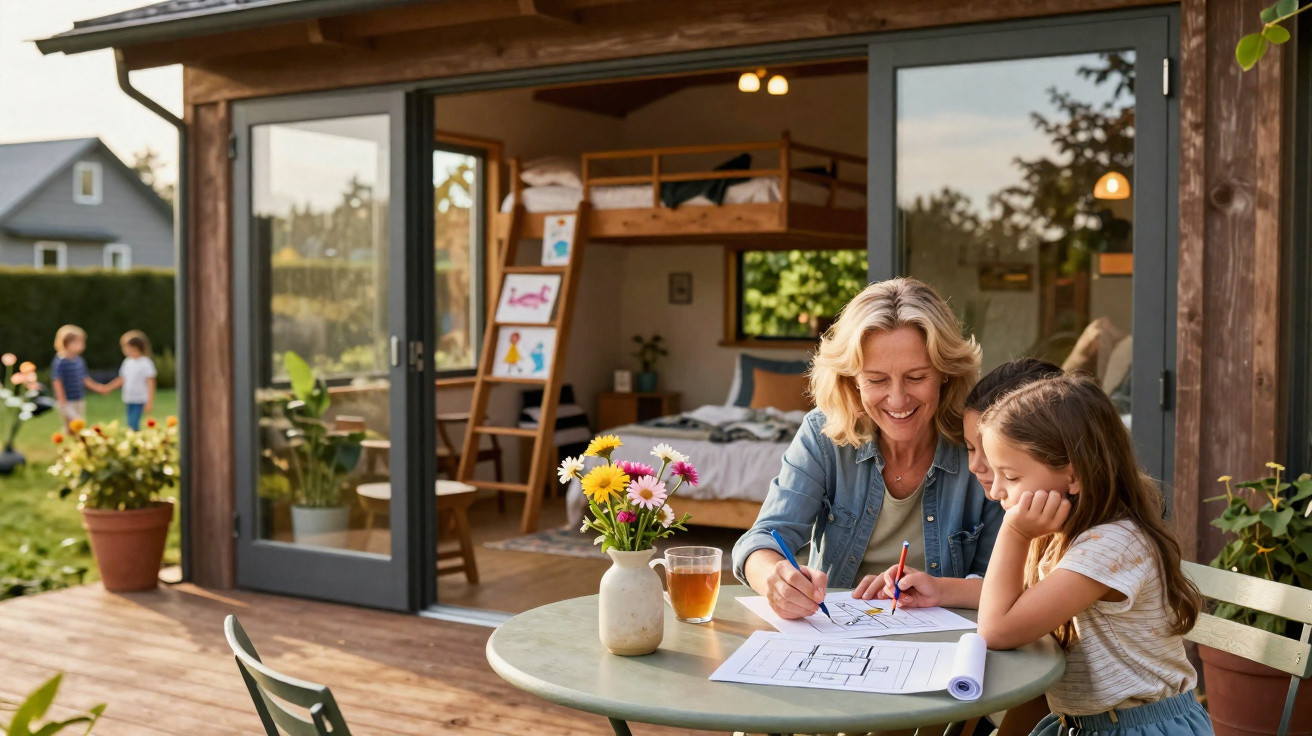
In the United States, a grandmother has chosen to live just metres from her family so she can help care for the children every day.
After leaving Arizona for Oregon, Denise Martin moved into a small home built on her daughter’s land. US business magazine Fortune has described how this family arrangement has transformed her daily life while providing valuable support for the young parents.
A move designed to be closer to her granddaughters
Denise Martin was 65 when she left her Arizona home for Bend, Oregon, in December 2024. Her new home is neither in a nearby neighbourhood nor in a retirement community: it stands at the bottom of her daughter Sarah Taherkhan’s garden.
The former financial adviser lives in a 400-square-foot studio, equivalent to around 37 m². Above all, this decision was driven by family: she wanted to be close to her granddaughters. One child had already been born when she moved in, and the family has since welcomed a second baby.
“The main reason I moved here is that I had one granddaughter, and now I have a second one who is four months old,” Denise Martin told Fortune.
Living so close means the grandmother can help every day without sharing a home with her daughter. She can take the children to nursery and collect them, look after them in the evening, or step in while their parents are away for a few days. At times, her role is simply to care for the baby for an hour so her daughter can rest.
Denise Martin’s 37 m² garden studio, terrace and raised sleeping area
The bespoke home was made by Spindrift Tiny Homes, the company run by Denise Martin’s son-in-law, Bijan Taherkhan. There was sufficient room on the family plot for this compact build.
The main living area covers roughly 28 m². Denise Martin sleeps in a loft of just over 9 m², fitted above the living space. A terrace also extends the home, increasing the usable day-to-day area when the weather allows.
- A living area of approximately 28 m²;
- A 10-foot by 10-foot loft, measuring just over 9 m²;
- An adjoining terrace;
- Gas-powered domestic appliances;
- A furnished, insulated home, according to Denise Martin.
Construction took less than three months. Denise Martin says she did not need planning permission or vehicle registration for the home, as the structure is not classed as a vehicle. These rules fall under the local US framework and cannot be directly applied in France.
The final bill came in at under $200,000, or about €172,000. By comparison, the median price of a house in the United States was $410,800, according to cited data from the US Federal Reserve. Standard models sold by Spindrift Tiny Homes typically cost less than $160,000, or close to €137,500.
Six months to adjust to a different way of living
Moving from a house into 37 m² was not an immediate adjustment. Denise Martin says it took her around six months to feel truly at home. She also had to sort through her personal belongings very thoroughly, particularly her clothes.
That adjustment period made her reassess what she actually needed. Living in a small space requires people to limit possessions, organise storage carefully and retain only what is genuinely useful. The loft frees up floor space, but it also means being able to access a raised sleeping area easily.
For Denise Martin, the biggest lesson was realising that she needed far fewer possessions than she had imagined.
She has not entirely left her former life behind. She kept her Arizona home and spends two months there each year. However, living in Oregon costs her less on a day-to-day basis.
The washer-dryer, cooker and water heater run mainly on gas. Every month, she refills propane cylinders for $35, or around €30. This figure does not cover every expense associated with a home, but it gives an indication of the stated gas use for this small property.
Family support whose value goes beyond the home
The most apparent financial benefit may not be for Denise Martin herself. Her presence also allows Sarah Taherkhan and her partner to reduce their reliance on external childcare. In the United States, this is a major cost for families.
An analysis published by LendingTree in 2025 put the average cost of raising and caring for a child at $297,674 over 18 years, or around €256,000. In the most expensive parts of the United States, that total can rise to $362,891, nearly €312,000. The study notes that childcare now costs more than rent in many cities.
The arrangement created by the Taherkhan family is therefore more than simple proximity. It is based on everyday mutual support: the grandmother maintains her independence in her own home, while the parents have a trusted, nearby source of help that the children know well.
In France, a project governed by planning rules
In France, creating an independent home in a garden requires checking the planning rules that apply in the local authority area. As a general rule, a new building of more than 20 m² requires planning permission. Requirements may also vary according to the local development plan, the relevant zone and connections to utility networks.
A garden studio intended for residential use should not be confused with a straightforward garden shed. A dwelling raises issues relating to floor area, drainage, electricity, access, parking and compliance with local rules. Before starting work, the planning department at the town hall remains the appropriate point of contact.
The French situation also differs from the Oregon model: the formalities do not depend solely on the building’s size. The nature of the project and locally set rules can change which permissions must be sought.
Garden studios sought after by American families
Denise Martin’s situation forms part of a wider trend in the United States. Jason Waugh, president of the Coldwell Banker Affiliates estate agency network, has seen growing demand for garden studios intended for grandparents.
“Economic necessity, practicality and mutual support: I think those are the three main drivers,” Jason Waugh told Fortune.
In his view, this shift is explained by interest rates, a shortage of available homes and the rising cost of serviced retirement communities. It is also taking place at a time when many Americans are working for longer or are concerned about the future state of their savings.
According to a Pew Research Center analysis cited by Fortune, around 20% of Americans aged 65 or over are still working, a share almost twice as high as it was 35 years ago. A 2025 survey by investment bank D.A. Davidson also found that two retirees in five fear their savings will not be enough.
For Denise Martin, the studio is not presented as a fallback option. It enables her to keep a space of her own and maintain her own routines, while remaining only a few steps from her two granddaughters.





Comments
No comments yet. Be the first to comment!
Leave a Comment