
Why add us? Get Zona Militar news on Google.
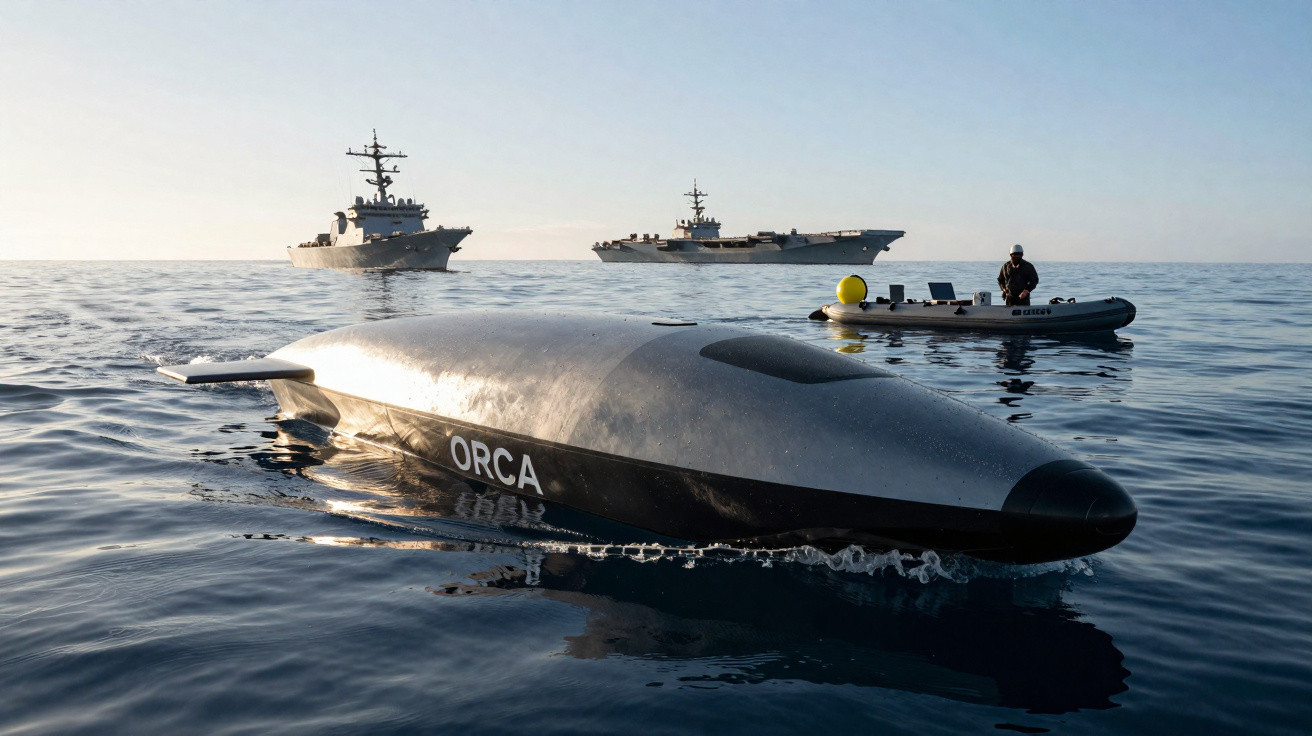
The United States Navy has reached a new milestone in developing uncrewed undersea capabilities after one of its autonomous ORCA vehicles completed a voyage of more than 1,000 nautical miles in the Pacific in July. The activity forms part of the Pacific Fleet Submarine Force’s efforts to expand the use of autonomous platforms alongside crewed submarines.
👉 Read more: US Air Force declares Initial Operational Capability for the new MH-139A Grey Wolf helicopter to strengthen the nuclear arsenal
ORCA expands the role of uncrewed systems in the undersea domain
The ORCA belongs to the US Navy’s Extra-Large Unmanned Undersea Vehicle (XLUUV) programme and was created to support an expanding range of undersea missions. The project began taking shape during the 2010s under Boeing, which drew on expertise gained through earlier autonomous underwater vehicle programmes.
In 2019, the Navy ordered the first ORCA for US$ 43 million, and Boeing delivered the first unit in December 2023. The service subsequently purchased a total of six vehicles: five prototypes and one unit for training. Two programme-related contracts totalled US$ 281 million.
📌 You may also be interested in:
- Republic of Korea Navy: KSS-III Dosan Ahn Chang-ho submarine completes historic Pacific mission
- US Air Force deploys B-52H bombers to Australia to reinforce the Indo-Pacific
Integration with carrier strike groups and crewed submarines
The new milestone was announced during a visit by Rear Admiral Chris Cavanaugh, commander of the Pacific Fleet Submarine Force, to the aircraft carrier USS Theodore Roosevelt (CVN-71) on 30 July, following completion of the maritime phase of Rim of the Pacific 2026 (RIMPAC 2026).
At the meeting, Cavanaugh and Rear Admiral Marcos Jasso discussed ways to incorporate uncrewed undersea vehicles into carrier strike groups. The Navy believes these platforms could serve as tactical extensions of crewed units, increasing their range and providing new operational options in contested environments.
Cavanaugh noted that the Pacific operational environment continues to change rapidly because of technological advances in the undersea domain. According to the officer, the Pacific Fleet is increasing investment in uncrewed systems specifically to complement the capabilities offered by conventional submarines.
Alongside combat and surveillance missions, the commanders also considered potential logistical roles for UUVs. These include moving parts and components between submarines and aircraft carriers, allowing submerged units to receive support without having to return to port or unnecessarily compromise their operational stealth.
Previous experience with uncrewed undersea vehicles
The US Navy had already made progress in integrating UUVs with crewed submarines during 2025. That year, the Virginia-class attack submarine USS Delaware (SSN-791) conducted the first launch and recovery of an uncrewed undersea vehicle through a torpedo tube during an operational deployment.
The activities took place near Norway and involved three tactical sorties using the Yellow Moray system. Launches and recoveries were carried out through standard torpedo tubes, without requiring divers to support the operation.
The ORCA’s July 2026 voyage of more than 1,000 nautical miles in the Pacific now adds another milestone to the development of these capabilities. The Pacific Fleet Submarine Force intends to use this type of platform to broaden its options in deterrence, anti-submarine warfare, surface warfare, intelligence, surveillance and reconnaissance.
Images used for illustrative purposes.
Comments
No comments yet. Be the first to comment!
Leave a Comment