
Subscribe to Zona Militar on Google
Why add us? Get Zona Militar news on your Google.
Russian Armed Forces receive Pantsir-S and Pantsir-SMD air-defence systems
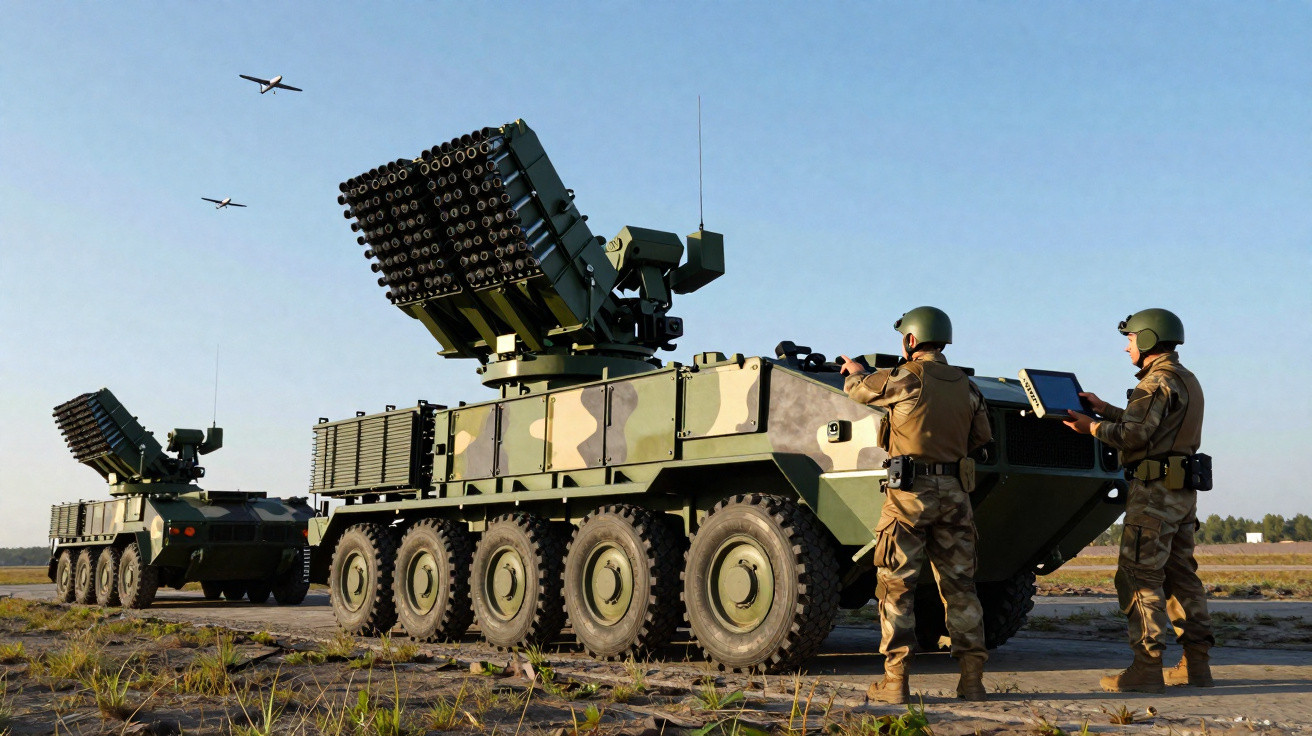
The Russian Armed Forces have taken delivery of a fresh batch of Pantsir-S and Pantsir-SMD air-defence systems, strengthening the anti-aircraft capabilities of units attached to the North Battle Group. According to information released by state media, the equipment was supplied by Rostec High-Precision Systems Holding after successfully completing a new round of tests before entering service.
👉 Read more: US Air Force declares Initial Operational Capability for the new MH-139A Grey Wolf helicopter to strengthen the nuclear arsenal
A commander from one of the units involved, known by the call sign Volk, stated that the new Pantsir-S was swiftly moved to its deployment area and placed on combat alert. The officer said personnel already have extensive experience of systems from the same family, which they have operated for several years, allowing it to be integrated into unit activities immediately. He also underlined the platform’s effectiveness against a range of aerial threats.
The newly delivered Pantsir-S systems are expected to enhance protection for priority military facilities, including sites used to store cruise missiles and other precision weapons deployed in the conflict against Ukraine. Coverage is also set to extend to major weapons-production facilities and strategic administrative buildings, in an effort to limit the effects of attacks that Ukrainian forces have been able to carry out inside Russian territory.
📌 You may also be interested in:
- South Korean Navy: KSS-III Dosan Ahn Chang-ho submarine completes historic Pacific mission
- US Air Force deploys B-52H bombers to Australia to reinforce the Indo-Pacific
Pantsir-SMD systems focused on counter-drone missions
The Pantsir-SMD systems, meanwhile, are being used on missions where defence against large drone swarms is central. For this type of operation, the variant features new launch systems with greater threat-tracking capacity, as well as mini missiles designed specifically to counter uncrewed systems. These weapons work alongside the two 30 mm 2A38M guns retained from the original design.
TKB-1055 mini missiles increase launcher capacity
Unveiled at the ARMY 2024 exhibition, the TKB-1055 mini missiles were designed as a smaller, shorter-range alternative to the 57E6, while offering the advantage of being produced and deployed in greater numbers. This is intended to improve the balance between cost and effectiveness when intercepting drones, particularly given the price gap between low-cost uncrewed systems and the interceptors traditionally used to neutralise them.
In performance terms, the TKB-1055 is said to have an approximate range of seven kilometres, whereas the 57E6 can engage targets at distances of up to 20 kilometres. On the other hand, the reduced size of the new mini missiles enables each launcher to carry as many as 48 units, compared with the 12 57E6 rounds that could previously be fitted.
Images used for illustrative purposes. Credit: Rostec.
Comments
No comments yet. Be the first to comment!
Leave a Comment