
Add Zona Militar to your Google feed
Why add us? Get the latest updates from Zona Militar in your Google feed.
Join the WhatsApp channel
Join our official WhatsApp channel and receive breaking news straight away.
On 10 August 2026, a magnitude 7.4 earthquake struck western Colombia, with its epicentre near San José del Palmar, Chocó. The tremor was felt in cities across the country and also in Panama, Venezuela, Ecuador and Peru. As of Monday, it had claimed 289 lives and left 143 people missing, as well as thousands injured and severe damage to infrastructure, while search-and-rescue work continues in the hardest-hit areas.
👉 Read also: Spanish Air and Space Force secures its strategic ISR capability with a new support contract for its MQ-9A Predator B
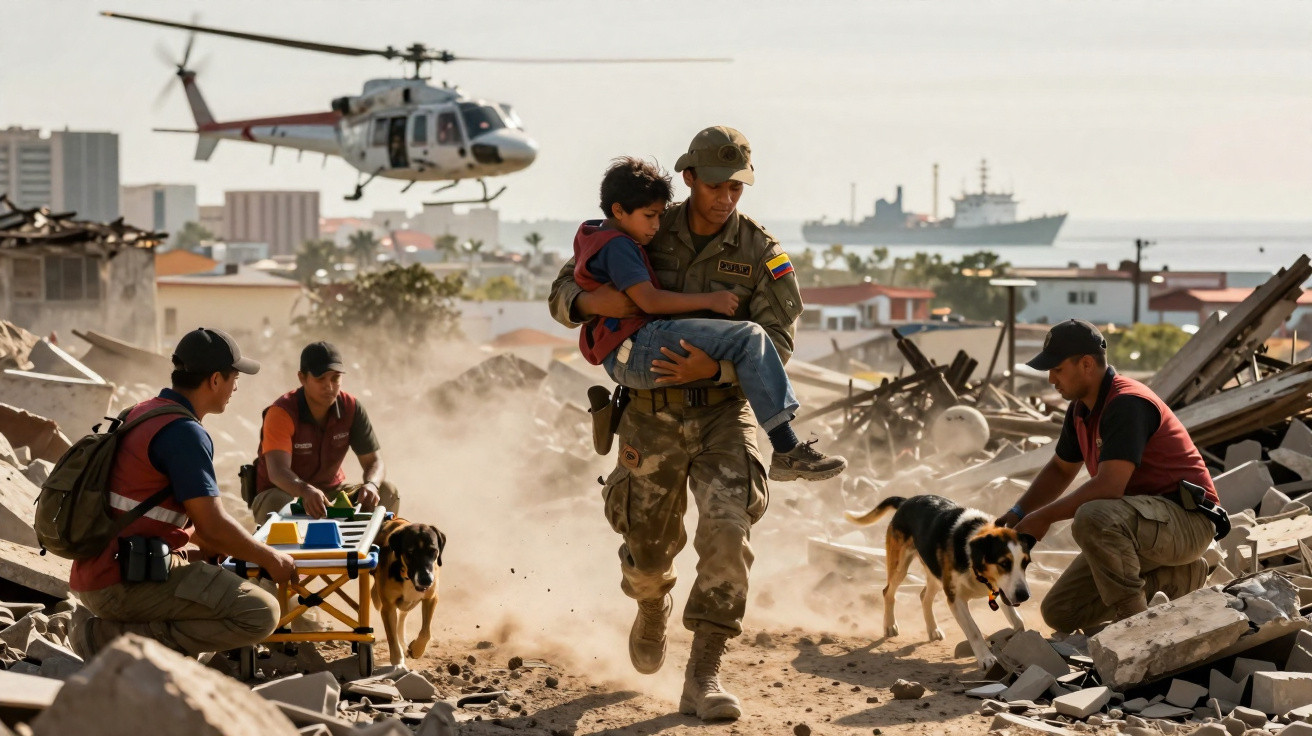
Given the scale of the disaster, Colombia’s Military Forces were among the first institutions to respond, deploying specialist units to assist the population.
Colombian National Army rescue deployment
The National Army sent the Disaster Response and Prevention Brigade, part of the Engineers Command, contributing five specialist platoons comprising 180 rescue soldiers. Equipped with canine teams, drones, acoustic sensors and thermal cameras, these sub-units were distributed across the affected areas: three platoons in the Coffee Region, chiefly supporting Pereira; one in Quibdó, Chocó; and one in Cali, Valle del Cauca.
📌 You may be interested in
- The challenges facing Colombia’s new General Staff amid the reality of the Military Forces and the internal conflict
- With Airfox drones and 8 countries involved, the Spanish Navy deploys the BAM Meteoro in the Gulf of Guinea
Additional assets included Disaster Response and Prevention Engineers Battalion No. 80, whose 75 soldiers are specialists in search and rescue in collapsed structures (BREC) and operated at critical locations in Cali. The Caldas Military Engineers Battalion of the Fifth Brigade dispatched a platoon of 27 personnel and two trained dogs from Bucaramanga to reinforce rubble-clearance operations in Valle del Cauca. Meanwhile, the Army Aviation Division transported rescuers aboard Antonov An-32 aircraft and employed its rotary-wing aircraft to move equipment and supplies.
Despite damage to their home bases, roughly 1,500 personnel from Territorial Control units were also deployed. They secured around 40 critical sites in Cali, Pereira, Manizales and Quibdó, protecting collapsed homes and businesses. Several units took part, including the Eighth Brigade, which kept troops at operational readiness and coordinated security and rescue activities in the region; the Battle of Ayacucho Light Infantry Battalion, positioned at strategic points in Manizales; the Combat Engineers Battalion, clearing rubble in Quindío municipalities including La Tebaida, Quimbaya and Montenegro; the San Mateo Battalion, immediately deployed to help residents in Pereira; and Comprehensive Action and Development Support Battalion No. 5, which led and coordinated the collection and logistics of tonnes of humanitarian aid from Ibagué to the Coffee Region.
Colombian Aerospace Force evacuation and logistics
Through the Military Air Transport Command (CATAM), the Colombian Aerospace Force made available medicalised Beechcraft King Air 350/360C and Cessna 208B Grand Caravan aircraft, while rapidly converting tactical transport aircraft such as the Airbus C-295 into air ambulances. UH-60 Ángel helicopters and other rotary-wing aircraft were deployed to carry personnel and cargo. The National Personnel Recovery Centre (CNRP) coordinated all activity, organising time-critical missions in real time with military doctors, nurses and paramedics to stabilise casualties during air evacuations.
Located in Bogotá, the Military Air Transport Command (CATAM) serves as the strategic hub for logistics operations. The base coordinates and launches flights carrying rescue personnel, members of the National Urban Search and Rescue Team, and humanitarian assistance sent from abroad aboard C-130 Hercules, Boeing 737 and Airbus Casa transport aircraft in different variants.
Colombian Navy operations in Buenaventura and Cali
The Colombian Navy is contributing through ARC Search and Rescue Groups, which specialise in rubble removal, urban rescue and direct support for civilians in the worst-hit neighbourhoods of Buenaventura. Its Risk and Disaster Management Company and the USAR COL 19 team are currently working at the Torres del Limonar building in Cali. The Naval Engineers’ Infrastructure Professionals Corps has assessed structural damage at affected institutional bases, as well as at jetties and civilian homes. Ground logistics crews have received, sorted and safely distributed domestic and international humanitarian aid arriving through the seaport.
The principal naval units in service have been the ARC “Benkos Biohó” hospital ship, which has eased pressure on Buenaventura’s medical centres while operating from the Pacific Maritime Signalling Jetty; the ARC “Bahía Málaga” amphibious landing ship, used to transport military and civilian medical personnel, medicines and donations to coastal settlements such as Punta Soldado; the ARC “Golfo de Tribugá” amphibious landing ship, which sailed to communities including La Bocana carrying more than 12 tonnes of humanitarian assistance; and the “SSCIM Senén Araujo” riverine support patrol vessel, deployed on the Atrato River in Chocó alongside two support boats and river operations equipment to transport supplies to isolated rural areas.
There have been many occasions on which soldiers and marines have helped rescue survivors. In Cali, eleven people were pulled from the debris of a four-storey building that collapsed at Calle Quinta and Carrera 44 in the south of the city. One of the most moving moments came when emergency teams located and brought out alive Carlos Esteban Rebolledo, a 35-year-old man who had spent hours trapped beneath the ruins. The survivor suffered minor injuries and showed signs of dehydration, and was immediately taken by ambulance to a medical facility.
Cali also witnessed a particularly emotional episode when a woman and her baby, only a few months old, were found and rescued alive from beneath the rubble. Their recovery was made possible by the combined efforts of emergency services and local residents volunteering in the search, digging with their hands and improvised tools until specialised machinery arrived.
In the days following the earthquake, rescue crews worked against the clock. They alternated complete silence in rubble fields to detect signs of life with the use of heavy machinery, trained dogs and cutting and breaching equipment. From the first day, authorities confirmed that people remained trapped beneath the debris. The government therefore reinforced the brigades with around one hundred additional rescuers from the Military Forces, the Army and the Navy, whose significant contribution focused on logistical support, including the removal of tonnes of rubble at the Torres del Limonar complex in Cali.
A further essential task has been the transport of supplies and every type of aid, collected throughout the country and supplemented by international donations from countries as varied as the United States, China, Mexico, El Salvador, Spain, India, Sweden, Norway and Italy. Hundreds of lorries, aircraft and ships were mobilised to bring assistance vital to the survival of those affected to remote municipalities such as San José del Palmar, Cantón de San Pablo, Nóvita and Sipí in Chocó, as well as El Cairo, Argelia, El Águila, Bolívar, El Dovio and Toro in Valle del Cauca.
Following these rescue efforts, and at the time and date this article was written, 355 people have been rescued. Although hopes of finding more survivors diminish with each passing hour, military and civilian rescuers continue working in the area to locate the 143 missing people and are beginning reconstruction work. Without doubt, personnel will remain alongside communities, moving resources and machinery to provide a new home for all those affected. Nevertheless, all available transport assets continue delivering food, medicines and other provisions to earthquake-hit areas, offering encouragement and hope amid a tragedy of such complexity for the country.
Comments
No comments yet. Be the first to comment!
Leave a Comment