
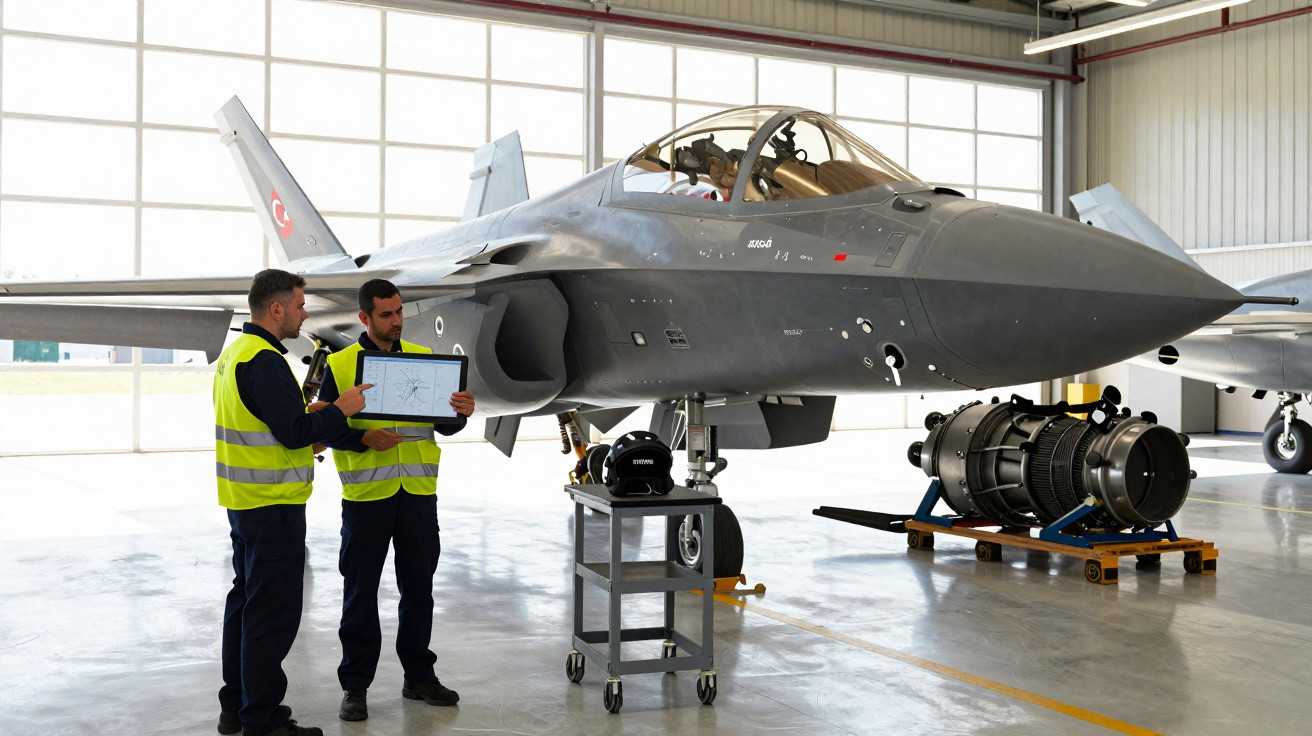
Turkish Aerospace Industries (TAI / TUSAŞ) has assembled the third prototype of the forthcoming TF-X KAAN fighter for the Turkish Air Force under the National Combat Aircraft programme. The news followed an official visit to its Ankara facilities, where the full-scale static-test airframe and the flight-development aircraft were exhibited together in one hangar, highlighting parallel progress in validation work and preparations for serial production.
TF-X KAAN prototype development at TAI
Haluk Görgün, President of Türkiye’s Defence Industry Agency (Savunma Sanayii Başkanlığı – SSB), visited TAI’s facilities and outlined the programme’s current position. “Our aircraft, which will be used for full-scale static testing, will be in the same frame together with our second prototype, which will carry out its subsequent flight after the first prototype that completed its initial flights upon exiting the hangar. This represents an important technical milestone and stands before us as a concrete indicator of the effort of thousands of people,” Görgün stated.
The KAAN programme is intended to produce a fifth-generation fighter that will remain in Turkish Air Force service for decades. Its planned features include low-observability characteristics, internal weapons bays, an advanced avionics architecture with sensor fusion, improved situational awareness and network-enabled operations. The aircraft will also feature electronic warfare systems and be able to undertake air-to-air and air-to-surface missions. At the same time, the contractual process for eventually supplying the aircraft to the air force command has begun.
In September 2025, TAI confirmed that two further TF-X KAAN prototypes were being assembled on its final assembly line in Ankara, with their maiden flights planned for April and May 2026. Mehmet Demiroglu, the company’s general manager, said those flights would mark “the beginning of intensive flight testing”, adding that the new aircraft would carry most of the mission systems intended for the operational variant. This differs from the initial P0 prototype, which completed two flights in 2024. Overall, six prototypes are planned to support the test campaign.
Changes visible on KAAN P1 and P2
Recent audiovisual footage has allowed P1 and P2 prototypes to be identified inside TAI’s hangar, revealing changes from P0. These include the movement of the air intakes further aft beneath the cockpit line, revisions to the rear-fuselage geometry, the partial repositioning of the main landing gear, and greater spacing between the engines. The configurations are intended to improve the internal space available for sensors and weapons bays. The footage also reveals ASELSAN’s Tulgar Helmet-Mounted Display (HMD) fitted in the cockpit of the aircraft identified as P1.
Indigenous TF-35000 engine development
The two new prototypes are due to enter testing in 2026, as Türkiye also works on an indigenous engine to replace the US-origin powerplants installed in the first aircraft. Osman Saim Dinç, general manager of TR Motor, which is developing the TF-35000 engine, said: “We consider the engine project a matter of national survival,” underlining the strategic significance of technological autonomy to the KAAN programme.
Cover image for illustrative purposes.
Translated by Constanza Matteo
You may also like: Turkish Air Force F-16 fighter jets have arrived in Somalia to support the fight against the Al-Shabaab terrorist group





Comments
No comments yet. Be the first to comment!
Leave a Comment