
Add us to your favourites on Google
Why add us? Get the latest news from Zona Militar in your Google feed.
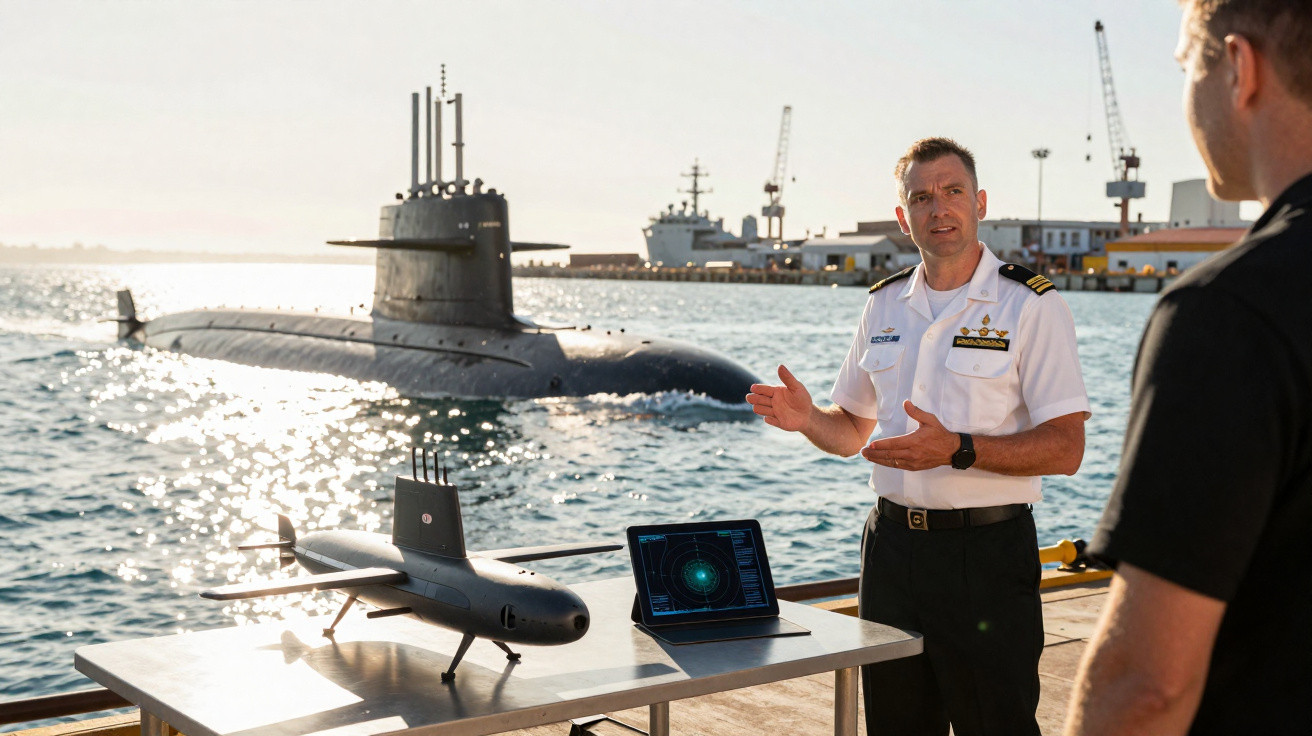
Australia will receive three in-service Virginia-class submarines under the AUKUS agreement, following a revision announced by Australia, the United States and the United Kingdom during a ministerial meeting in Singapore. The decision replaces the previous proposal to acquire one new and two second-hand Virginia-class boats, aiming to make the future Australian fleet easier to operate.
The announcement was made during the Shangri-La Dialogue by US Secretary of War Pete Hegseth, Australian Defence Minister Richard Marles and UK Defence Secretary John Healey. Their joint statement said the revised approach would streamline logistics, maintenance and the costs linked to Australia’s nuclear-powered submarine programme.
Under the updated plan, Canberra will purchase three Virginia-class submarines currently serving with the US Navy. This replaces the previously planned mix of one new Block VII submarine and two operational Block IV vessels. Meanwhile, work continues on the future SSN-AUKUS submarine, a joint Australian-UK design scheduled to enter service during the 2040s.
Australia aims to simplify operation of its future submarine fleet
At a press conference, Marles said the change was driven by the need to reduce the operational complexity of Australia’s future submarine force. Australia had expected to retain upgraded Collins-class submarines alongside two used Virginia-class boats, one new Virginia and, later, SSN-AUKUS submarines. That arrangement would have required it to run four different submarine classes.
“That becomes quite complicated in terms of how you operate a submarine fleet,” Marles said. He added that buying three used submarines offers a simpler and more efficient route to introducing the planned capability, while noting that the overall financial saving would be relatively modest within the wider programme.
US industrial capacity and Virginia-class submarine production
The revision also comes as the United States continues efforts to expand attack-submarine output. US naval officials have stated that the industrial base must reach annual production of 2.33 attack submarines. For example, construction began on USS Barb, the 31st Virginia-class submarine, in December 2025.
USS Barb’s construction forms part of a sustained year of activity for the programme. On 21 November, the US Navy accepted USS Massachusetts (SSN-798), the 25th submarine in the class and the tenth Block IV vessel. Delivery took place at the same Newport News shipyard.
The ability to build one Columbia-class strategic submarine each year must also be taken into account. Construction of USS Wisconsin, the second boat in that class, began in September last year, while USS District of Columbia, whose construction began in 2022, has still not reached 70% completion.
Nevertheless, Marles said he was confident in the development of US industrial capacity and highlighted Australia’s financial contribution to support that expansion. “We are fully aware of the challenges in the US industrial base, but we have also been aware of them from the outset, when the optimal pathway was announced in 2023. That is why we are making a financial contribution to help increase the production rate,” he said.
Australia is also continuing to build the workforce and industrial capabilities needed to operate nuclear submarines. According to Marles, around 200 Australian personnel are training at Pearl Harbor and taking part in maintenance work on US Navy Virginia-class submarines. In addition, Submarine Rotational Force-West (SRF-West) remains on schedule to become operational in 2027, enabling US and British nuclear submarines to rotate through HMAS Stirling naval base in Western Australia.
AUKUS also moves forward on uncrewed underwater drones
Alongside the submarine programme update, the three countries announced the first joint project under AUKUS Pillar II. The initiative focuses on the development of Uncrewed Underwater Vehicles (UUVs) and their associated systems, with deliveries expected from 2027. The programme will support the development of interoperable sensors, payloads and weapons systems for the three nations’ fleets.
According to the joint statement, the new UUVs will help safeguard critical underwater infrastructure, improve surveillance, reconnaissance and strike capabilities, and strengthen anti-submarine warfare, anti-surface warfare, electronic warfare and mine-countermeasure operations. The project will proceed in two phases: an initial stage focused on nationally developed yet mutually compatible payloads, followed by a second phase for the joint development and production of next-generation trilaterally designed systems.
Images for illustrative purposes.


Comments
No comments yet. Be the first to comment!
Leave a Comment