
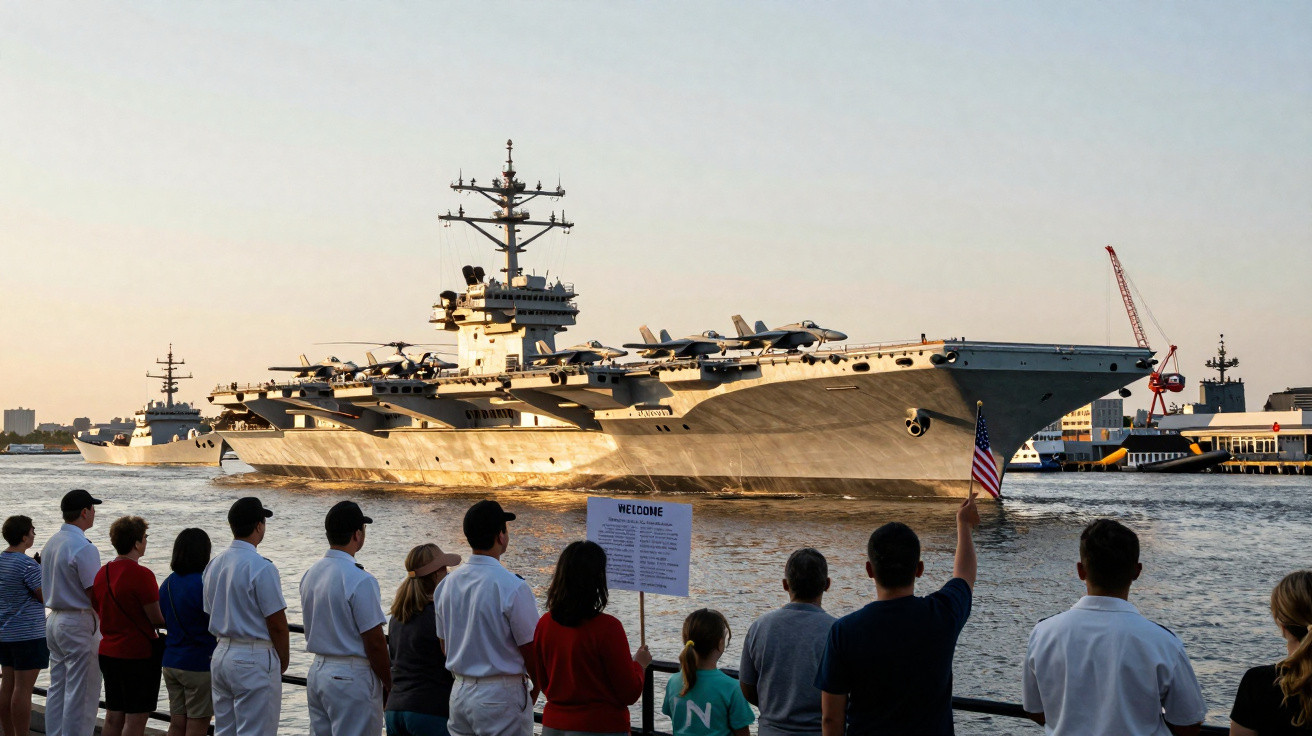
Following one of the US Navy’s longest and most demanding missions of recent decades, the nuclear-powered aircraft carrier USS Gerald R. Ford (CVN-78) returned to Naval Station Norfolk, Virginia, on 16 May. This brought to a close a 326-day deployment in which it operated within the areas of responsibility of the 4th and 5th Fleets. The ship arrived alongside the destroyers USS Bainbridge (DDG-96) and USS Mahan (DDG-72), while USS Winston S. Churchill (DDG-81) returned to its home port at Naval Station Mayport, Florida.
The Ford’s homecoming concludes an operational sequence that began as a planned deployment on 24 June 2025 but developed into a global campaign. Before reaching Norfolk, the carrier and its Strike Group sailed more than 57,713 nautical miles and conducted 23 underway replenishments. Its Carrier Air Wing 8 logged over 5,760 flying hours and 12,200 aircraft launches - figures illustrating the operational strain of a mission sustained for almost eleven months.
From Europe to Southern Command and then the Middle East
The USS Gerald R. Ford Strike Group deployment did not follow a straightforward course. The group had initially been due to operate in the European theatre under the 6th Fleet, maintaining a presence in the Mediterranean and other areas of US interest. However, the changing regional situation resulted in its redeployment to the US Southern Command (USSOUTHCOM) area, where it took part in operations connected with Southern Spear and Absolute Resolve, amid US military pressure on Venezuela and intensified naval activity in the Caribbean.
The final phase of the deployment brought the Ford to the Middle East under the 5th Fleet. There, it joined US Navy operations within Operation Epic Fury, intended to place pressure on Iran and its nuclear programme. In this theatre, the carrier operated alongside other carrier strike groups, including those led by USS Abraham Lincoln (CVN-72) and USS George H.W. Bush (CVN-77), creating an exceptional concentration of US air and naval power in the region under US Central Command (USCENTCOM). After several months, the Ford departed the Middle East in May and headed into the Atlantic to begin its final voyage to Norfolk.
A deployment shaped by tensions and incidents
The campaign was also defined by the considerable demands placed on the ship’s personnel and equipment. While deployed in the Mediterranean and Middle East, the Ford experienced a non-combat fire in its laundry area. The incident required technical assessments and repairs during port calls at Souda Bay, Greece, and later Split, Croatia, before the carrier returned to the USCENTCOM area. Although it did not prevent the carrier from resuming operations, the fire underscored the pressures of an extended deployment for a platform which, despite being the most modern of its type, is still establishing its operational maturity.
When the crew returned on 16 May, Defence Secretary Pete Hegseth welcomed them in Norfolk and stressed the exceptional nature of their mission. In a message, he said that for almost a year the USS Ford’s sailors had “held the line” for the United States, serving in locations not anticipated when they departed: from Europe and Southern Command to the Middle East. At the same ceremony, Strike Group 12 was awarded the Presidential Unit Citation, the highest collective honour available to a US military unit.
More than a Strike Group
The Carrier Air Wing comprised nine squadrons, including Fighter Attack Squadron (VFA) 37, “Ragin’ Bulls”; Fighter Attack Squadron (VFA) 213, “Blacklions”; Fighter Attack Squadron (VFA) 31, “Tomcatters”; Fighter Attack Squadron (VFA) 87, “Golden Warriors”; Electronic Attack Squadron (VAQ) 142, “Grey Wolves”; Airborne Command and Control Squadron (VAW) 124, “Bear Aces”; Helicopter Sea Combat Squadron (HSC) 9, “Tridents”; Helicopter Maritime Strike Squadron (HSM) 70, “Spartans”; and a detachment from Fleet Logistics Support Squadron (VRC) 40, “Rawhides”.
The end of an era for the fleet’s most modern aircraft carrier
The USS Gerald R. Ford is the first aircraft carrier of a new generation, fitted with systems including the Electromagnetic Aircraft Launch System (EMALS), the Advanced Arresting Gear (AAG), expanded electrical architecture, and greater capacity to integrate future crewed and uncrewed aircraft. Its 326-day deployment, the longest by a US aircraft carrier since the Vietnam War, also acted as a maturity test for a class criticised for years over delays, budget overruns and early challenges.
With the Ford now back in Norfolk, it enters a period of post-deployment recovery, maintenance and assessment. After almost eleven months of continuous operations, the ship will undergo work to restore its operational readiness, inspect critical systems, repair internal fire damage and prepare for its next operational cycle. For the US Navy, the return represents not only the end of a lengthy mission but also the need to absorb lessons from a campaign that took the aircraft carrier from the North Atlantic and Mediterranean to the Caribbean, Red Sea and Middle East.
The current US aircraft carrier picture
The departure of USS Ford from the Middle East, and therefore from that theatre of operations, changes the picture of the American presence. According to the situation report issued by analysts, the aircraft carriers USS George H.W. Bush and USS Abraham Lincoln remain in service with the 5th Fleet. Meanwhile, USS George Washington and USS Dwight D. Eisenhower are completing their COMPTUEX (Composite Training Unit Exercise), with plans to replace the Lincoln in the coming weeks. In this context, the return of CVN-78 reduces the exceptional concentration of aircraft carriers in the Middle East, while other strike groups maintain a significant US Navy presence in the region.
You may also be interested in: US Armed Forces missile and ammunition stocks: still solid and lethal




Comments
No comments yet. Be the first to comment!
Leave a Comment