
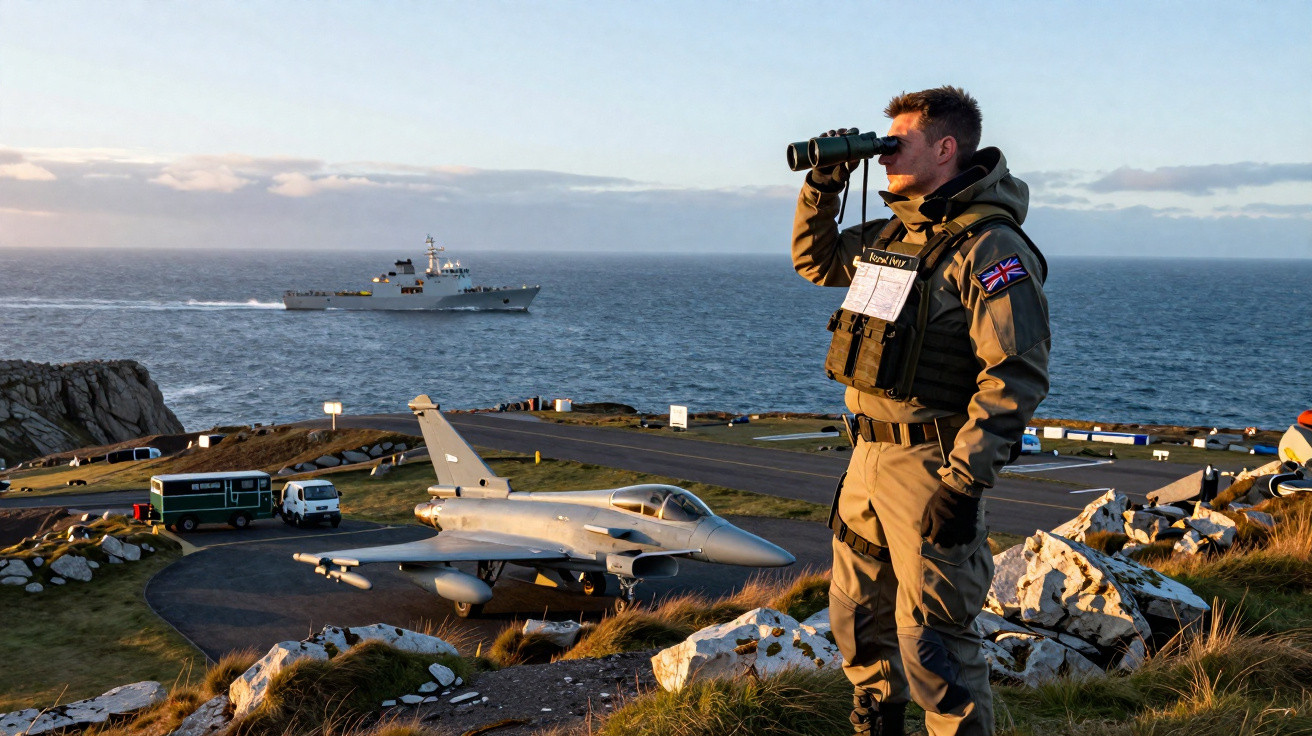
The operational capability of the United Kingdom’s Armed Forces, together with their deployment in the Malvinas Islands, is a core part of the country’s defence strategy in the South Atlantic. The deployment brings together naval, air and land assets, maintains a permanent presence across the archipelago, and is supported by global power-projection capabilities that can sustain operations far from the British mainland.
Royal Navy capabilities
At sea, the Royal Navy is structured to provide both strategic deterrence and expeditionary power projection. Its foremost assets include the two Queen Elizabeth-class aircraft carriers, HMS Queen Elizabeth and HMS Prince of Wales, which underpin its naval aviation capability and enable combat aircraft to operate in distant theatres.
Supporting these vessels are four Vanguard-class submarines, assigned to the nuclear deterrent, and six Astute-class submarines for attack and surveillance tasks. Together, these platforms provide the United Kingdom with considerable scope to control maritime areas and project power at range, including in strategically important regions such as the South Atlantic.
The surface fleet also includes six Type 45 destroyers, focused on air defence, and eight Type 23 frigates, primarily intended for anti-submarine warfare. The Royal Navy further operates nine River-class patrol vessels, including HMS Forth and HMS Medway, which routinely rotate through the Malvinas Islands to maintain continuous maritime monitoring.
Royal Air Force capabilities
In the air domain, the Royal Air Force (RAF) operates a varied fleet covering combat, transport and logistical support roles. Its principal aircraft include 107 Eurofighter Typhoon fighters and 33 F-35B fighters, allowing it to conduct air-superiority, strike and air-defence missions.
RAF strategic and tactical mobility is underpinned by 51 Boeing CH-47 Chinook helicopters for heavy-lift transport, alongside 22 Airbus A400M Atlas aircraft and 8 C-17A Globemaster III transport aircraft. These platforms are essential for supporting operations in remote territories, including deployments to the Malvinas Islands.
The archipelago’s air component is based at RAF Mount Pleasant, the principal operational and logistics hub. A permanent detachment of four Eurofighter Typhoons operates from the base, undertaking air-defence and early-warning duties against potential incursions.
Air support is reinforced by Airbus A400M Atlas transport aircraft and a Voyager tanker, which maintain supply links between the archipelago and other support locations. Helicopters are also assigned to search-and-rescue duties and tactical transport throughout the islands.
Deployment in the Malvinas Islands
At sea, the United Kingdom employs a forward-presence model centred on uninterrupted patrol activity. Under this arrangement, the offshore patrol vessel HMS Medway replaced HMS Forth in January 2026 as the principal surveillance platform in the surrounding waters, ensuring an ongoing presence in the area.
This element is supplemented by seasonal and support deployments, including the icebreaker HMS Protector and the research ship RRS Sir David Attenborough. Both support logistical tasks and scientific work across the Antarctic and sub-Antarctic region.
On land, the British Army keeps a rotating garrison equivalent to one infantry company, maintaining operational preparedness while avoiding an impact on force availability on the mainland. Units deployed recently have included personnel from the Royal Irish Regiment and the Royal Gurkha Rifles.
Air defence is a central part of the land deployment, particularly after the introduction of Sky Sabre to replace Rapier. The new-generation system has an effective range of up to 25 kilometres and provides 360-degree coverage, substantially enhancing protection from air threats.
Developed by MBDA, Sky Sabre incorporates the lightweight, supersonic CAMM (Common Anti-Air Modular Missile), known in British Army service as Land Ceptor, as well as the Giraffe AMD three-dimensional radar and the Rafael MIC4AD command-and-control system. This configuration allows for a coordinated and effective response to multiple threats across different operational settings.
Among recent developments, an RAF Airbus KC.Mk 2 Voyager tanker stopped at a Chilean Air Force (FACh) base in January 2026 after operating from Mount Pleasant. The movement illustrated the reach of the British logistics network in the South Atlantic and its links to the Antarctic axis.
Meanwhile, Operation FIRIC took place in February 2026, during which the British Army evaluated the operational capabilities of the 1st Battalion, Royal Irish Regiment, in the Malvinas Islands. The exercise concluded that unit’s deployment cycle and preceded its replacement by the 4th Battalion, Parachute Regiment, in accordance with the permanent troop-rotation system.
Taken together, the United Kingdom’s operational capacity in the Malvinas Islands rests on a combination of permanent presence, rotating forces and long-range logistical support. This model enables it to sustain an active military deployment in the South Atlantic, respond to a range of scenarios, and integrate its three principal service components.
UK operational weaknesses
The Astute-class submarines are at different stages of maintenance or have limited availability. HMS Astute is waiting for HMS Audacious to complete its maintenance period before entering a mid-life refit, while HMS Ambush has a very low state of readiness. HMS Agamemnon, commissioned in September, is not yet operational. HMS Anson, meanwhile, has deployed to Australia to reinforce the United Kingdom’s commitment to the AUKUS programme. As a result, the United Kingdom has no submarines ready to deploy.
This reduced submarine availability not only limits the deployment potential of submarine forces, but also prevents the deployment of a carrier strike group. Put simply, while the United Kingdom possesses HMS Queen Elizabeth and HMS Prince of Wales, a strike group requires destroyers, submarines, and support or logistics vessels; without any of these elements, its ability to deploy is increasingly constrained.
For that reason, despite pressure from the US a few days ago, the UK government said it had no intention of sending an aircraft carrier to the Middle East to assume a more active role in the conflict, restricting its contribution to the deployment of the Type 45 destroyer HMS Dragon.
It should be noted that, although five of the six Astute-class attack submarines are not fully operational and the sixth is in Australia, the United Kingdom also has four Vanguard-class submarines: HMS Vanguard, HMS Victorious, HMS Vigilant, and HMS Vengeance. These are not attack submarines, however, but nuclear-powered ballistic-missile submarines, and therefore do not carry out the same role as the Astute-class boats.
In the British aerospace sector, attention should also be given to events in July 2025, when BAE Systems began dismantling the final assembly line for Eurofighter Typhoon fighters at its Warton facility in Lancashire. The move followed declining Eurofighter orders and the Royal Air Force’s preference for other systems, including the F-35A, over fighters manufactured domestically.
Regardless of the debate over whether the F-35A is superior or inferior to the Eurofighter Typhoon-and despite the United Kingdom not ordering new aircraft while upgrading existing jets with ECRS MK2 radars-the situation significantly reduces the country’s manufacturing capacity. It has also prompted public dissatisfaction and opposition from British trade unions.
Finally, the development timelines of these weapons systems must be considered. It was stated some time ago that the Eurofighter Typhoon is expected to remain in service until 2060. At the same time, the United Kingdom, Italy and Japan are jointly developing the GCAP (Global Combat Air Programme) sixth-generation fighter, with Germany potentially joining if it formally leaves the FCAS project. However, the programme only envisages having a fighter aircraft by 2023, meaning that almost a decade remains.
In terms of air superiority and the contest to become the first power to develop a sixth-generation fighter, GCAP trails well behind the US Boeing F-47 and Chinese models, which are developing the J-50 and J-36.
Images for illustrative purposes only.
You may be interested in: As it continues its voyage towards South America, the nuclear-powered aircraft carrier USS Nimitz is conducting exercises in the Pacific





Comments
No comments yet. Be the first to comment!
Leave a Comment