
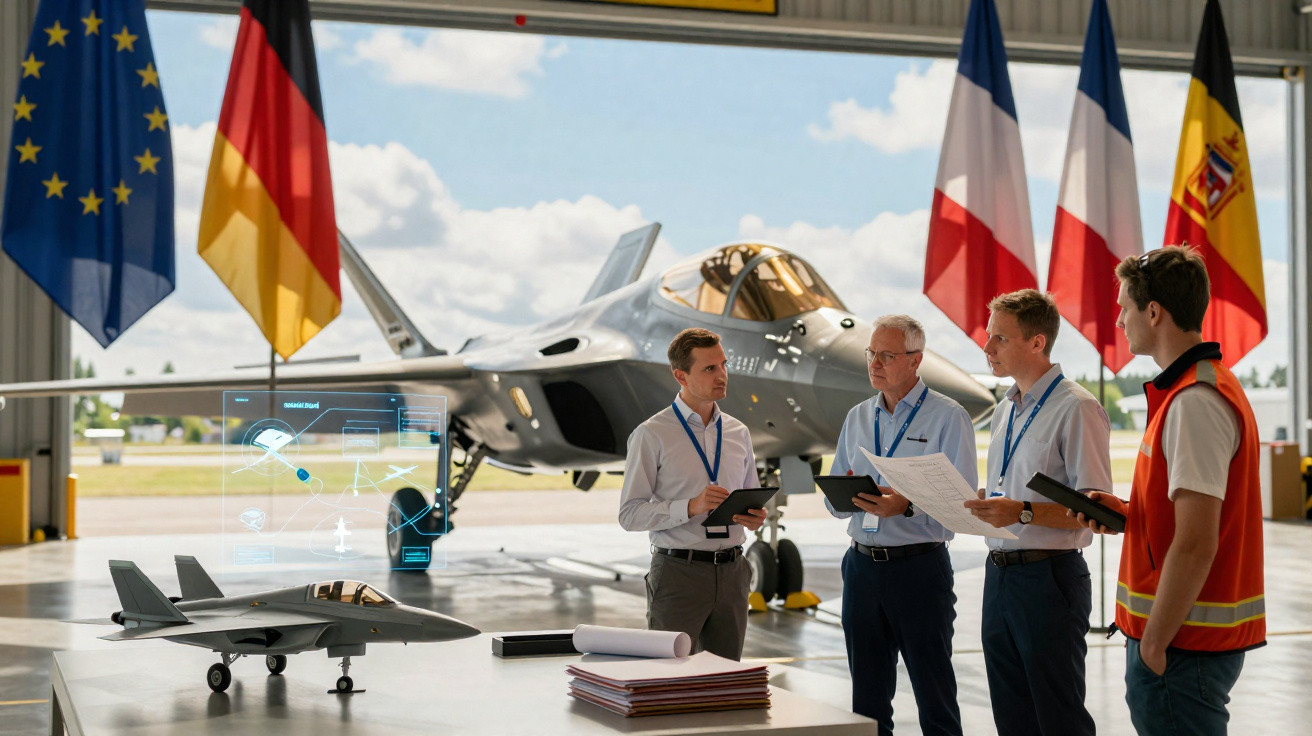
The FCAS sixth-generation fighter programme involving Germany, France and Spain has once again been plunged into uncertainty after another delay in decisions on the European project. With Berlin and Paris still unable to reach agreement, alongside industrial disagreements between Dassault Aviation and Airbus, a programme central to European defence remains stalled. Spain, represented by Indra, is awaiting clarity that will shape investment, technological capabilities and strategic planning.
A discussion held on the evening of Wednesday 18 March between German Chancellor Friedrich Merz and French President Emmanuel Macron, ahead of the European summit, had been regarded as a decisive opportunity to get the programme moving again. However, German government sources said that no final agreement was reached, and the two countries chose to postpone the decision until mid-April, while agreeing to “a final attempt at mediation between the industries”, to be conducted by experts.
FCAS sixth-generation fighter programme remains stalled
France and Germany launched the Future Combat Air System (FCAS) in 2017 as an effort to develop a next-generation air combat system bringing together a crewed fighter aircraft, uncrewed systems and a digital combat cloud. Spain subsequently joined the programme through Indra, under an arrangement with not only an industrial dimension but also political and strategic importance in the pursuit of greater European defence sovereignty.
The central source of tension continues to be the dispute between Dassault Aviation and Airbus over control of, and direction for, the programme, which is valued at roughly €100 billion. Available information indicates that Dassault wants an aircraft more closely tailored to the requirements of the French Armed Forces and seeks authority over key elements of its development. Airbus, meanwhile, supports a different configuration more aligned with German priorities, a divide that has even prompted discussion of pursuing separate solutions.
Against this backdrop, Dassault chief executive Éric Trappier has not ruled out finding alternative partners should the current cooperation framework fail to deliver a result. “We will find other partners if necessary,” he said recently, signalling the scale of the tensions within the programme. Reports from Germany also state that Berlin has opened discussions with Swedish company Saab, reinforcing the view that alternatives are being considered if FCAS cannot overcome its current deadlock.
Indra and Spain await clarity on FCAS
For Spain, the programme’s continuation is particularly significant because of Indra’s assigned role as national coordinator and lead for areas including the Combat Cloud, the digital architecture intended to connect crewed aircraft, drones and sensors. The Spanish company has spent years building capabilities in command and control, radar and electronic warfare, while the programme also involves dozens of companies across the sector and points towards long-term contracts connected with the development of sixth-generation technologies.
With progress still absent, the Spanish government has introduced interim measures to support industrial and technological capacity while the European programme remains paralysed. In January, it launched the Siagen programme, awarded to Indra for around €540 million. It had previously approved, by royal decree, an €80 million loan for the partnership established between Airbus and Indra to study the “National Future Air Combat System”, an initiative presented as temporary support should FCAS continue to face delays.
Meanwhile, in Germany, speculation has also grown over a possible expansion of the fleet of F-35 stealth fighters built by Lockheed Martin, an alternative that could increase Berlin’s dependence on US military technology. Sources cited by Reuters said the German government is assessing the purchase of more than 35 additional aircraft, although an official spokesperson denied this, saying: “There are no plans and there is no decision.” The Ministry of Defence likewise maintained that there are “no concrete plans or political decisions” for another acquisition.
FCAS uncertainty and the race for sixth-generation fighters
The uncertainty surrounding FCAS also coincides with developments in other sixth-generation programmes and interest from external players. India’s Ministry of Defence told its Parliament’s Standing Committee on Defence that it is considering joining one of the two major European consortia currently under way: FCAS or the Global Combat Air Programme (GCAP).
Quoting one section of the document that addresses the matter: “The Committee was informed that two consortia are working on sixth-generation aircraft. One is a consortium of the United Kingdom, Italy and Japan (Editor’s note: the GCAP programme), and the other is a consortium of France, Spain and Germany (Editor’s note: the FCAS programme), and both are developing aircraft. The Committee was also informed that the Air Force will seek to join forces with one of the consortia and will immediately begin considering a sixth-generation fighter in order to ensure that it is not left behind in achieving the goal of advanced aircraft.”
Italy, a GCAP partner alongside the United Kingdom and Japan, has also said that Germany “could probably join this project in the future”, according to remarks by Defence Minister Guido Crosetto. In this context, the Franco-German delay affects not only the FCAS roadmap, but also creates scope for industrial and strategic realignments in the race to develop the future sixth-generation fighter.
Images for illustrative purposes.
Translated by Constanza Matteo
Read also: ETAP-C 26-1: The Spanish Air and Space Force continues to support the training and specialisation of European military transport aircrew






Comments
No comments yet. Be the first to comment!
Leave a Comment