
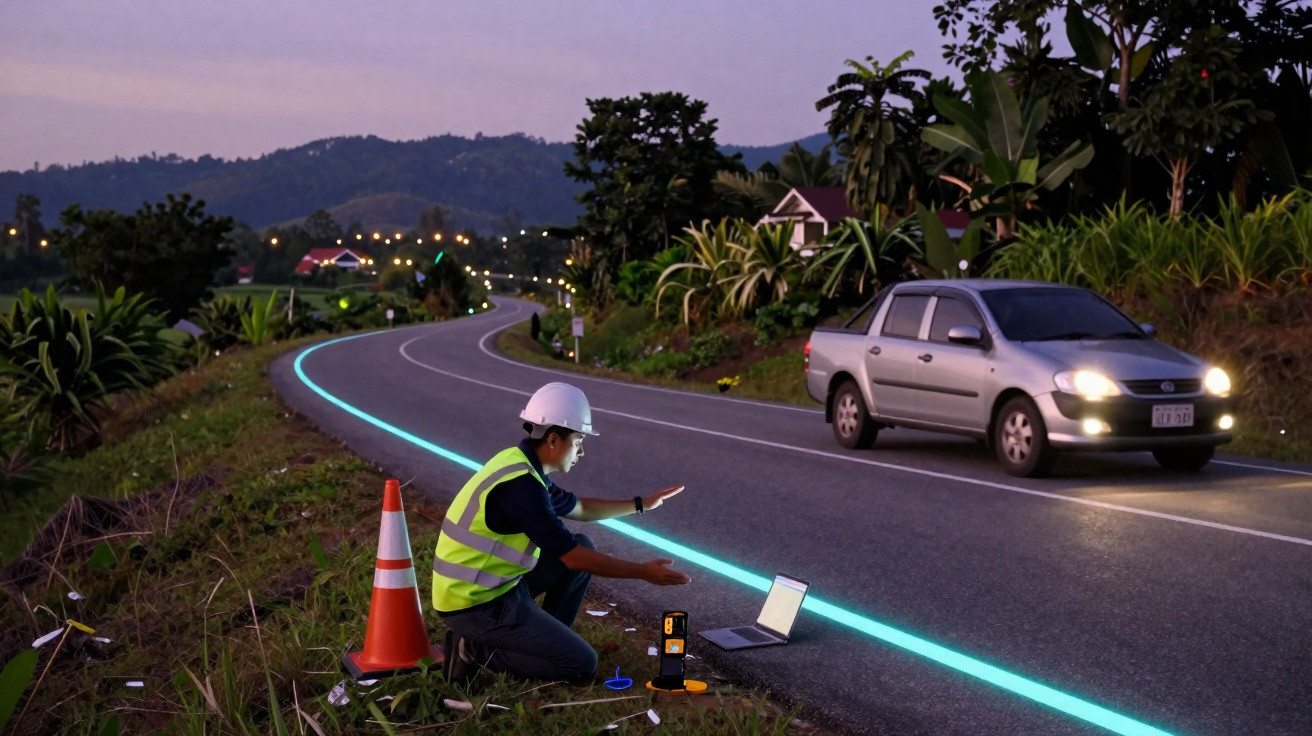
In a suburb of Kuala Lumpur, a rural road briefly looked like a glimpse of the future: road markings that charged in daylight and illuminated themselves after dark. The government hoped they would make unlit routes safer, but the project changed course abruptly after an initial wave of enthusiasm.
How a rural road became a future-facing project
The trial took place on a stretch of road measuring around 245 metres near Semenyih, in Hulu Langat District, Selangor. There were no conventional streetlights there, leaving the carriageway difficult to see at night. This was precisely the problem Malaysia’s Public Works Department aimed to address.
Its solution was road markings made with photoluminescent paint. The material absorbs sunlight during the day before releasing it after nightfall. As a result, drivers can identify their lane without an electricity supply. In daylight, the lines appear to be ordinary road markings; in the dark, they give off a bright glow.
Officially, the project was not intended as a showpiece, but as an attempt to make roads safer without having to install poles and cables everywhere.
The responsible minister, Alexander Nanta Linggi, said the markings remained visible for up to ten hours, with the glow still clearly noticeable even in rain. Many motorists also reported on social media that they found it far easier to orientate themselves.
The technology behind the glowing road markings
The paint used photoluminescent pigments. Put simply, these materials store light energy and release it later. The principle is familiar from glow-in-the-dark emergency exit signs in buildings.
On a road, the technology offers several potential benefits:
- No ongoing electricity costs: The markings need no cables, lamps or control systems.
- Less maintenance for poles: There is no need to repair streetlights or their foundations.
- Improved guidance: On winding and poorly lit roads in particular, glowing lines can be more immediate than widely spaced points of light.
The concept itself was not entirely new. Years earlier, the Netherlands attracted headlines with its “Smart Highway” project and its so-called “Glowing Lines”. There, the lines stayed visible for up to eight hours, while a test route operated for several months. The road surface itself was intended to serve as the illuminated area.
Malaysia, however, placed less emphasis on design and focused squarely on poorly lit rural roads. The Semenyih trial was conceived as an everyday road-safety measure, not as a futuristic spectacle.
Plans for a major rollout
The favourable response soon encouraged politicians to think on a larger scale. In February 2024, Selangor announced plans to expand the technology to 15 additional locations across all nine districts.
Around 15 kilometres of roads were under discussion, including routes in Sepang, Kuala Langat and Petaling. The projected cost was approximately 900,000 Malaysian ringgit. Johor also expressed interest, identifying 31 roads for trial schemes, including a 300-metre section in Batu Pahat.
The glowing markings therefore appeared close to becoming a new standard option for dark traffic routes. Many road users praised the experiment publicly, and media coverage was largely positive.
Then the bill arrived
Behind the scenes, however, engineers and financial planners had already begun calculating the figures - and that was where the problem emerged. According to the government, the photoluminescent paint cost around 749 ringgit per square metre. Conventional road-marking paint costs about 40 ringgit per square metre.
| Type of marking | Price per m² | Factor |
|---|---|---|
| Standard road paint | RM40 | 1 |
| Glowing paint | RM749 | just under 19 |
That made the futuristic option almost twenty times more expensive than the conventional one. Its service life, weather resistance and replacement requirements had not yet been conclusively established either. Each additional rainy season and every heavily used road could have worn the paint away more quickly, creating uncertain follow-on costs.
One statement in Parliament changed everything
The reversal came in November 2024. In Parliament, Deputy Works Minister Ahmad Maslan said the costs were too high and that the glowing lanes were therefore unlikely to continue.
The minister made clear that the trials had not convinced the ministry’s specialists sufficiently - neither on cost-effectiveness nor on technical grounds.
The flagship scheme thus became a familiar infrastructure issue: a measure that works in everyday use and is well received by the public may still fail to meet the strict demands of budget planning, maintenance and standards.
The 245 metres in Semenyih remained a pilot project rather than the start of a new nationwide system.
Why the issue remains relevant
Even without glowing paint, the underlying challenge remains: how can road markings be designed so that they are clearly visible at night, in rain and in fog - particularly outside larger cities?
Road authorities around the world are working on this question. In Japan, for instance, the National Institute for Land and Infrastructure Management is examining how the quality and visibility of motorway markings can be measured and maintained effectively. There, lane markings are explicitly regarded as part of a comprehensive safety system, rather than merely “lines on the asphalt”.
For countries such as Malaysia, with extensive stretches of rural road, the same question repeatedly arises: is expensive technology across a wide network worthwhile, or is a robust standard solution with regular renewal ultimately more sensible?
Alternatives to glowing roads
The failed expansion of the glow-in-the-dark markings does not mean there are no other ways to improve safety. Options under discussion include:
- Highly retroreflective markings: Special glass beads within the paint direct headlamp light back towards drivers.
- LED guide posts or “active” markings: Integrated LED elements flash or illuminate at bends and hazardous locations.
- Intelligent street lighting: Lamps that brighten automatically when traffic levels rise or weather conditions deteriorate.
- Improved maintenance cycles: Clear rules setting out when faded markings must be renewed.
Many of these measures can be deployed in a modular way. A dangerous bend can be equipped differently from a long, straight stretch in a remote area. Governments must always weigh the same combination of factors: upfront investment, ongoing operating costs, lifespan and demonstrable safety benefits.
What the Malaysia case means for other countries
The Semenyih project demonstrates how narrow the line can be between innovation and an expensive gimmick. New road-building ideas can quickly generate excitement, especially when they are highly visible and photograph well. Glowing roads look striking in images and convey a sense of progress.
For planners in other countries, the Malaysian trial may nevertheless offer useful lessons:
- Early cost-benefit assessments should run alongside technological development.
- A broad rollout requires robust durability data under real traffic loads.
- Acceptance among road users matters, but it does not replace technical assessment.
- An expensive technology may sometimes be better suited to isolated hotspots than widespread deployment.
Especially in light of climate targets and energy prices, demand for solutions that do not require continuous electricity is likely to grow. Photoluminescent markings could return to the agenda in the longer term - perhaps combined with more durable binders or lower production costs achieved through mass production.
Context: what “photoluminescent” means in everyday life
The term may sound technical, but it describes many everyday products. Photoluminescence means that a material absorbs light energy and emits it again later, without burning or producing light in the manner of a light bulb.
Typical examples include:
- Glow-in-the-dark stickers in children’s bedrooms
- Emergency-exit and escape-route markings
- Watch dials that shimmer at night
On roads, though, the demands are far greater: tyres, heat, UV radiation, oil stains and heavy lorries all take their toll on the coating. That is exactly why establishing a durable yet cost-effective glowing solution for asphalt is so challenging.
With the Semenyih project, Malaysia showed how far such an idea can go - and the point at which costs, standards and expert assessments put the dream of a futuristic road on hold for the time being.





Comments
No comments yet. Be the first to comment!
Leave a Comment