
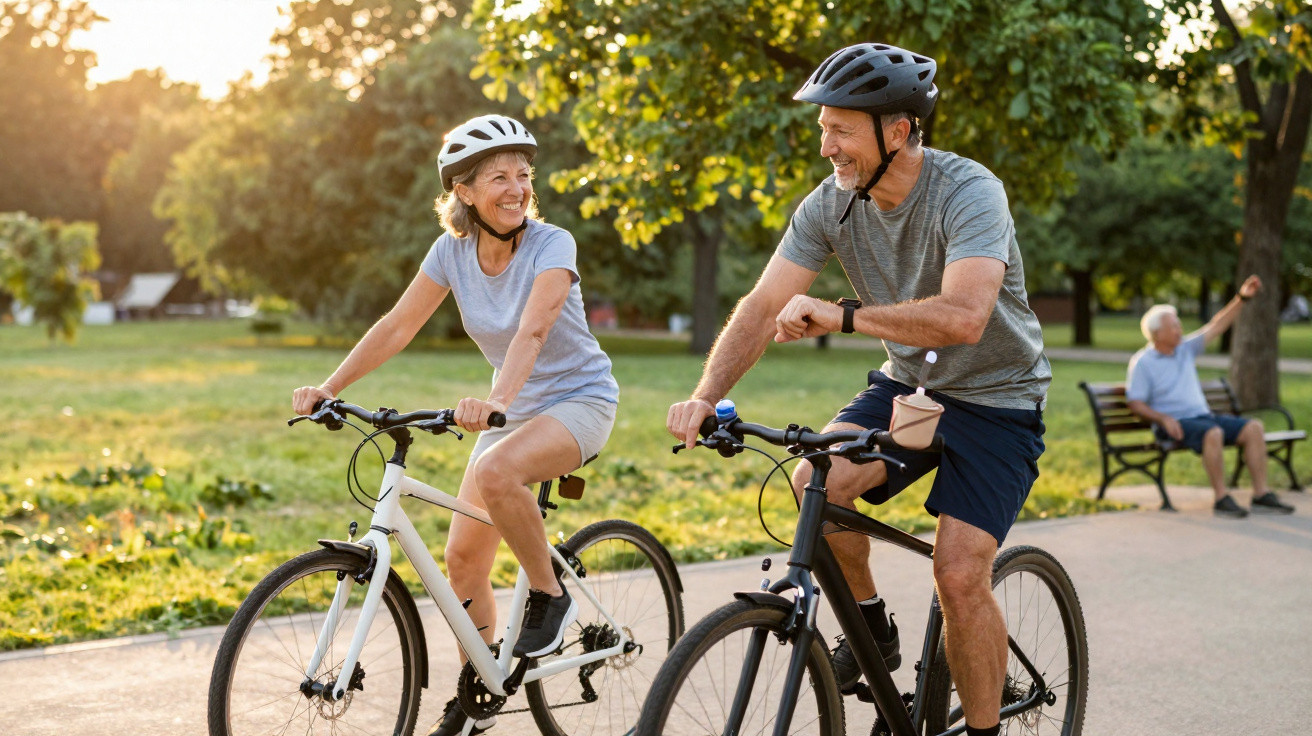
A small group of older women cyclists rolls through the park ahead of me: grey hair beneath colourful helmets, quiet laughter blending with the hum of their chains. One is riding an old trekking bike, another a gleaming new e-bike. They stop at the traffic lights, take a deep breath and wipe their foreheads. None of them looks as though they have stepped out of an advert. They look more like people who have realised, at some point, that sitting down makes you tired – not getting older. When the lights turn green, I pedal alongside them for a few minutes. Their conversation is remarkably easy and their faces look relaxed. It makes me wonder: what actually happens in the body when we get back on a bike at 62 – or do so for the first time in decades?
Why cycling after 62 can be a game changer
People who begin cycling seriously again at 62 often have an eye-opening moment: their heart rate rises and breathing becomes harder, yet they feel more alert than they do after any evening on the sofa watching a series. Many say that, after a few weeks, they can suddenly climb the stairs without gasping when they reach the top. Cycling taps into something very human: movement without performance, getting out and about without pressure. You can set off slowly, stop whenever you need to and turn back at any point. Yet something is happening inside you that is quieter, but more powerful, than any fitness app.
A 64-year-old reader recently shared his story with me. He had heart palpitations, high blood pressure and constant tiredness. His doctor recommended moderate endurance exercise, while his own first thought was: “Me? Exercise? Certainly not.” He then bought a second-hand city bike, fitted a basket to the front and started cycling to the market twice a week. Ten minutes there and ten minutes home. No sports clothing and no heart-rate monitor. After three months, simply going to the market was no longer enough. He made his route longer and took a detour through the park. He now rides three times a week, for 45 minutes each time. His medication has been reduced, and his grandchildren can barely keep up. The statistics behind this are clear, but this small personal turning point makes them easier to understand.
As we age, the heart loses pumping power without exercise, the lungs use less of their capacity and muscle mass declines. Cycling addresses exactly these three weak points without overwhelming the body. Pedalling engages a large proportion of the leg muscles, breathing becomes deeper, and the heart has to work harder, but within a manageable range. Your joints are relieved because you are sitting on your weight rather than carrying it. Regular rides noticeably improve maximum oxygen uptake, the well-known VO2max. It may sound technical, but in daily life it feels straightforward: eventually, you can complete the route that once required three rests in one go.
How to start cycling when you feel unfit
The most effective way to build endurance through cycling after 62 is surprisingly simple: take short, planned rides and use the same route each time. Choose a circuit lasting 15–20 minutes, ideally without steep hills, and initially ride it only twice a week. During the first two weeks, speed does not matter; the aim is simply to let your body learn: “We are going to do this more often.” After around ten rides, gradually extend the route – first by five minutes, then by ten. If you wish, try the principle of riding in sets: roll along for five minutes, take one minute very easily, then pedal for another five minutes with a little more effort. It may look modest, but it is still effective endurance training.
What many people underestimate is that fitness is not the greatest obstacle – the mind is. We all know that moment when the inner voice whispers: “Not today, you’re tired.” Let us be honest: nobody genuinely manages it every day. You do not need to be perfect to notice progress. Instead, schedule “realistic days”, such as Tuesday and Saturday mornings, at roughly the same time each week. Put your clothes out the night before and charge your e-bike if you have one. Give yourself permission to stop along the way, take a photograph or enjoy the view for a moment. That is not cheating; it is your way of weaving movement into everyday life.
“I started cycling again at 65. At first, every bridge felt like a little mountain. Now bridges are my favourite check: if I can ride over one and still talk, I know my endurance has improved.” – Marianne, 68
- Start slowly: The first four weeks are for getting used to it, not for testing your performance.
- Regularity matters more than intensity: two consistent rides a week beat one heroic effort every three weeks.
- An e-bike counts too: Assisted cycling is real exercise, as long as your legs are genuinely working.
- Keep to one demanding activity per day: do not take a hard bike ride and tackle heavy gardening one straight after the other.
- Celebrate small improvements: Your first ride without a stop or your first gentle hill – these are the milestones that count.
What endurance really means after 62
Endurance is not simply a number on a heart-rate monitor. It becomes visible in the everyday moments when you suddenly have more in reserve: carrying shopping bags two streets further, playing tag with your grandchildren, or taking a city break without being stuck to the hotel bed after the first day. Cycling extends precisely this kind of everyday range. The research may be matter-of-fact, but the experience behind it is deeply emotional: someone who stays active at 62 will not only have better readings at 72, but also more freedom. At this stage of life, freedom is worth more than any smaller jeans size.
| Key point | Detail | Benefit for the reader |
|---|---|---|
| A gentle start | Short, repeated rides of 15–20 minutes, twice a week | A low barrier to entry, quick feelings of achievement and less fear of doing too much |
| Joint-friendly exercise | Most body weight rests on the saddle, while the legs work cyclically rather than with impact | Often possible even with knee, hip or back problems, allowing longer periods of movement without pain |
| Everyday endurance | Better heart and lung function, plus stronger muscles, through regular pedalling | More energy for travel, family and hobbies, with less exhaustion after ordinary daily tasks |
FAQ: Cycling and endurance after 62
- Question 1 Can I start cycling at 62 if I have not exercised for decades?
- Answer 1 Yes, and this is exactly when it can be especially worthwhile. Begin with very short distances, keep your heart rate in a moderate range and have a medical check-up if you have pre-existing health conditions.
- Question 2 Is an e-bike worse for endurance than a standard bicycle?
- Answer 2 No. As long as you are not permanently using the highest assistance setting, you will effectively train your heart, lungs and muscles, while gaining more confidence on hills and in headwinds.
- Question 3 How often should I cycle each week to noticeably improve my endurance?
- Answer 3 Cycling two to three times a week is usually enough to notice improvements in everyday life within a few weeks. The sessions do not need to be long, but they should be regular.
- Question 4 How can I tell whether I am overdoing it on the bike?
- Answer 4 Warning signs include dizziness, a feeling of pressure in the chest, unusual shortness of breath or persistent exhaustion the following day. In that case, slow down, take more frequent breaks and seek medical advice if in doubt.
- Question 5 Can cycling replace other activities such as walking or swimming?
- Answer 5 For endurance, cycling alone can take you a very long way. However, combining cycling with some strength training and occasional walking or swimming provides the broadest range of health benefits.






Comments
No comments yet. Be the first to comment!
Leave a Comment