
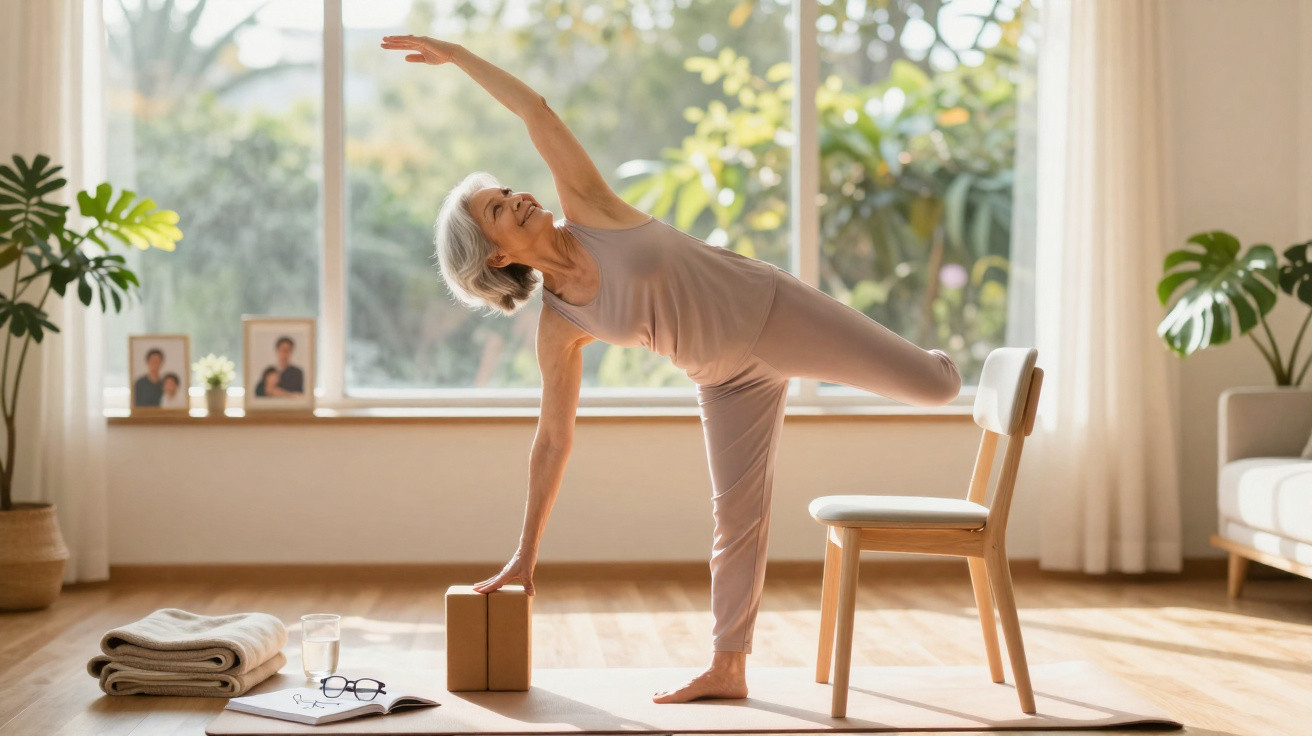
Outside, the walking sticks of older women tap as they arrive one after another, slightly doubtful yet also curious. At the front is a row of colourful yoga mats, while a small speaker hums quietly somewhere in the corner. “At 70, I’m supposed to be crawling about on a mat now?” one woman mutters, laughing shyly as she grips her chair.
Rather than launching into an explanation, the yoga teacher responds with a simple movement: she places one hand on the chair, gently raises her heel – almost imperceptibly – and says calmly, “This is where it starts.” All at once, yoga no longer seems like Instagram acrobatics; it feels like something that belongs in this room, in the middle of real life. And something remarkable begins to happen here, among chair legs, wrinkles and laughter.
Why yoga at 70 is not too late – and can be exactly right
Anyone watching a senior yoga class for the first time soon notices that it is not really about contortions, but about faces. A forehead softening with a long exhale. Eyes briefly lighting up when someone manages to stand on one leg for two seconds without wobbling. In moments like these, you can sense the deep longing for security behind every small movement.
We all know that point when a kerb suddenly appears higher than it once did. When the thought, “I hope I don’t fall”, becomes stronger than the enjoyment of moving. Gentle yoga begins precisely there: with balance, mobility and the quiet fear that few people like to admit. Instead of applying pressure, it invites curiosity. Lift one leg, stretch one arm, breathe. Little by little, a new awareness of the body emerges – not dramatic, but noticeable.
The evidence is clear: studies show that regular balance training can significantly reduce the risk of falls in later life. In many yoga classes for older people, participants say after only a few weeks that they feel steadier on stairs or wobble less while putting on their socks. It may sound ordinary, but anyone who has nearly fallen in the hallway at night knows how much freedom lies in such an “ordinary” improvement.
A typical example is Mr Becker, 72, standing beside his chair. Both hands rest on the backrest and he looks ahead. The teacher asks him to lift one heel slightly, then the other foot. At first he hesitates, before finding a careful rhythm. Two weeks later, with quiet pride in his voice, he says that he remained standing on the bus without holding on. A small personal miracle, prompted by movements that seemed almost minimal.
Why are these gentle exercises so effective? Because they address several challenges at the same time. Balance depends not only on strong legs, but also on the interaction between the eyes, ears, muscles and nervous system. Many yoga poses – including very simple chair-based ones – stimulate this interaction. The brain receives fresh information, while the muscles learn to react more quickly again.
At the same time, the hidden fear of movement often starts to ease. Anyone who realises they can hold a position for several breaths begins to trust their body again. That trust is rather like an invisible handrail in everyday life. Unlike a real handrail, however, it goes everywhere: into the bathroom, the supermarket and up the stairs to friends on the third floor.
Gentle senior yoga: how to begin yoga at 70
Starting does not begin on the floor, but in the mind. Giving yourself permission to move more slowly than everyone else is often the most important first step. In practical terms, a class clearly labelled “yoga for seniors” or chair yoga is not a step backwards, but a sound place to start. Exercises there are adapted so that nobody is holding their breath for fear of falling.
A straightforward beginner routine might look like this: sit upright on a chair with both feet firmly on the floor. Breathe in and raise your arms to shoulder height; breathe out and lower them again. That is all – repeat five to ten times. Then, while standing, place one hand on the chair back and slowly shift your weight from one foot to the other, as if gently swaying. If you wish, briefly lift one heel now and then. These movements may look modest, but they develop balance, core stability and breathing at the same time.
Let’s be honest: nobody really does this every day, and that does not need to be the benchmark. Many older people do not struggle with the movement itself, but with expectations that are too high. “I’m just not flexible” can become an excuse that keeps every mat out of reach. A more useful target is realistic: 15 to 20 minutes two or three times a week. Perhaps more on good days and less when you are tired.
Common mistakes include beginning too quickly and comparing yourself internally with the 30-year-old neighbour from the gym. Trying to copy the poses in colourful online pictures at 70 is likely to lead to frustration. Pain is a warning sign, not proof of determination. It is far better to speak to the teacher early on and be open about knees, hips and dizziness. In a good senior class, this is as routine as unrolling the mat.
“At 74, I began daring to take the curtains down from a ladder again. Not because my legs suddenly became 20 years younger, but because I learned how to catch myself when I wobble.” – Maria, senior yoga participant
To keep the start gentle, it helps to have a small personal compass, such as:
- Movement may feel demanding, but it should never feel threatening.
- After a session, you should feel alert rather than exhausted.
- Always practise balance exercises with support first, such as a wall, chair or table.
- The rule is: do not breathe into pain; stop before pain begins.
- Once a month, deliberately look for an “everyday success”: using the stairs, shopping or gardening.
How gentle yoga exercises make everyday life quieter and safer
The most interesting benefits rarely appear during the yoga session itself, but in the gaps between sessions. Reaching into the top kitchen cupboard may suddenly be possible without a pulling sensation in the shoulder. Turning over in bed no longer feels like manoeuvring a lorry. These small improvements often quietly reshape everyday life – away from fear of the next fall and towards greater ease in your own body.
Yoga at 70 does not mean that wrinkles disappear or that joints are magically lubricated anew. The body remains a body with a history – with scars, prostheses and osteoarthritis. That honesty is exactly what makes the practice so restorative. You work with what is there, rather than with an idealised image. And sometimes, that calm acceptance creates a new kind of strength, measured not by muscle size but by inner peace.
Those who have experienced this often tell others about it. A grandchild is amazed to see Grandma weeding in the garden in a calm standing pose. A friend dares to try a class herself because someone close to her says, “I feel safer.” This is how gentle exercises spread, like word-of-mouth recommendations around a neighbourhood – quietly, but sustainably. At some point, the chair in the yoga room stops being merely a support and becomes a symbol: of courage that arrives late, yet is still exactly right.
| Key point | Detail | Benefit for the reader |
|---|---|---|
| Gentle start | Chair yoga, short sessions, adapted poses | A low barrier to a safe start without feeling overwhelmed |
| Balance training | Weight shifting, support from a chair or wall, conscious breathing | Less fear of falling and greater everyday stability |
| Recognising everyday benefits | Notice small improvements: stairs, bus journeys, household tasks | Motivation stays high and progress becomes tangible |
FAQ
- Is yoga at 70 not too late? No. Many people only start in advanced age and benefit considerably: better balance, greater mobility and often improved sleep as well. The key is instruction suited to seniors.
- Do I have to be able to get down onto the floor? Not for senior yoga. Complete sessions can be done entirely on a chair or standing with support. If you later want to and are able to, you can gradually move to a mat.
- How often should I practise to notice an effect? Even two to three sessions of 15–20 minutes a week can bring noticeable changes. Many people feel more secure while walking after four to six weeks.
- What if I have balance problems or dizziness? Make sure you speak to the teacher and always practise with firm support. Gentle yoga can support the balance system, but it does not replace a medical assessment.
- Can I do yoga with artificial joints or osteoarthritis? Often, yes, with adapted poses. An experienced senior yoga teacher avoids extreme angles and uses aids such as a chair, block or cushion. It is worth having a brief conversation with your doctor beforehand.






Comments
No comments yet. Be the first to comment!
Leave a Comment