
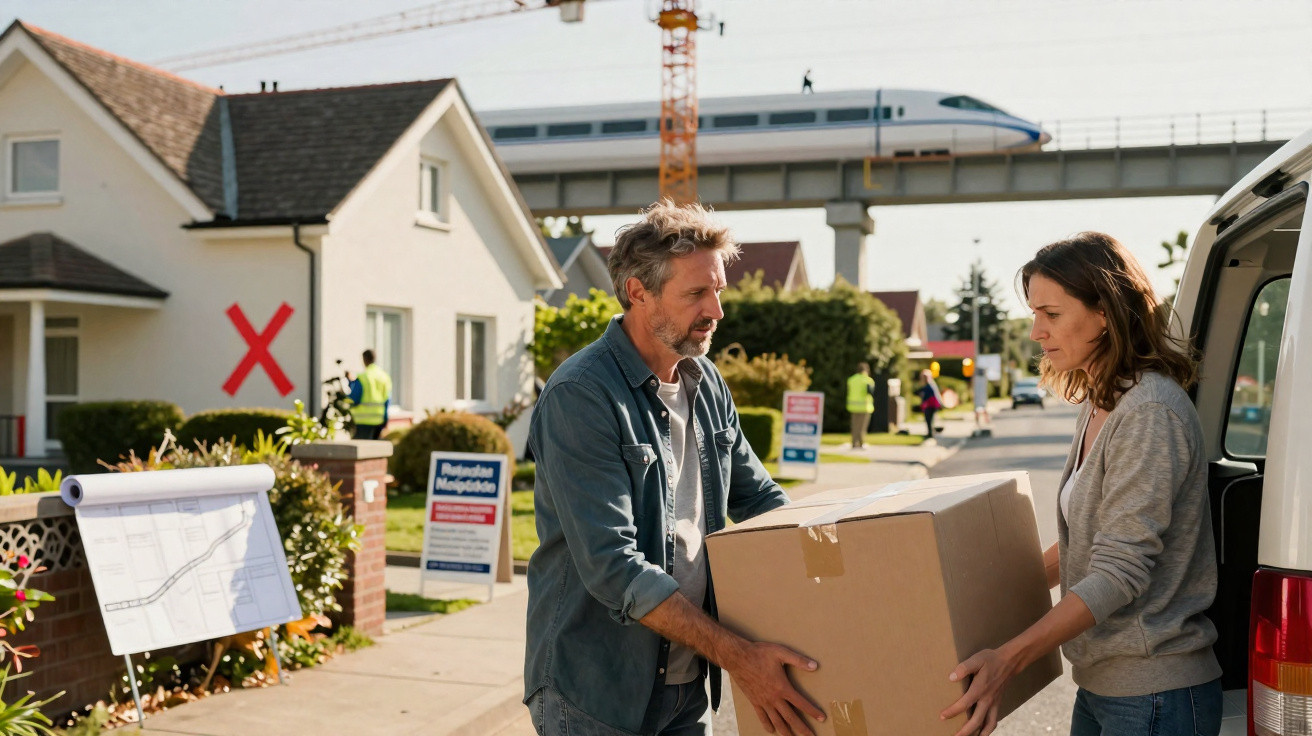
Construction of the high-speed line will destroy 17 homes and force two businesses in Estarreja to relocate. Compulsory purchase proceedings are due to begin, with work scheduled to start in August.
Work on the high-speed rail line is expected to get under way in August, but Bruna Pereira and her mother, Marisa Ribeiro, have been living with uncertainty for three years. It began when the residents of Avanca, in the municipality of Estarreja, suspected that the country’s commitment to faster rail travel would cost them the home they have lived in for two decades. They had recently replaced the roof, were preparing to improve the property and hoped one day to build a barbecue area and a swimming pool. The TGV brought all of those plans to a halt.
"We panicked," admits Bruna, who has lupus and saw her health deteriorate. The "anxiety" became so severe that Marisa was signed off work for two months. "I still suffer because of it today," she says.
The timing of the project is also "difficult", Bruna adds, because "houses are incredibly expensive". "I am afraid they will not give us enough time or money to leave here comfortably and find another home," she says, stressing that she wants to remain in the area where she has put down roots. "They have held a knife over us and now told us to get on with it. Will they give us a fair amount for the house and for the damage [suffered]?" asks her mother, Marisa.
Expensive alternatives
They are not the only people being "sacrificed" for high-speed rail in Estarreja. In addition to the main TGV route, an access branch to the Northern Line will be built in the municipality. According to information sent to JN by the AVAN consortium, which holds the concession to design, plan, build, finance and maintain the high-speed line between Porto and Oiã, in Oliveira do Bairro, "in the municipality of Estarreja, the high-speed section construction project will directly affect 12 homes and indirectly affect five homes". At this stage, it is not possible to specify how many are primary residences. "Two businesses in the municipality" have also been identified as being affected by the scheme.
Businessman Pedro Silva has already started calculating the costs. Warehouses in Beduído used by three family businesses will be demolished. The news did not come as a surprise: more than a decade ago, the family tried to expand the premises but was unable to do so "because the TGV was already being talked about".
"We will have to relocate the businesses and we are facing problems because there are hardly any warehouses available to rent or buy. What little is available is extremely expensive. We have large machinery that is difficult to transport, as well as employees who may not agree to move too far away," he says.
However, Pedro Silva has further reasons to be "extremely concerned". His parents’ home, next to the warehouses, will not be demolished like their neighbour’s property, but the railway line will run "24 metres" from its front door. The road outside will also be cut off. He says his parents are "very psychologically affected" by the change.
Reducing the impact
Pedro Silva is trusting in the "good faith of the company" that will carry out the compulsory purchases in Estarreja.
"What is about to happen is already bad enough. I hope the experts make realistic offers and do not make people’s lives even more difficult," says the businessman. He emphasises that he understands the benefits some specialists say the new TGV connection will bring to the country. "I do not believe the Government would undertake a project like this lightly, simply to spend European and taxpayers’ money. If it is for the good of the country, then I think it should go ahead. But they must create the right conditions and minimise the impact on the Portuguese people who will be affected."
For now, "the debate is over. The line will happen". Those were the words of Isabel Simões Pinto, Mayor of Estarreja, as she opened an information session organised by the local authority a few days ago.
"The concerns are now focused on compulsory purchases. Some people will lose their homes, businesses will have to relocate," and land will be acquired for the high-speed line, the mayor acknowledges. The parishes most affected will be the Union of Canelas and Fermelã, Beduído and Avanca.
Experts will carry out valuations
Álvaro Fonseca, Operations Manager at the AVAN consortium, assured attendees there would be "transparency" and that the compulsory purchase process would be "expensive". It will be managed by the AVEXP team, which is part of the same consortium, while valuations will be undertaken by "independent specialist experts". They will put forward compensation offers to be negotiated with residents and business owners affected by the project.
"Agreements are already being reached further south" and this will happen in Estarreja "in the coming months", Álvaro Fonseca added. The first construction activity on site is expected to begin in "late August, September".
In Estarreja, the railway infrastructure will extend for 30 kilometres: 13.4 kilometres of track for the main section, plus 16.6 kilometres for the Canelas connection to the Northern Line. The route will mainly lie east of the A1, the Northern Motorway, and will include several engineering structures, including a bridge over the River Antuã, a bridge over the River Jardim, and ascending and descending viaducts required for the Canelas junction.
Centre will create jobs
Plans also provide for a maintenance centre, a new electrical traction substation, and a train passing and stabling facility. The consortium said the centre, which will maintain several areas of the high-speed line, will create around "one hundred jobs".
As for the road network, the plan provides for the reinstatement of several roads that will be severed, ensuring communities are not left isolated.
As it crosses the municipality, the high-speed line will pass through protected areas, requiring a range of impact-reduction measures set out in the Single Environmental Title issued when the project was licensed. The scheme therefore includes measures to protect the Aveiro lagoon and BioRia routes, including ecological corridors, water drainage and filtration systems, and steps to limit impacts on wetlands, among other actions.
The quantity and quality of water was, in fact, one of the concerns raised at the Estarreja information session. One person warned about the project’s impact on groundwater and the risk that it could "dry up wells" needed to cultivate vegetable gardens and fields. In response, the company said it would monitor water throughout the progress of the works.





Comments
No comments yet. Be the first to comment!
Leave a Comment