
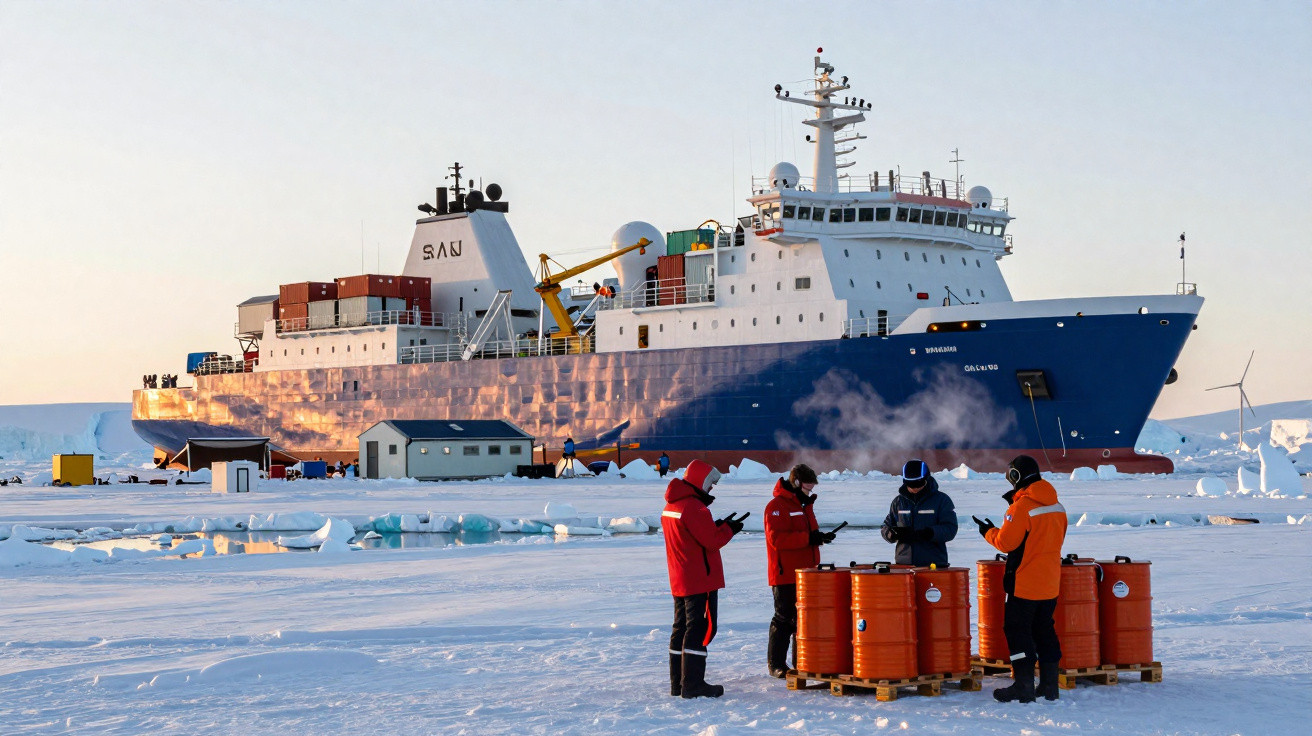
Far beyond the glow of harbour lights, three isolated Antarctic research stations are preparing to depend on the same lifeline: one heavily reinforced vessel that will support their survival during the coming decade of polar winters.
A 10,000-tonne workhorse connecting three polar nations
The Silver Mary is not a luxurious cruise liner. This 10,000-tonne resupply ship has an ice-strengthened hull, heavy plating and engines designed to force their way through sea ice. For the next ten years, it will form the centrepiece of an unusual three-nation Antarctic logistics agreement between the United Kingdom, Norway and Germany.
Under the arrangement, the Silver Mary will carry food, fuel and scientific equipment to three principal stations: Halley VI (UK), Troll (Norway) and Neumayer III (Germany). Its first visit to the British Halley station is planned for January 2026, beginning a new shared supply network on the frozen continent.
For the first time, three major polar programs will rely on one heavy ship to keep their Antarctic bases alive.
The agreement follows a German–British trial in the 2023–24 season. During that mission, the Malik Arctica broke through sea ice to resupply Halley after years of maritime isolation. The voyage demonstrated that collaborative shipping could succeed in one of Earth's most unforgiving environments.
Why Antarctica requires a new logistics approach
Antarctic research stations lie at the far end of the world's longest supply routes. Hiring a vessel capable of polar operations for one country alone can cost several million dollars each year. Every programme requires months of preparation, suitable weather windows and crews ready to work through 24-hour daylight or the depths of polar night. Each additional passage also consumes vast quantities of fuel.
By combining their requirements into a single ship and timetable, the UK's British Antarctic Survey (BAS), the Norwegian Polar Institute and Germany's Alfred Wegener Institute aim to deliver three benefits simultaneously:
- Reduce operating expenditure by sharing vessel time and crews.
- Cut emissions by limiting the number of lengthy, fuel-heavy voyages.
- Provide more dependable deliveries for stations reliant on annual “lifeline” missions.
In practical terms, Halley, Troll and Neumayer will jointly order and pack their freight, coordinate loading in the Northern Hemisphere, then arrange Antarctic delivery windows so the Silver Mary can follow a sensible coastal circuit.
Each voyage becomes a moving warehouse for three nations instead of a dedicated mission for one flag.
Releasing a cutting-edge research vessel from cargo work
More sea time for climate and ocean research
The agreement concerns more than diesel costs and pallets. It will alter the way one of Britain's most sophisticated research ships operates. The RRS Sir David Attenborough, widely regarded as the UK's floating polar laboratory, currently must set aside weeks in its schedule to transport supplies to Halley.
Moving this responsibility to the Silver Mary should release roughly 40 to 60 days of Attenborough ship time in each season, BAS expects. Those weeks could instead support Southern Ocean mapping, studies of melting ice shelves or sampling of deep-water ecosystems, rather than leave the vessel offshore acting as a cargo carrier.
In Antarctic science, a lost season is difficult to recover. Numerous observations-including long ice cores, baseline ocean records and uncommon wildlife sightings-rely on highly specific conditions. Missing a year can interrupt a record built over decades and reduce the strength of climate models that follow change across generations.
Every extra day of research ship time in Antarctica can mean another crucial data series extended instead of abandoned.
The relationship between a cargo-led vessel and a science-led vessel illustrates how logistics can subtly determine the speed of discovery. The Silver Mary carries fuel; the Attenborough carries knowledge.
Reducing carbon emissions on the route south
A proving ground for lower-carbon polar shipping
Antarctic shipping contains an inherent contradiction: researchers go there to investigate climate change, but rely on powerful engines and heavy fuel to get there. The Silver Mary will not remove that conflict overnight, though it is intended to reduce it.
With funding from the UK's Natural Environment Research Council, a portion of the vessel's standard fuel will be substituted with a lower-carbon fuel oil on Antarctic journeys. Present plans indicate that more than 40% of the distance on every voyage could be covered using this alternative fuel blend.
The change will not be spectacular when viewed from space. The vessel will continue to produce greenhouse-gas emissions, while exhaust trails will remain visible over the Southern Ocean horizon. However, where every expedition carries an immense carbon footprint, cutting emissions by tens of percent on a repeated route is a tangible operational shift rather than a promise for the future.
Polar operators worldwide are observing the trial. Should lower-carbon fuels prove safe in intense cold, with heavy loads and far from repair facilities, the argument for broader use will be stronger across icebreakers, fishing fleets and even tourist vessels travelling south.
Keeping people connected along a changing ice edge
Shared expertise when conditions become hostile
This three-country alliance extends beyond fuel costs and cargo lists. Operating on the Antarctic coast involves drifting sea ice, concealed crevasses and storms capable of stopping flights for weeks. Each national programme has developed its own safe-working practices; these lessons are now being exchanged in a more systematic way.
Norwegian, German and British logistics teams already share procedures covering matters including:
- Delivering heavy freight onto floating ice shelves and fast ice.
- Evaluating ice stability and crack formations close to unloading locations.
- Keeping fuel and food at −30 °C without compromising safety or quality.
- Handling emergency evacuations when weather leaves station crews stranded.
Troll and Neumayer III also serve as aviation hubs able to assist Halley. If severe weather prevents direct landings at the British station, aircraft may divert to either partner base, refuel or wait until storms pass. This flexibility can prevent weeks of delay and lower the pressure for hurried decisions in marginal flying weather.
In a region where isolation can escalate into danger, three programs now function more like a loose network than three separate islands.
Halley's vulnerable route to the sea
For Halley VI, the arrival of the Silver Mary will be especially symbolic. No ship could safely reach the station between 2019 and 2023. Major fractures developed in the Brunt Ice Shelf, where Halley stands. The cracks made the normal unloading site a hazardous area of unstable ice, leaving BAS dependent on infrequent and extremely costly flights for essential supplies.
A large iceberg eventually calved from the shelf in 2023, altering the shape of the coastline. This created a new and more stable route for vessels. The Malik Arctica tested the passage in January 2024, successfully delivering cargo and showing that a managed return to sea access could be achieved.
The Silver Mary will now extend that delicate success. Its routine visits are expected to provide Halley with a steadier supply of fuel, food and equipment, while detailed surveys monitor any further movement in the ice shelf below the station.
A quiet history of cooperation on the ice
From bilateral schemes to shared vessels
Even amid increasing global tensions, Antarctic science remains inclined towards cooperation. Britain has conducted joint work with the United States, including research on Thwaites Glacier, and with Germany through programmes examining ice-sheet stability and ocean circulation. Norway, meanwhile, accommodates international teams at Troll and contributes to multinational satellite and climate data sets.
All three countries are members of the Council of Managers of National Antarctic Programs (COMNAP), a forum established in 1988 to promote shared airfields, combined search-and-rescue operations and coordinated logistics. The Silver Mary agreement clearly follows this model: fewer duplicated convoys and more common infrastructure.
| Country | Main station in deal | Key role in partnership |
|---|---|---|
| United Kingdom | Halley VI | Leads science programmes and provides the ship-charter framework. |
| Norway | Troll | Supplies an air hub and expertise in inland logistics. |
| Germany | Neumayer III | Contributes ice-navigation experience and cargo-capacity planning. |
Shared logistics may appear ordinary beside dramatic footage of glacier calving, but they determine how much research can truly take place on the ground. Without routine freight deliveries, even a well-equipped research station becomes an isolated outpost with restricted experiments and very few personnel.
What the agreement means for future polar operations
This 10,000-tonne vessel offers an indication of how Antarctic activity could develop over the next decade. Rather than every country constructing and operating an entirely independent system, regional “corridors” may develop in which several nations use a small number of common ships, runways and depots. Such a move would allow greater funding and attention to shift from logistics towards the science that justifies Antarctica's research presence in the first place.
The approach also creates new questions. Shared supply networks depend on trust over cargo priorities, emergency action and even longer-term station planning. If one partner expands substantially, the others could feel that their own access has been restricted. Maintaining that balance will require clear arrangements and continual communication between polar institutes.
For people following climate science, the story also reveals a less conspicuous part of the process: the means by which instruments, drilling equipment and skilled technicians actually get to the ice. When research produces a new record of ancient air enclosed in ice, or an updated estimate of sea-level risk, a quiet logistical operation has usually enabled people to remain safe, warm and supplied in the planet's coldest workplace.
The Silver Mary is unlikely to appear in many scientific papers. Nevertheless, over the next ten years, findings from Halley, Troll and Neumayer will carry its imprint through uninterrupted time series, repaired equipment and experiments that did not need to be abandoned because fuel or spare parts were unavailable. In Antarctic science, this level of reliability can alter the scale of what researchers are willing to attempt on the ice.




Comments
No comments yet. Be the first to comment!
Leave a Comment