
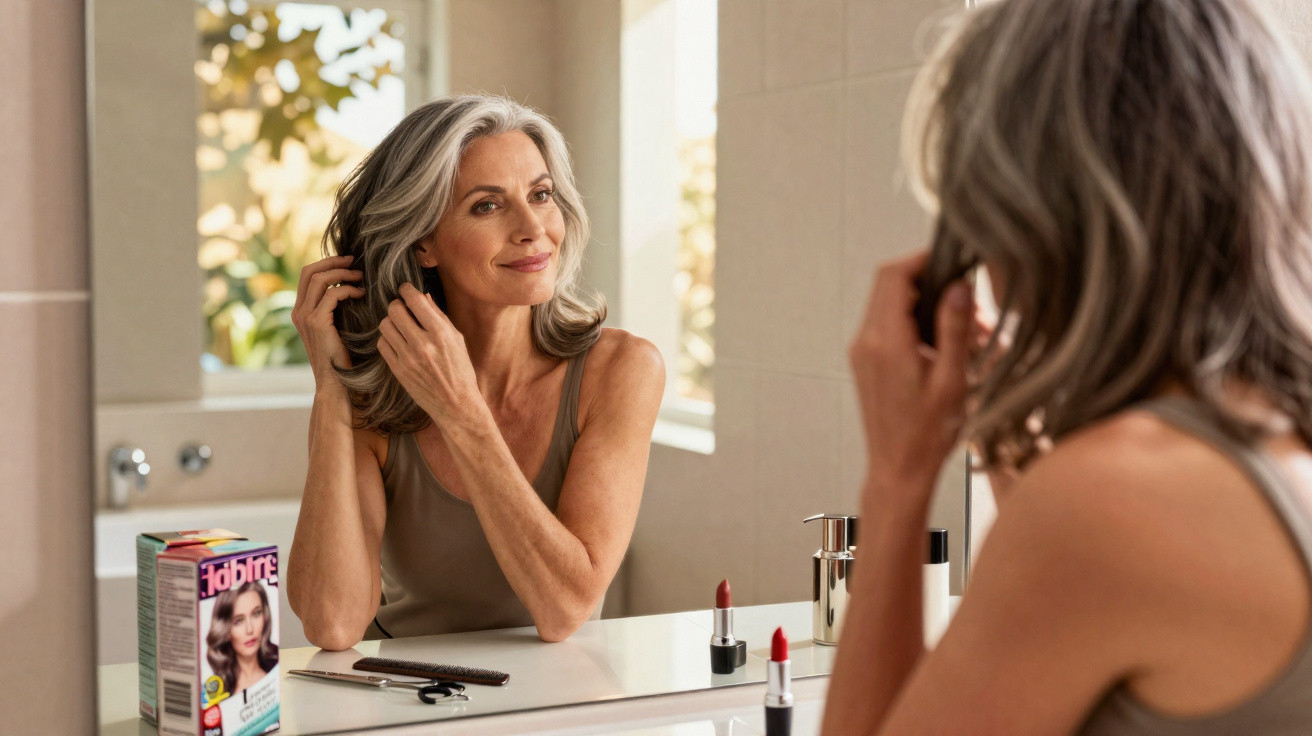
She is in her late forties, still wearing her blazer, with her laptop bag by her feet. “Make sure you cover everything,” she says, staring at the fine silver line emerging at her roots. In the chair beside her, a teenager flicks through TikTok while proudly running a hand over a precise, icy-grey bob she paid well for. Two generations, one colour, and entirely different narratives.
The contrast is even clearer outside. There is a silver bun at the pedestrian crossing, a salt-and-pepper undercut on a man in his twenties, and a woman in her sixties whose bright steel-grey hair catches the winter sunlight. No one appears to be concealing it now. And when they do, the instinct seems oddly old-fashioned.
A subtle yet radical change is moving from bathrooms into boardrooms.
Grey hair is not giving up, it’s showing up
The most noticeable thing about this “stop colouring” movement is not the grey itself, but the energy around it. Women and men are turning up at work, on Zoom calls and at family lunches with hair that at last reflects the person they see in the mirror. Some seem slightly apprehensive, as though they are about to step on stage for the first time. Others look unexpectedly unburdened, as if they have set down a weight nobody realised they were carrying.
When roots began to appear, we once called it “letting yourself go”. Quietly, that expression is becoming something more like “letting yourself be”. Grey is no longer muted or apologetic. It looks crisp, graphic and almost editorial. Whether under unforgiving supermarket strip lights or gentle café lighting, it says the same thing: this is my age, my face, my hair. No filter. No cover.
Hairdressers will tell you that the balance has shifted. A London colourist who once spent Saturdays disguising “the line of shame” now uses those same appointments to help clients deliberately move towards silver. She describes waiting lists and women arriving with images of Andie MacDowell, Sarah Jessica Parker and Glenn Close on red carpets, their unapologetic grey hair gleaming beneath the cameras. A 2023 survey by a major beauty retailer found that searches for “grey blending” and “silver transition” almost doubled over a year. Brands go where the clicks lead. Campaigns now feature models with striking white streaks at their temples rather than airbrushing them away.
This is more than a fashion moment: it quietly rewrites the script that has tied youth to desirability. Once grey becomes aspirational, the familiar map of beauty, age and life stage begins to fracture. The radical grey movement overlaps with body neutrality and anti-anti-ageing culture, as people tire of the relentless effort of concealment. Colour can be enjoyable, but it can also become a chore when you are committed to a four-week root routine. Every millimetre left untouched becomes almost political. Every silver hair declares: I am not malfunctioning, I’m progressing.
How people are actually doing the grey shift in real life
Giving up colour is anything but theoretical. It begins in intensely ordinary moments: feeling fresh, wiry strands at the crown in the shower; standing in the brightly lit chemist aisle with a hand suspended between box dyes 5.0 and 6.0; or looking in the mirror on an unremarkable Tuesday and asking: What if I just stop?
Plenty of people do not stop all at once. They have their hair cut shorter, then shorter still, to get through the two-tone stage faster. Others book a lengthy, costly salon appointment to “lift” artificial colour and merge it with their natural grey. The middle stage can be difficult. Two shades compete across the same head. One woman said she felt like “a raccoon and a rockstar, depending on the day”. During Zoom calls, the upper part of her hair was grey while the lower lengths remained old-chestnut. Eventually, she began to appreciate that contrast.
The reasons for these changes are seldom purely cosmetic. It may follow a divorce, a health scare or a promotion. A 52-year-old manager told her colleagues during a team call that she was “breaking up with hair dye” after 30 years. They laughed, but within two weeks three of them had privately asked where she found the courage. Her first meeting with her grey fully on show felt like entering the room naked. Yet nothing blew up. The project carried on, and the world did not end. Ultimately, the radical discovery was how little anyone else considered her hair radical.
The logic behind a rebellious strand of silver
Grey hair has always carried meaning. It is biological, but it also acts as a billboard for all the stories we attach to time, worth and visibility. For decades, companies presented “anti-ageing” as an obligation: conceal, remove, reverse. The radical grey trend reverses that message. Rather than battling time, it plays with it. Hair does not seek approval; it simply grows.
Psychologists recognise a familiar pattern in this. Anxiety can ease and energy can return when people stop attempting to repair something that was never broken. Opting for grey is not about abandoning beauty, but about altering the rules. You are not choosing to care less; you are caring in another way. There is less camouflage and more attention to texture, shine, cut and presence.
Society often reads grey hair on men as “distinguished”, while interpreting it on women as “tired”. That double standard is being challenged slowly but visibly. Young influencers now bleach and tone their hair silver by choice, jumping straight to the shade their mothers were taught to conceal. There is something almost absurd about that cycle. If one colour can be both an in-demand fashion statement and a feared natural development, pigment is plainly not the issue. It is the meaning assigned to it. And unlike hair, stories can be radically rewritten overnight.
How to stop colouring without hating your mirror
The first practical step is surprisingly straightforward: leave more time between your usual colouring appointments. If you normally colour every four weeks, try six, then eight. Those additional millimetres of root growth are not merely hair; they are a gradual test for your confidence and your eyes. You can adjust to the altered shade in stages rather than facing one dramatic change.
After that, alter the shape before you alter the shade. A more defined cut, a fringe, bob or layered shag can completely change the way grey hair sits. A skilled hairdresser will discuss contrast and balance, not only coverage. Ask about “grey blending” rather than solid colour: delicate highlights or lowlights that mirror your natural pattern and soften the line of demarcation.
Then move away from “colour-safe” products and towards products focused on shine. Grey strands may be drier or coarser, so they benefit from moisture and luminosity. Consider nourishing masks, serums and violet shampoos to prevent yellow tones. The aim is not to force grey hair into submission, but to make it bright enough for people to ask whether you had it done deliberately.
The hardest element is not technical but emotional. Some days, the half-grey, half-coloured stage may make you want to reach for the nearest dye and end the experiment altogether. On those days, put your hair up - quite literally. Scarves, clips, buns and hats become small survival aids rather than mere accessories. When your reflection stirs old fears about “looking old”, find confidence elsewhere: a bold lipstick, your favourite shirt or a walk with someone who is not fixated on your roots.
Everyone knows how a casual remark from a relative over Sunday lunch can hit like a stone: “Oh, you’ve stopped taking care of yourself?” That comment has ended more grey transitions than any technical error. Keep in mind that people are speaking from their own anxieties, not from objective truth. Fill your online and offline world with images of silver-haired people you genuinely find attractive. Give your mind fresh reference points.
You may also receive unexpected praise. A younger colleague might ask about your “cool streaks”, or a stranger may say that your eyes look brighter. Let those comments register too. And if you change your mind and dye it again? There is no drama. Hair grows, and decisions change with it.
“Going grey wasn’t me giving up,” says Laura, 49, who documented her transition on Instagram. “It was the first time in years I wasn’t organising my life around my roots.”
For anyone who prefers a practical approach, here is a brief roadmap:
- Begin by extending the gaps between dye appointments, allowing yourself to adjust gradually to regrowth.
- Arrange a consultation for a cut that complements your natural grey pattern.
- Choose hydrating care and a mild purple shampoo to keep silver shades luminous.
- Prepare accessories - scarves, clips and hats - for the awkward in-between days.
- Build a “grey inspiration” folder filled with faces and styles you truly love.
Grey as a quiet revolution you wear every day
What makes this grey hair trend so compelling is not simply its appearance, but the feeling behind it. There is something almost defiant about entering a room with your age visible rather than quietly disguised. In a world still preoccupied with filters and everlasting youth, exposed roots resemble small flags raised in the centre of the battlefield.
Speak to people who have made the shift and a clear pattern emerges. They talk less about hair than about time, money and mental space. Salon appointments give way to dinners, walks, naps and projects. Their inner conversation becomes gentler. One 55-year-old teacher put it this way: “My grey arrived and suddenly my to-do list got shorter by one impossible task.” The radical decision was not really about colour, but about permission.
This is how the trend subtly alters standards. Once grey no longer signifies “the end” and instead becomes “another aesthetic option”, the whole age pyramid trembles a little. Younger people can picture futures in which they do not need to erase themselves to remain visible. Older people see that they are not alone in wanting to stop the pursuit. Between them, millions stand somewhere between the dye aisle and the mirror, deciding which narrative they want to wear on their head.
The issue is not whether everyone ought to go grey. It is whether hiding it should remain the default. Beauty standards do not transform overnight because of a hashtag. They change strand by strand: in office lifts, on buses and beneath bathroom lights. One person stops colouring, then another, and soon a whole row of visible roots sits in the front seats at a conference. Someone will notice them and think quietly: maybe me, next.
| Key point | Detail | Benefit for the reader |
|---|---|---|
| Grey as a choice, not a failure | Moving from concealing “roots” to styling natural silver intentionally | Helps reframe grey hair as strength rather than loss |
| A realistic transition path | Extending time between dye sessions, blending methods, strategic cuts | Offers practical steps rather than vague inspiration |
| The emotional side of going grey | Handling comments, moments of doubt and unexpected compliments | Makes the shift feel human, achievable and less isolating |
FAQ:
- Won’t going grey make me look older straight away? Age comes from the entire picture: posture, style, skin and energy. Many people actually look fresher with their natural grey than with flat, overly dark colour that pulls the face down.
- How long does it take to fully transition to grey hair? It can take anywhere from 6 months to 2 years, depending on your hair length and growth rate. Shorter cuts speed up the process dramatically.
- Can I still look “polished” with grey hair at work? Yes. A precise cut, healthy shine and deliberate styling look professional regardless of colour. Many senior leaders demonstrate this quietly every day.
- What if I start and then hate the in-between phase? You can cut it shorter, add blended highlights, or pause and recolour. This is not a moral contract. It is hair, and you can have as many fresh starts as you want.
- Do I need special products for grey hair? Hydrating shampoos and masks, alongside occasional purple shampoo to control yellow tones, are usually enough. Let’s be honest: nobody follows a 10-step hair routine every day.






Comments
No comments yet. Be the first to comment!
Leave a Comment