
When media reports emerged in 2019 about alleged cost overruns and delays in delivering a vessel for the General Maritime Directorate (Dimar)-reports far from unusual in national defence procurement-few could have imagined that this ship, despite the doubts surrounding it, would play such a significant role in the history and development of the nation’s seas. The vessel cost just $14 million, far less than Damen’s first frigate, whose selection details remain a mystery and which, as in other cases, is shielded by the contrived argument of “national security”.
ARC Caribe and the San José Galleon recovery
The ARC Caribe, quietly overcoming its setbacks, has now achieved a landmark for the study of the nation’s history. Alongside the Colombian Navy, it presented archaeological objects in Cartagena de Indias on 19 November 2025. The items had been recovered from the Protected Archaeological Area of the San José Galleon during the second stage of the research project Towards the Heart of the San José Galleon.
On this occasion, Operation Poseidon was carried out to inspect, investigate and recover historical objects from the San José Galleon. Surface vessels with the navigational capability, positioning accuracy and offshore stability required for the task took part. They enabled the transport of equipment, Diving and Salvage units, and underwater-operations specialists, who brought the archaeological pieces from the seabed to the surface in a controlled and safe manner. Advanced robotic technology and delicate manoeuvres were used, alongside observation, verification and recording operations.
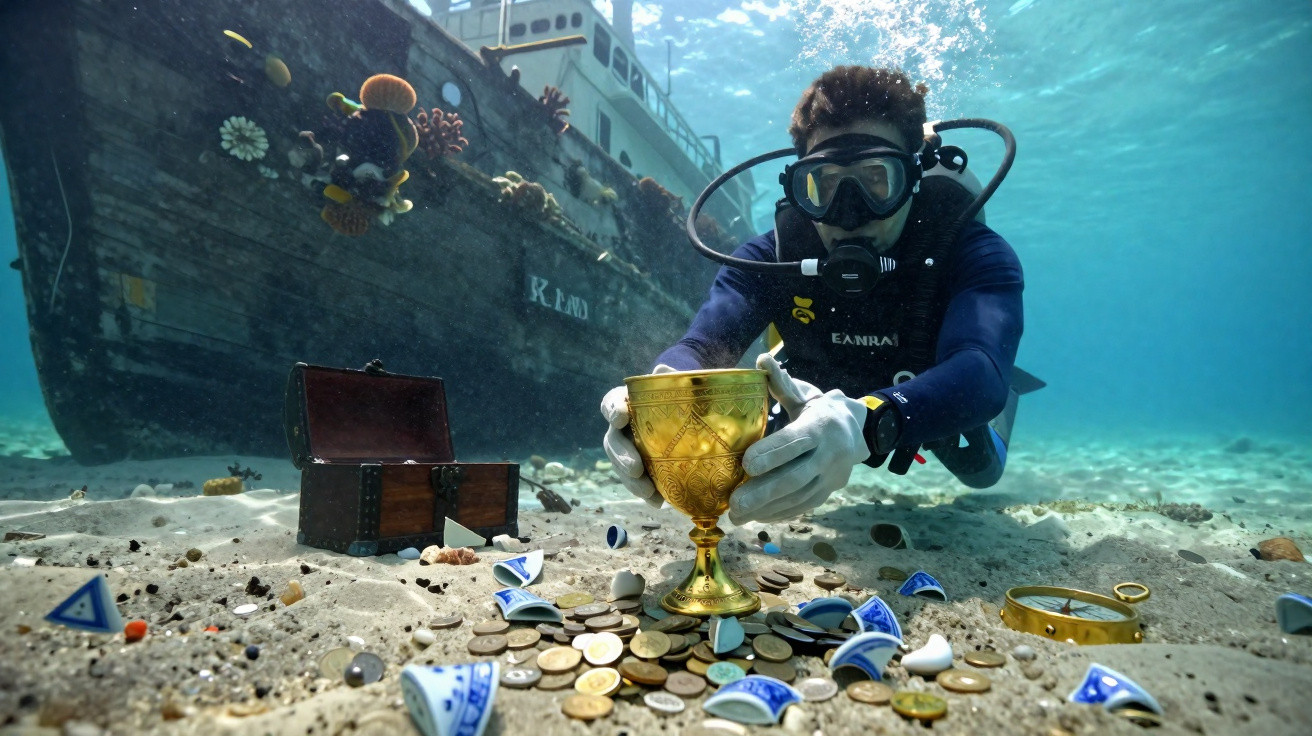
Five objects were collected: a porcelain cup, a cannon and three macuquinas (coins), as well as two porcelain fragments and sediment residues associated with those items. All of them will be placed in the care of the Underwater Cultural Heritage laboratory at the Caribbean Oceanographic and Hydrographic Research Centre (CIOH), which forms part of the General Maritime Directorate (Dimar). There, they will undergo archaeological and archaeometric examination, as well as conservation work.
The history behind the San José Galleon
This operation represents a major step towards heritage protection and historical redress. After the San José Galleon sank off Cartagena on 8 June 1708, following an English pirate attack during the War of the Spanish Succession, countries including Bolivia and Spain asserted claims to sovereignty over it.
In 1979, Colombia began active exploration in partnership with the private company Sea Search Armada, leading to the galleon’s location and certification in November 2015. The Colombian government subsequently declared the vessel to be of cultural interest in 2020.
Research project and protected archaeological area
In May 2024, the government launched the research project Towards the Heart of the San José Galleon to characterise and examine the wreck site. In December of that year, it was declared a “Protected archaeological area”. Expeditions were established using ships adapted for scientific projects-such as the ARC Caribe-and underwater robots to investigate the site. These explorations uncovered further remains, including an anchor, rings, a nail and a map containing archaeological evidence.
Exploration work continued throughout 2025, reaching this latest milestone: the recovery of artefacts through an autonomous operation independent of other countries or private companies. Today, a cup, a cannon and three coins stand for independence and the construction of the collective memory of all Colombians.





Comments
No comments yet. Be the first to comment!
Leave a Comment