
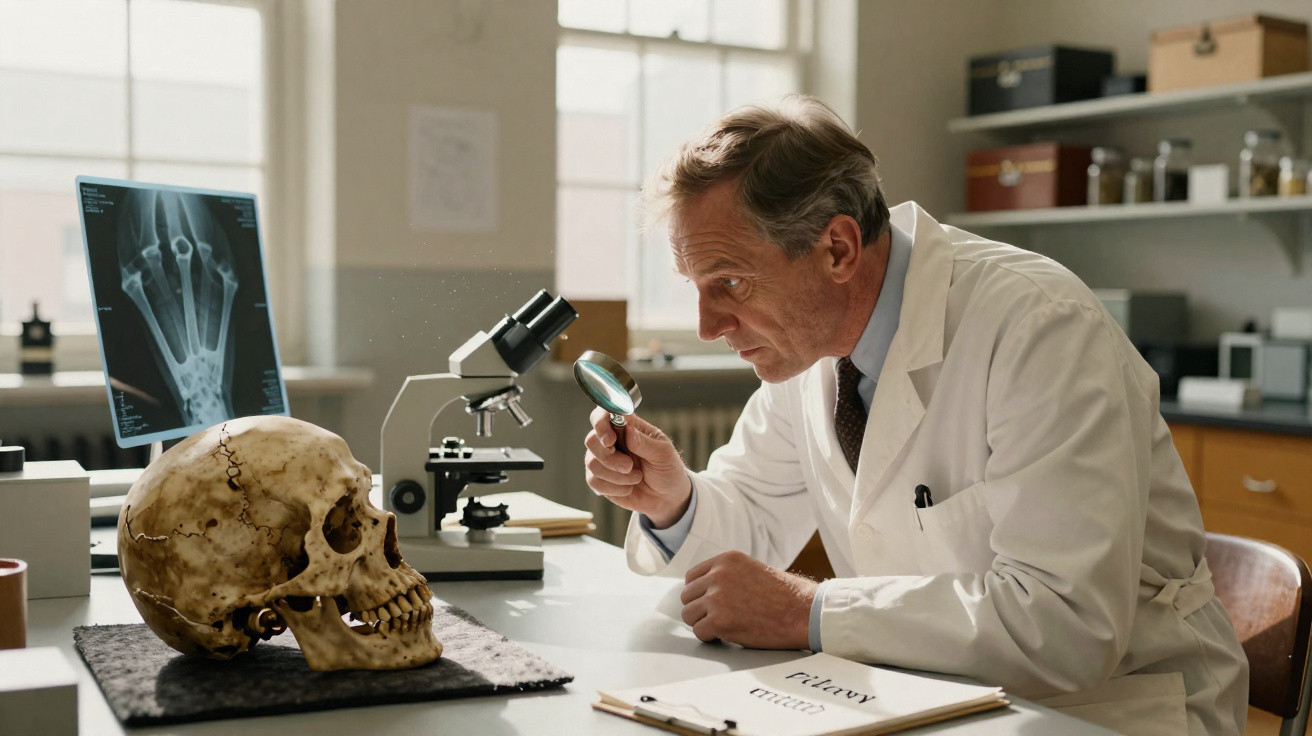
For almost 40 years, fragments presented as an unknown human ancestor featured in books, debates and scientific reconstructions. The problem was that this “fossil” never existed as a real creature. The so-called Piltdown Man combined pieces of a human skull with a primate jaw altered to look ancient, creating one of science’s most notorious hoaxes.
How did Piltdown Man emerge?
In 1912, amateur archaeologist Charles Dawson and palaeontologist Arthur Smith Woodward unveiled fragments found at Piltdown, in southern England. The material included portions of a human-looking skull and a jaw that resembled that of a great ape far more closely. The assembled specimen was named Eoanthropus dawsoni.
The find appeared to provide exactly what many researchers were seeking at the time: an intermediate form in human evolution. Although scientists raised questions from its earliest years, Piltdown acquired enormous significance and was regarded by part of the scientific community as proof of a very ancient ancestor discovered on British soil.
Why did the Piltdown Man hoax seem so convincing?
One reason lay in the expectations of the period. Some researchers believed that, in human evolution, a large brain would have developed before other modern characteristics. Piltdown fitted this view conveniently, pairing a comparatively human cranial vault with a more primitive-looking jaw.
There was also a desire to locate ancient ancestors in Europe, and particularly in Great Britain. An English fossil that appeared exceptionally old therefore met existing scientific and cultural expectations. This does not mean that everyone accepted Piltdown, but it helps explain why serious inconsistencies were not enough to destroy its standing immediately.
- In 1912, the remains were introduced as belonging to a possible unknown human ancestor.
- The skull was human, whereas the jaw belonged to a primate, later identified as an orangutan.
- The teeth had been filed down to create wear that looked more human.
- Parts of the material were artificially stained to seem older and to match the Piltdown environment.
- In 1953, fresh analyses assembled enough evidence to expose the construction publicly as a hoax.
How was the fossil revealed to be a fabrication?
As analytical methods advanced, the story began to unravel. Fluorine tests helped demonstrate that the separate pieces did not share the age assigned to the whole. More detailed examinations also established that the skull and jaw came from different species, ruling out the possibility that they represented one individual.
Microscopy provided an especially telling clue: markings revealed that the teeth had been artificially filed to make them appear more human. The bones had also been treated and stained to give them an ancient appearance. In 1953, researchers Joseph Weiner, Kenneth Oakley and Wilfrid Le Gros Clark conclusively exposed the hoax.
Watch the video shared by the YouTube channel CIENTIFICANDO™ recounting the human “missing link” “hoax”.
Whose skull and jaw were used in Piltdown Man?
Analysis established that the cranial fragments were human, while the jaw came from an orangutan. Decades later, new genetic, chemical and imaging techniques strengthened the reconstruction of the deception and indicated that the materials had been carefully altered by the same hand, with Charles Dawson considered the most likely culprit.
The forger did not need to fabricate an entire skeleton. Combining genuine parts from different sources, reshaping the teeth, changing the bones’ appearance and presenting them within a persuasive narrative was enough. The outcome demonstrates how authentic evidence can produce a false conclusion when it is removed from its context and manipulated.
What does the Piltdown hoax teach science?
Piltdown was not left unchallenged throughout those years, and new discoveries about human evolution made the specimen increasingly difficult to reconcile. Even so, it took around four decades for the fraud to be fully dismantled, making the episode a classic example of the dangers of interpreting evidence according to prior expectations.
The story also illustrates one of science’s greatest strengths: claims can be reassessed when better techniques and evidence emerge. Piltdown’s “ancestor” vanished, but its lesson remains relevant. Be especially sceptical of discoveries that seem to confirm perfectly what everyone hoped to find, because questioning compelling stories can matter as much as discovering them.






Comments
No comments yet. Be the first to comment!
Leave a Comment