
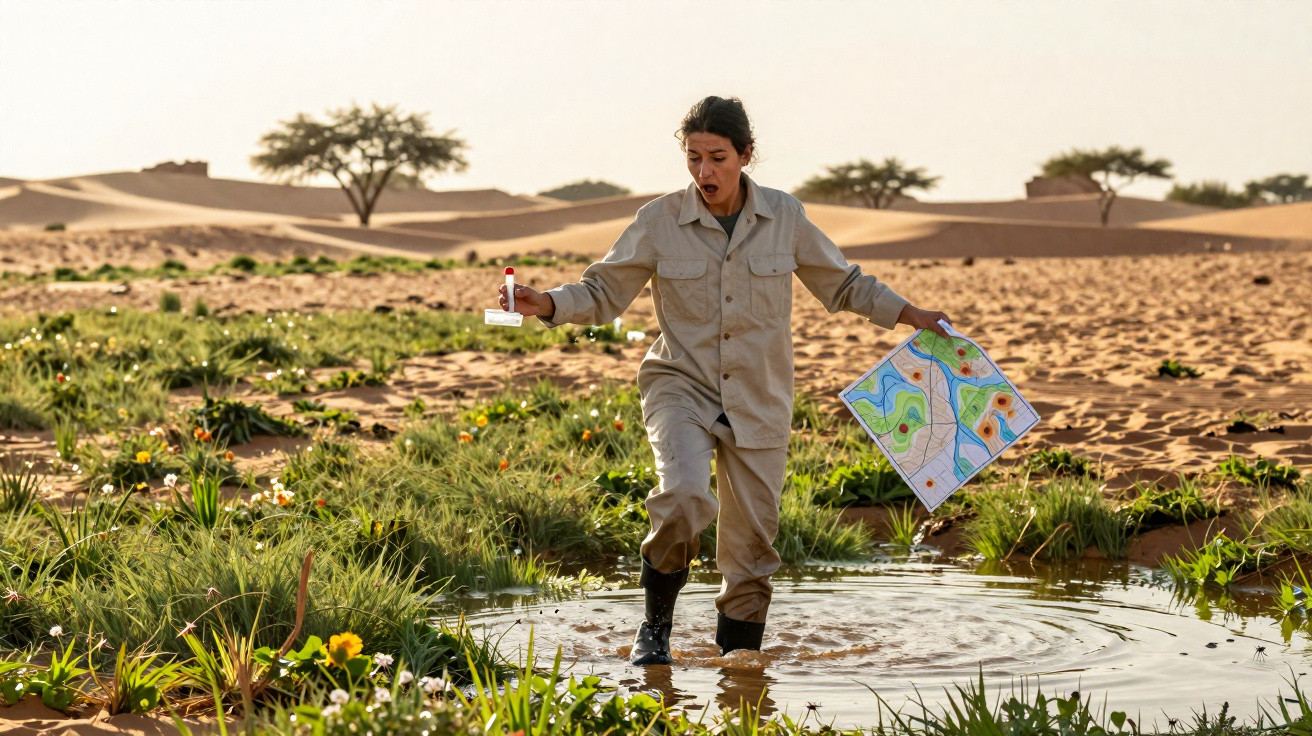
At dawn beside a track in Mauritania, sand does not look quite the same after a shower. It becomes compacted and darker, holds a few footprints and can sometimes reveal grass so delicate that it seems almost unreal. Sahara residents know these fleeting transformations well: a dry wadi turns into a trickle, goats suddenly have something to graze on, and children come outside to watch the sky as though it were a rare performance. In recent years, satellite imagery has indicated that certain parts of the desert are receiving more rainfall. The prospect of a greener Sahara is naturally compelling. Yet behind this promise of vegetation, researchers are monitoring a far less photogenic threat - one that could change everything.
When the desert receives too much water, the risk takes a different form
The Sahara is not destined to remain permanently yellow and mineral. Several thousand years ago, during the period known as the “Green Sahara”, lakes, grasslands and human communities occupied areas that are now arid. Scientists are now detecting signs that modestly echo this ancient past: more frequent rain in some parts of the Sahel and Sahara, linked to shifts in the African monsoon and warming oceans. Just a few wet days can transform the landscape. However, this water rarely arrives gently.
In September 2024, exceptional rainfall hit south-east Morocco and parts of the Sahara, temporarily refilling lakes that had been dry for decades. In the Errachidia region, images of vast stretches of water spread widely on social media because the sight appeared so unreal. Rainfall of this intensity is valuable for groundwater supplies and local crops, yet it also triggers sudden flooding. In the desert, hard ground absorbs water poorly when it falls all at once. The landscape may turn green, then become hazardous within hours.
What concerns researchers most, then, is not heat alone, despite its already dominant presence, or even the return of drought. It is the extreme irregularity of rainfall, which can alternate between abundance and disaster at a pace that is difficult to predict. A road, earthen home, encampment or oasis may be built to withstand sun and wind, but not necessarily an improvised river. The Sahara does not always lack water; it often lacks the time to receive it. That distinction completely changes how the phenomenon should be viewed.
Rainfall can sustain life… and revive forgotten threats
In response to this change, the most practical step is to improve monitoring of local rainfall events, village by village, rather than relying solely on national averages. Weather services, local authorities and residents can combine satellite warnings with straightforward markers: wadi levels, the condition of tracks and areas where water remains after a shower. Warning a family a few hours before a flood can make an immense difference. In desert areas, weather information is not an urban convenience. It becomes a form of everyday protection.
A common mistake would be to treat every green patch on a map as unquestionably good news. We all recognise the instinct: a landscape becoming green seems to signal that the world is being restored. Yet new vegetation also attracts insects, alters animal movements and can sometimes create stagnant water. These temporary environments may provide favourable conditions for certain mosquitoes and animal diseases. Let us be honest: hardly anyone checks the condition of a water point every day, particularly when they must already work, travel and support their family.
Scientists therefore call for practical preparedness, without dramatising every shower or downplaying the signs already observed. As specialists in arid climates often put it:
“The danger is not only a lack of water, but water that arrives too quickly, in the wrong place and without warning.”
The priorities most frequently identified on the ground are:
- mapping flood corridors around oases and villages;
- protecting wells and water reserves after floods;
- monitoring areas of stagnant water and insect vectors;
- adapting tracks, bridges and homes to heavy rainfall.
A greener Sahara would not necessarily be an easier Sahara to live in
The possible greening of the Sahara reveals a disconcerting reality: climate change cannot be reduced to a rising thermometer. It shifts seasons, disrupts rainfall and reshapes territories once thought unchanging. For herders, a few weeks of grass can bring genuine relief. For oasis farmers, replenished groundwater is an opportunity. But if this water destroys crops, cuts off roads or encourages disease, its benefit becomes fragile, almost cruel.
Climate models do not all predict precisely the same future for the Sahara, particularly at the scale of a valley or village. They nevertheless agree on one point: intense rainfall events are likely to carry greater weight in the daily lives of many North African and Sahelian communities. The challenge is not to choose between desert and greenery, as if looking at a postcard. It is to build territories able to withstand surprises from the sky, without leaving residents to face them alone.
This story also demands a different way of viewing spectacular photographs of dunes covered in flowers or reappearing lakes. They are beautiful, they inspire hope, and they can conceal a very immediate emergency for those living there. A greening desert does not erase vulnerabilities; it shifts them. The next time an image of a green Sahara appears in a news feed, perhaps the question will not be “isn’t it beautiful?”, but “who is ready to live with this new water?”
| Key point | Detail | Value for the reader |
|---|---|---|
| The Sahara may receive more rainfall | The African monsoon and climate warming can alter the distribution of rainfall. | Understanding that the desert is not a fixed landscape. |
| Extreme rainfall is the main danger | Flash floods and stagnant water affect areas poorly prepared for such volumes. | A clearer sense of why a shower can become a major risk. |
| Local preparedness matters | Warnings, wadi mapping and health monitoring reduce the human consequences. | Identifying practical solutions beyond simplistic images. |



Comments
No comments yet. Be the first to comment!
Leave a Comment