
Hand-drying machines in toilets are raising fresh questions after a visual experiment was widely shared on social media.
The action seems harmless: once hands have been washed, they are held beneath a blast of warm or high-speed air before people leave. Yet a demonstration involving culture dishes has put hygiene back at the heart of the discussion. On its own, the experiment cannot measure the actual risk of infection. It does, however, underline that the air in a shared toilet is never entirely neutral.
A culture dish held beneath a hand dryer
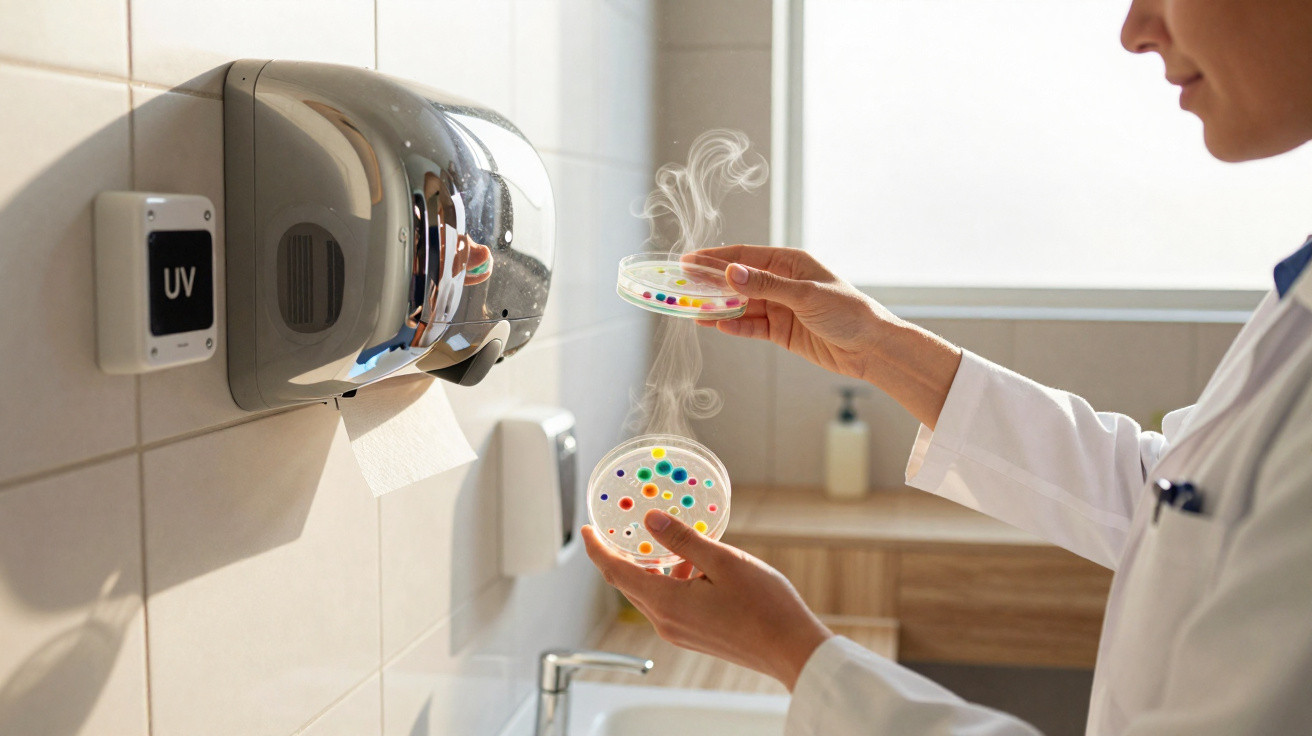
The method shown is straightforward. A Petri dish containing a medium that supports the growth of micro-organisms is placed beneath a hand-drying machine. A second dish is left exposed in a reference environment, away from the airflow generated by the appliance.
After incubation, the dish positioned under the air jet displays several coloured colonies: white, yellow and dark patches. The control dish appears far less affected. The contrast is striking at first glance and understandably raises concerns: the air that dries hands may also move particles present in the room or lodged within the machine's internal areas.
A culture dish shows the presence of micro-organisms that can grow. It is not enough to identify a bacterium with certainty or to prove a danger for every user.
This distinction is important. To establish whether a colony belongs to a particular species, a laboratory must carry out further tests. The appearance of a patch in a dish alone cannot confirm that it is a specific germ. Even so, the demonstration is useful in making one point visible: public toilets contain biological particles that can be recirculated by air.
Why an air jet can spread particles
The fastest appliances produce an exceptionally forceful airflow. Some models claim speeds of up to 643.74 km/h. This power shortens hand-drying time, but it can also lift droplets, dust and particles deposited on nearby surfaces.
In a busy toilet, there are many possible sources of contamination: door handles, flush buttons, taps, floors, walls and toilet bowls. When a toilet is flushed without the lid being closed, tiny droplets may spread through the surrounding area. Scientists refer to these as aerosols.
Hand dryers are rarely cleaned internally
The visible outer casing is often included in routine cleaning. The inside of a hand dryer, by contrast, requires technical servicing. Dust can build up in grilles, ducts and around the motor. Where maintenance is irregular, the airflow may set some of these deposits back in motion.
The demonstration also refers to a swab taken from inside a machine. The residue visible on the swab was very dark. This observation cannot establish that dangerous microbes are present, but it does raise a straightforward question for managers of heavily used premises: how often are these machines opened, inspected and cleaned?
- Toilets in stations, shopping centres and restaurants are used by large numbers of people every day.
- Machines installed close to toilets or bins are exposed to more airborne particles.
- A highly concentrated air jet may direct air towards the hands, clothing and face of a child standing nearby.
- Inadequate handwashing in the first place remains a far more direct risk than the choice of drying method alone.
The bacteria mentioned require a cautious approach
Among the micro-organisms regularly cited in this debate are Staphylococcus aureus and Escherichia coli. The former may be found on the skin or in the nose without causing illness. In some circumstances, it can lead to skin infections. The latter is linked to the digestive tract and is often used as an indicator of faecal contamination.
Their possible presence on a surface does not automatically mean that someone will become ill. Several factors must coincide: a sufficient quantity of germs, survival of the micro-organism, contact with a vulnerable area and the susceptibility of the exposed person.
The first protective step does not take place beneath the machine: it begins with careful handwashing with soap for at least 20 seconds.
People with weakened immune systems, young children, older people and anyone with an open wound may opt for an additional precaution. In a place where cleanliness appears questionable, using a single-use paper towel is a reasonable option.
Paper towels remain a practical option
Paper hand towels do not make a toilet clean by magic. They do nevertheless offer one practical benefit: they do not introduce a powerful air current into an enclosed room. They can also be used to turn off a manual tap or open a door without directly touching it with clean hands.
This option has environmental and logistical costs. Dispensers must be refilled, bins need emptying and waste has to be managed. Electric machines reduce paper consumption, which explains why they have been installed in many establishments. The issue, therefore, is not to set environmental concerns against hygiene too quickly, but to select equipment suited to the setting.
Filters and ultraviolet light may reduce the issue
Some newer models include HEPA filters. Under standardised conditions, these filters capture around 99.97% of particles measuring 0.3 micrometres. Their performance depends on correct installation and, above all, regular replacement. A saturated or poorly maintained filter loses much of its value.
Other machines use ultraviolet light inside the system. The aim is to reduce the microbial load in the ducts. This technology does not remove the need for cleaning or servicing. It must also be properly designed so that light exposure is sufficient to affect the intended micro-organisms.
Simple habits in public toilets
There is no need to panic in response to images of culture dishes. A few habits can already greatly reduce exposure to everyday microbes.
- Wash every part of the hands with soap and water, including the thumbs and the spaces between the fingers.
- Rinse thoroughly, as soap carries away loosened dirt and micro-organisms.
- Choose a paper towel where one is available and the premises appear poorly maintained.
- Avoid touching the face immediately after using toilet facilities.
- Use the towel to operate a handle or button whenever possible.
Damp hands can transfer certain microbes more easily than properly dried hands. Avoiding drying altogether is therefore not a good idea. If paper towels are unavailable, allowing hands to air-dry for a few moments or using the machine while keeping the face away offers a compromise.
The debate around these machines mainly highlights a less dramatic reality: in shared spaces, cleaning standards and maintenance matter as much as the technology selected. A clean appliance that is properly maintained and positioned well away from sources of splashes raises different questions from an old, dusty machine used continuously throughout the day.





Comments
No comments yet. Be the first to comment!
Leave a Comment