
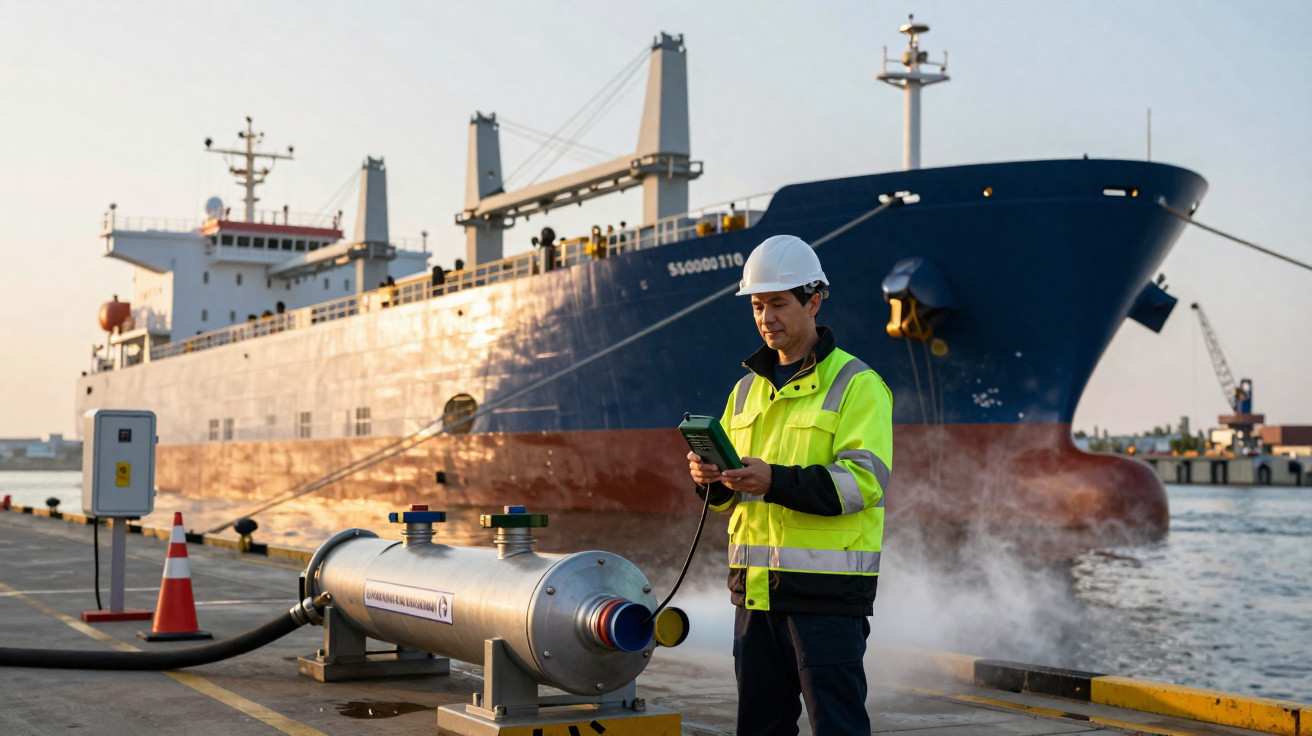
It begins in Korea, carries a Belgian flag and is aimed at cargo-scale operations.
Shipyards are entering a new chapter, with Belgium taking a prominent role. HD Hyundai Mipo has started constructing a new generation of gas carriers for EXMAR, capable of using ammonia as fuel. If delivery timetables are maintained, the ships could move the technology from industry discussion into routine service.
A quiet maritime revolution under a Belgian flag
At the heart of the development are medium-sized gas carriers built to transport liquefied gases, including LPG and ammonia, while also being able to burn ammonia as fuel. HD Hyundai Mipo is building them in Ulsan for Belgium’s EXMAR, and they will operate under the Belgian flag. Two vessels, Champagny and Courchevel, have already left the yard as part of a six-ship programme.
Its significance extends well beyond shipyard prestige. The International Maritime Organization puts shipping’s contribution at roughly 2.2% of global greenhouse gas emissions. Regulators are now placing strong pressure on vessels delivered after 2025. For owners investing in assets intended to operate for 20 years, a fuel that eliminates CO2 at the point of use can alter the calculation.
These are among the first commercial vessels built to run on ammonia-no carbon in the fuel, dual‑fuel flexibility, and safety engineered into the hull.
Why ammonia, now
Because ammonia contains no carbon, burning it does not produce CO2 from the exhaust stack. It is already transported internationally as a fertiliser feedstock, providing an initial infrastructure base for bunkering. By volume, it has greater energy density than hydrogen, and can be stored at moderate pressure or refrigerated, both of which are established practices aboard gas carriers.
The challenge lies earlier in the supply chain. Only “green” ammonia, made using renewable hydrogen, can significantly reduce lifecycle emissions. Blue ammonia, produced from natural gas with carbon capture, can cut emissions, but its performance relies on capture rates and methane management. To substantiate climate claims, operators will require fuel traceability and reliable certification.
Inside the dual-fuel design
The vessels feature a dual-fuel configuration, combining conventional marine fuel as a back-up with a main engine able to use ammonia. Selective catalytic reduction reduces nitrogen oxides, while a shaft generator helps extract further efficiency from the main engine. By avoiding dependence on a single fuel source, the arrangement lowers transition risk during the early years of adoption.
The numbers that matter
| Metric | Value |
|---|---|
| Length overall | 190 m |
| Breadth | 30.4 m |
| Cargo volume | Up to 46,000 m³ liquefied gas |
| Deadweight range | ~70,000–85,000 tonnes |
| Fuel options | Ammonia and conventional marine fuel (dual‑fuel) |
| Emissions controls | SCR for NOx; dual‑fuel engine management |
| Operator | Exmar LPG France (EXMAR) |
| Target service | Q2 2026 |
First voyage window: second quarter of 2026. Series size: six ships. Mission: move LPG or ammonia, burn ammonia when available.
Safety by design
As ammonia is toxic, the design places substantial emphasis on prevention, detection and containment. Fuel tanks are separated from accommodation areas. Pipework is routed through ventilated trunks, while real-time gas sensors monitor for leaks. Water-spray systems can suppress vapour clouds. Further mitigation equipment is intended to contain and scrub any unplanned release.
Safety features at a glance
- Continuous ammonia leak monitoring throughout machinery and fuel spaces
- Dedicated water deluge systems to suppress vapour along fuel lines
- Separation of tanks and pipework from accommodation and control rooms
- Ventilation and purging equipment with controlled discharge locations
- Selective catalytic reduction to control NOx during ammonia combustion
Who runs these ships and where they fit
EXMAR will operate the vessels through Exmar LPG France, creating an additional element within its gas-shipping portfolio. The carriers can work on ammonia trades, LPG routes or blended contracts as ammonia bunkering is tested and expanded. That operational flexibility can help maintain high utilisation while the fuel market develops.
Ports already equipped to handle ammonia for fertiliser use have an advantage. Once appropriate bunkering hoses, vapour-return systems and emergency-response plans are in place, they can progress from cargo handling to supplying fuel. When a vessel has been designed for ammonia fuel from the outset, the time required for retrofit work is reduced.
How this changes the cost curve
Short-term economics will depend on the difference between fuel prices. Green ammonia is still costly, although policy incentives and carbon pricing can reduce the disparity. Dual-fuel capability offers operators protection: ammonia can be used where availability and pricing are favourable, with conventional fuels available where they are not.
What this means for shipping, ports, and fuel producers
Shipping operators obtain an early route towards meeting CO2 targets, as well as a tangible response to cargo owners seeking cleaner transport. Ports gain a scalable, internationally traded fuel around which to develop bunkering services. Producers gain an initial group of dependable customers for green ammonia plants linked to wind and solar power.
Technical development will accelerate once the vessels are operating commercially. Engine maps can be improved, start-stop approaches can be refined and crew procedures can be strengthened through drills. Information gathered from these six ships will influence class rules, training guidance and insurance conditions.
Risks, open questions, and what to watch
- Nitrous oxide control: engines need to limit N2O formation, a powerful greenhouse gas, and demonstrate performance through stack measurements.
- Fuel certification: owners will require dependable guarantees of origin to recognise climate gains within regulatory schemes.
- Bunkering readiness: common hose standards, emergency shut-off arrangements and crew training across ports will determine availability.
- Supply ramp: green ammonia production needs to expand in line with vessel schedules, rather than only industrial demand.
- Insurance and liability: new contractual clauses will set out responsibilities when fuel incidents occur alongside a berth.
Extra context for readers
Key term to know: green vs. blue ammonia
Green ammonia is made with hydrogen generated by water electrolysis powered by renewable energy. Blue ammonia uses hydrogen derived from natural gas alongside carbon capture. The former aims for near-zero lifecycle CO2, whereas the latter reduces emissions but depends on capture effectiveness and methane control.
A quick thought experiment
Consider a seven-day journey using ammonia rather than very low sulphur fuel oil. CO2 from combustion at the stack falls to near zero, while SCR reduces NOx. Where the ammonia is green, lifecycle CO2 drops considerably; where it is blue, the reduction is less pronounced. Monitoring N2O and slip then becomes the deciding factor in the overall climate effect.
Where the next breakthroughs may land
Further progress is likely to include quicker fuel-injection systems for dependable ammonia ignition, better catalysts for addressing NOx and N2O, and standardised ship-to-ship bunkering packages. Crew preparation will move from classroom learning towards simulator sessions and live drills. Charterers will begin requesting fuel-mix clauses in agreements, connecting freight rates with verified low-carbon voyages.




Comments
No comments yet. Be the first to comment!
Leave a Comment