
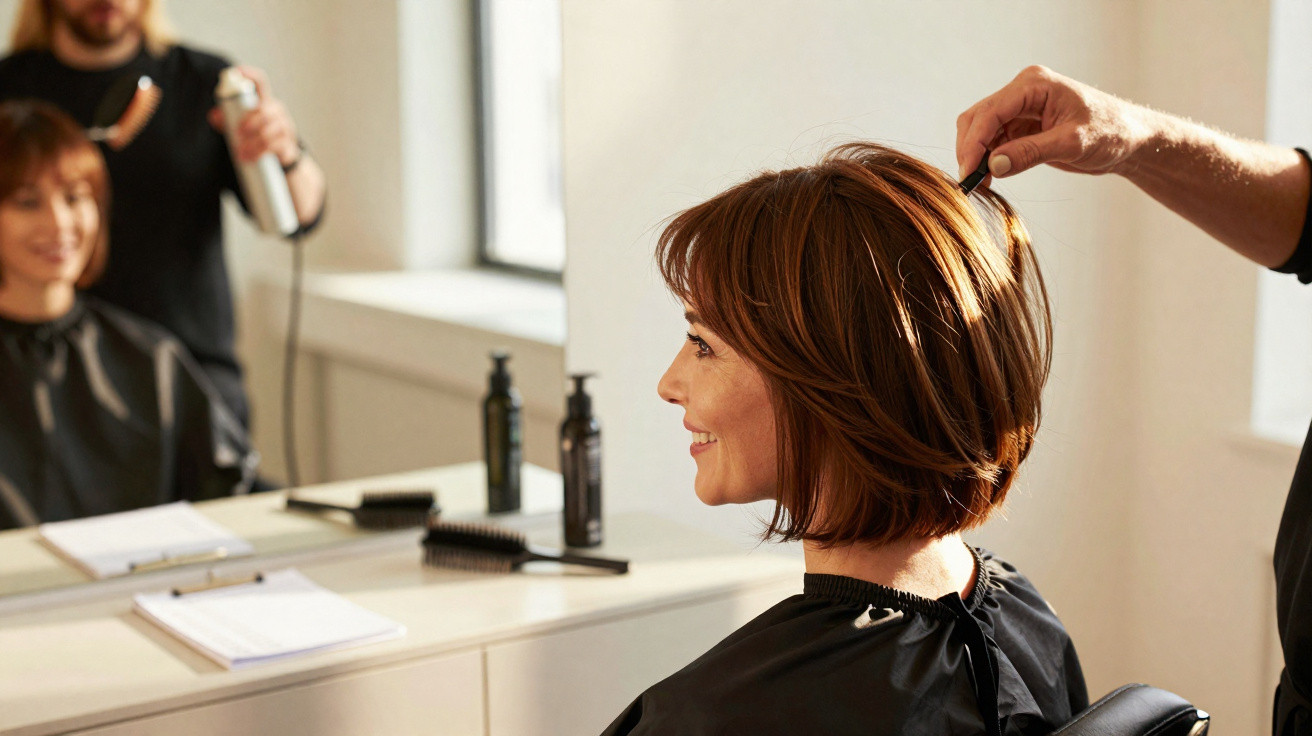
Saturday morning, 9:12 a.m., and the salon is already alive with chatter. In the third chair, a woman exhales as she sees herself beneath the harsh ring light. Her shoulder-length hair is sleek and smooth, yet the diagnosis is the one she has heard for three years: “It’s a bit flat on top.” Her stylist raises the crown with a comb, adds spray, teases it slightly and smiles. It looks brilliant for ten minutes, before gravity takes over on her walk home. By afternoon, the volume is gone and the top of her head resembles a fallen soufflé.
While her colour develops, she scrolls through her phone and pauses at one phrase: “the haircut that lifts the crown after 40.”
She glances up, touches her roots and asks softly:
“So… what is that cut, exactly?”
Why hair falls flat at the crown after 40
For many women, somewhere between 40 and 50, hair seems to alter the rules overnight. A blow-dry that once lasted three days may lose its body by lunchtime. A style that previously created easy root lift can start to look sleek, weighty and almost pressed against the scalp at the crown.
Many women blame their own styling ability or decide they simply “don’t know how to do their hair.” Yet the cause is often more fundamental: the structure of the haircut itself. A cut that draws its weight downwards compresses the crown. One designed to create lift can make the top appear to float almost naturally.
Consider Sophie, 47, who arrived at a small city salon with a common concern: “I look like I’ve slept on my head all day.” Her hair was long and almost entirely one length, with only light layers through the ends. It was healthy and glossy, but strikingly flat from the front. In photographs, the back of her head appeared to drop straight down, with no gentle curve or subtle fullness.
Her stylist proposed a modest adjustment: retain the face-framing length while cutting invisible layers into the crown, just above the occipital bone. After twenty minutes of precise cutting, the back of Sophie’s head had shape again. As she shook out her hair, the top lifted by itself. No backcombing. No hairspray helmet. Only air and movement.
This flat-crown effect commonly results from three factors meeting at once: slower hair growth, strands becoming slightly finer, and haircuts that are too uniform in length. Long, heavy sections pull the whole shape down, flattening the parting and revealing the scalp in strong light. After 40, many women also find one side of the crown becomes thinner, making the effect more pronounced.
A thoughtfully cut shape can counteract all of this, while a poorly planned one can draw attention to it. The answer is not always to go shorter; it is about positioning the shortest, lightest area directly at the crown, so the eye notices lift rather than collapse. This is precisely where one modern haircut excels.
The soft crown bob: volume where it matters most
The haircut that discreetly helps women over 40 tackle a flat crown is a modern bob with light layering and a “soft bump” at the back. Think of it as the soft crown bob. It is neither the rigid stacked bob of the 2000s nor a blunt, boxy cut that deposits all its weight at jaw level. Instead, it combines subtle graduation at the nape with exceptionally gentle layers at the very top of the head.
From the front, the result appears uncomplicated and effortless. Viewed from the side, however, there is an elegant curve at the crown, almost like a natural push-up for the profile. It may fall to the collarbone or sit midway down the neck, but one detail is essential: the shortest, lightest point sits around the crown, allowing that area to rise.
Picture someone turning their head in a café. You notice it at once: gentle roundness at the back of the head, hair softly following the neck and a top section that looks almost “aired out.” That is the shape to seek.
One Paris colourist describes the change this way: “Women come in saying they look tired from the side. We adjust the bob, carve out volume at the crown, and suddenly their silhouette looks alert again.” Stylists often say that the crown is the “volume zone” with the greatest effect on whether a hairstyle appears youthful or tired, sometimes even more so than length. A heavy, drooping crown suggests fatigue; a raised crown conveys lightness.
Layers are not needed everywhere. What matters is intelligent layering in this single, targeted area.
The reason this cut works so well against flatness is straightforward. Hair naturally drops towards its longest point. When the longest and heaviest hair is positioned at the crown, the entire style sinks onto the scalp. Shorten and lighten that upper section slightly, and it lifts before it falls. In effect, you are moving the centre of gravity.
A soft crown bob also makes the parting look smaller. Added height at the crown makes the visible scalp line appear narrower and softer. That alone can make hair seem denser, even when its actual density is unchanged. After all, people do not inspect individual hairs in photographs; they notice shape and shadow. When the shadow at the crown curves outwards rather than inwards, the whole head appears fuller.
How to request and style a soft crown bob
Begin by setting aside the words “just a trim.” To overcome a flat crown, talk about shape rather than centimetres. Once in the chair, try saying: “I want a bob or lob that has a gentle bump at the back of the head, not flat. Lighter at the crown, a bit closer in at the nape, and not too thinned at the ends.” Bring side-profile photographs as well as front-facing ones.
Ask your stylist to identify your occipital bone, the small curve at the back of the skull that serves as the key reference point. Graduation should begin just below it, with subtle layering placed immediately above it. Styling at home then becomes simpler: while drying, raise this section with a round brush or a large Velcro roller, then allow the remaining hair to fall naturally around it.
The major risk is excessive layering or thinning. If the crown is cut into too many short pieces, it can stick up in spikes before dropping flat again after two hours. If the ends are aggressively thinned, they become wispy rather than light. The result is the dreaded “triangle”: a flat top, broad bottom and uneven outline.
Cutting a bob too bluntly and heavily along one line is another frequent error. It can appear stylish on the first day, but once natural oils develop at the roots, the top clings to the scalp. Be gentle with yourself here. You are not “bad at hair.” More likely, you are trying to work with a cut that was not designed for your texture, lifestyle or hormonal reality. A very small adjustment to the graduation can achieve more than three new volumising sprays.
“Women tell me, ‘I thought I needed more products, but I just needed a different shape,’” confides Mara, a stylist with 20 years behind the chair. “When the cut supports the crown, they finally stop fighting their hair every morning.”
- Ask for a soft crown bob with gentle graduation at the nape and discreet layers through the top.
- Avoid heavy one-length cuts that concentrate all the weight at, or immediately below, the crown.
- Blow-dry by lifting the crown first and smoothing the lengths afterwards; the sequence matters.
- Use products as support, not as crutches - with the right cut, a light root mousse is sufficient.
- Schedule a small reshape every 8–10 weeks so crown layers do not grow out and become flat again.
What happens when the crown has lift again
When the crown finally develops that soft lift, the reflection changes in subtle ways. The face can look more open, cheekbones slightly more elevated, and the jawline softer without appearing to sag. Even ponytails sit differently, with natural fullness at the top instead of drawing everything backwards into one flat sheet. Women often report feeling “finished” with less make-up simply because the outline around the head looks more structured.
This cut can make mornings easier, too. Rather than battling with a round brush for twenty minutes, you can tip your head forward, roughly dry the roots, set one large roller at the crown for five minutes while drinking coffee, then leave the house. We all know that thought: “I have the products, I have the tools, why does it still look… meh?” Quite often, the blueprint is simply wrong.
Once you describe hair in architectural terms - bump, curve, weight and crown - rather than only “shorter” or “longer”, discussions with stylists become different. Take along side-profile images you like and explain that you want the crown to appear rounded and light, not flat and straight. Ask which version of the soft crown bob is suitable for your texture: straighter hair can take cleaner lines, while wavy hair benefits from softer ones.
A flat crown is neither a life sentence nor proof that you have somehow “let yourself go” after 40. It is simply a mismatch between your hair’s biology today and a haircut that suited yesterday. Volume at the top is not about attempting to look 25 again. It is about allowing your face to sit beneath a shape that lifts it, both literally and visually. Often, that is enough for you - and everyone else - to see you differently.
| Key point | Detail | Value for the reader |
|---|---|---|
| Soft crown bob structure | Light graduation at the nape, gentle layers at the crown, clean but not blunt perimeter | Creates automatic lift at the crown without heavy styling |
| Focus on the occipital area | Shorter, lighter sections around and above the occipital bone | Creates a rounded profile and lessens the “flat back of the head” effect |
| Simple daily routine | Dry the crown first with lift, use minimal product, refresh with one roller if needed | Saves time, reduces frustration, and maintains volume all day |
FAQ:
Should women over 40 always cut their hair shorter to get volume at the crown?
Not necessarily. You can retain some length, but the shape around the crown needs to be lighter and more graduated. A collarbone-length soft crown bob often provides more lift than a very short crop cut to one uniform length.Will this haircut work if my hair is very fine?
Yes, provided the crown layers remain subtle and the ends are not excessively thinned. Fine hair often reacts well to minor structural changes because every millimetre of lift is noticeable.What should I tell my stylist so they don’t remove too much volume?
Explain that you want a soft bump at the crown rather than aggressive layering, and that you want the perimeter to stay full-looking. Ask them to cut less initially and make adjustments gradually.Do I need special products for this cut to work?
A light root-lifting spray or mousse may help, but the cut itself does most of the work. Prioritise how you dry the crown over buying three new volumising products.How often should I refresh the soft crown bob?
Every 8–10 weeks is ideal, preventing the crown layers from becoming too long and collapsing. Small, regular reshapes preserve the architecture and keep volume consistent.






Comments
No comments yet. Be the first to comment!
Leave a Comment