
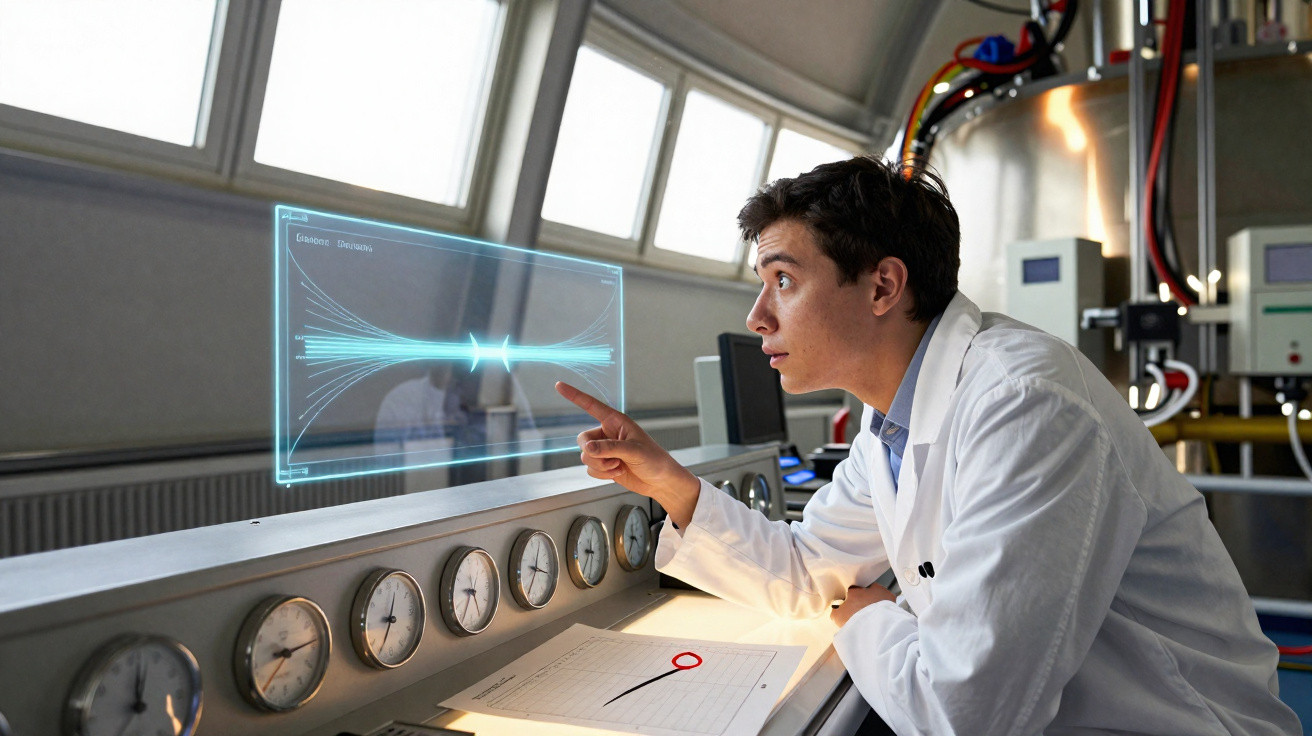
A disturbance in timing at the world’s most precise machine is the rumour circulating through CERN this week. A solitary microsecond is appearing where none ought to be-and it is disrupting the account told by particle data.
An engineer gestured with an expression caught between a grin and a frown: a run of proton collisions had arrived a fraction late, as though the universe had blinked and lost track for an instant. Nobody panicked-people at CERN do not panic-but their posture changed. Coffee cups stopped on their way up, keyboards fell silent and eyes turned towards the timing dashboards. The entire room seemed to pause for breath. The late events were minuscule, just a microsecond, but their timing would not agree with the clock. There was an absence where there should have been none. Then another trace on the screen shifted out of alignment. And another.
A microsecond that refuses to disappear
The team had not found an isolated fault. Instead, there was a pattern: intermittent, persistent and coherent enough to feel unsettling. During runs in which trigger logic, fibre links and detector subsystems should have operated in exact synchrony, several captured collision events were recorded one microsecond away from the predicted timing. In accelerator physics, that is an immense interval. LHC crossings occur every 25 nanoseconds, while the electronics are adjusted at picosecond precision. Yet the data seemed to say, almost mischievously: this is your drift. It returned across thousands of events-too orderly to disregard, but too irregular to declare understood.
The figures carry their own message. Over a week of fills at mixed intensities, diagnostic records marked roughly 0.07% of events with a microsecond-scale discrepancy between predicted and timestamped arrival times. It was neither a deluge nor a negligible rounding discrepancy, but a steady, quiet stream. In one overnight run, engineers singled out a sequence from a high-granularity calorimeter module and compared its timestamps with the beam pick-up monitors and the machine’s 40 MHz master clock. The offset persisted after hardware was re-synchronised, software restarted and fibre delays recalibrated. It even appeared briefly during a low-luminosity calibration fill, precisely when conditions ought to have been uneventful. Uneventful is valuable. This was not.
What could explain it? The careful answer is an ordinary one: clock skew, ageing cables, an odd firmware behaviour in a trigger board, or a buffer queue stumbling under a particular rate pattern. White Rabbit synchronisation, which normally achieves sub-nanosecond alignment, may nevertheless be affected by asymmetries and temperature gradients. However, the results invite more expansive speculation. Should the offset prove genuine-not an artefact or alignment drift-some researchers are quietly considering time-symmetric models and quantum histories that split and reunite. It is an old, radical proposition: reality may sample several internally consistent timelines, with interference producing large-scale timing signatures. On that view, the microsecond could be a mark left where two histories have brushed against one another.
Hunting the anomaly in CERN’s clocks
The current approach is uncompromisingly straightforward: trap the delay until it has no place remaining to conceal itself. Engineers are placing portable caesium clocks at several points to verify the master timing chain, then tracing each signal route like investigators. Fibre lengths are being measured again and adjusted first to the metre, then to the centimetre. They are also using timing beacons-brief, labelled pulses inserted into the network-to generate reference “pings” that expose jitter, latency and asymmetry at every hop. Attractive graphs are not the objective. They need decisive evidence: one component that fails at precisely the moment the data do.
Several precautions are strikingly human. Staff are recording room temperature, time of day and even restart sequence, in case a plume of heat or a sleep cycle pushes the system into unusual behaviour. Files are being versioned as though it were 1999, with plain-text change logs fixed to the wall. Frankly, nobody maintains that routine every day. But when one microsecond could overturn a billion-euro narrative, every possible safeguard becomes necessary. For anyone reading at home, the parallel is simple: if something small repeatedly slips through your grasp, slow everything down and measure each gap individually.
The search has an element of empathy, because the divide between a “bug” and a “breakthrough” is exceptionally narrow. On a good day, that is exhilarating; on a bad one, it is sobering. One team member put it simply: we’re calibrating our confidence as much as our clocks.
“If it’s hardware, we’ll find it. If it’s software, we’ll fix it. If it’s physics… we’ll earn it.”
- Reference clocks: Compare GPSDO, caesium and the machine’s 40 MHz signal to triangulate any drift.
- Path audits: Chart every nanosecond of latency from fibre, switches and FPGAs at different loads.
- Event mirroring: Re-run buffered collisions with synthetic triggers to identify deterministic delays.
- Thermal runs: Vary temperatures to uncover concealed timing dependencies in boards and cables.
- Blind analysis: Divide teams so that interpretation cannot steer instruments towards a preferred explanation.
What the CERN microsecond delay might mean-and what it does not
This is where the issue becomes difficult: a one-microsecond delay occupies an unusual middle ground. It is too large for a conventional quantum effect, yet too small for the sort of mechanical error identifiable with a spanner. If it withstands the coming battery of tests, it could shift discussion towards interpretations with genuine philosophical consequences. In some models, parallel quantum timelines are not science-fiction imagery but mathematical frameworks for describing consistent histories and the way measurement selects among them. A detectable timing shift might represent evidence of that selection-the world settling on one version of itself one beat later than anticipated. That doesn’t mean we’re hopping universes between coffee sips. It suggests that the timing of “when reality becomes classical enough to stamp a clock” could be more complex than textbooks imply.
Everyone knows the sensation of time becoming strangely elastic: minutes in a waiting room that feel like an hour, or a conversation that finishes before you are prepared for it. This is plainly not that, although the feeling has a resemblance. By inclination, engineers do not pursue resemblances; they pursue reproducibility. If the delay tracks beam intensity, crossing angle or even the trigger pattern in the Level-1 pipeline, then the explanation is mechanical. If it instead tracks event topology-for example, entangled decay channels appearing in subtly different subdetectors-the explanation becomes more unusual. The team is planning runs intended to make one of those accounts reveal itself.
It certainly does not amount to proof of multiverses, popular-science spectacle or a flaw in relativity. A microsecond remains an eternity beside the femtosecond-scale processes within a collision. The likeliest outcome is a measured shrug followed by a firmware patch note. Even so, the investigation has worth. When you drag a system through its paces to corner one misbehaving microsecond, you learn a thousand ways your certainty was a little too neat. That is how real breakthroughs tend to emerge: first as a maintenance task, then as a lecture, and only afterwards as a headline.
You need not be an accelerator physicist to understand the attraction of a truth arriving late. The image lingers: a particle event trying to communicate, its timestamp falling just off the beat, its plotted line shifting by a fraction that cannot be overlooked. Perhaps the final report will be mundane but admirable: a cable was responsible, it was repaired and everything is well. Perhaps it will become a footnote cited a decade from now as the catalyst for a new form of timing analysis. Or perhaps, against expectation, it will remain a genuine anomaly-the kind that forces open a doorway. Whatever happens, the work remains profoundly human. It demands patience, curiosity and the persistent grace of people who measure time so precisely that time occasionally resists them.
| Key point | Detail | Why it matters to the reader |
|---|---|---|
| Microsecond delay | Sporadic 1 µs offset in collision event timestamps across runs | Draws attention and shows why a “tiny” figure matters |
| Two live hypotheses | Timing-chain artefact versus genuine physics linked to event topology | Helps you assess conventional and mind-bending explanations |
| How they will test it | Clock triangulation, path audits, mirrored events, thermal sweeps and blind analysis | Allows you to follow the inquiry as though it were a detective story |
FAQ
- What exactly is delayed? A subset of recorded collision events receives a timestamp about one microsecond later than the machine’s timing model predicts, after known trigger latencies have been taken into account.
- Does this prove parallel quantum timelines? No. It points towards intriguing interpretations only if dedicated tests eliminate hardware, software and synchronisation explanations.
- Could this simply be a clock issue? Yes. Drift, fibre asymmetry, trigger-board firmware or thermal effects may all create microsecond-scale discrepancies in particular conditions.
- When will we know more? Engineers are conducting controlled tests during the next cycles, matching the delay against beam settings and event types. Preliminary notes are expected before any peer-reviewed claim.
- Why should I care? Because, whether it ends as a repair or a discovery, the pursuit shows how knowledge is made. One rogue microsecond can redraw the map of what we consider certain.






Comments
No comments yet. Be the first to comment!
Leave a Comment