
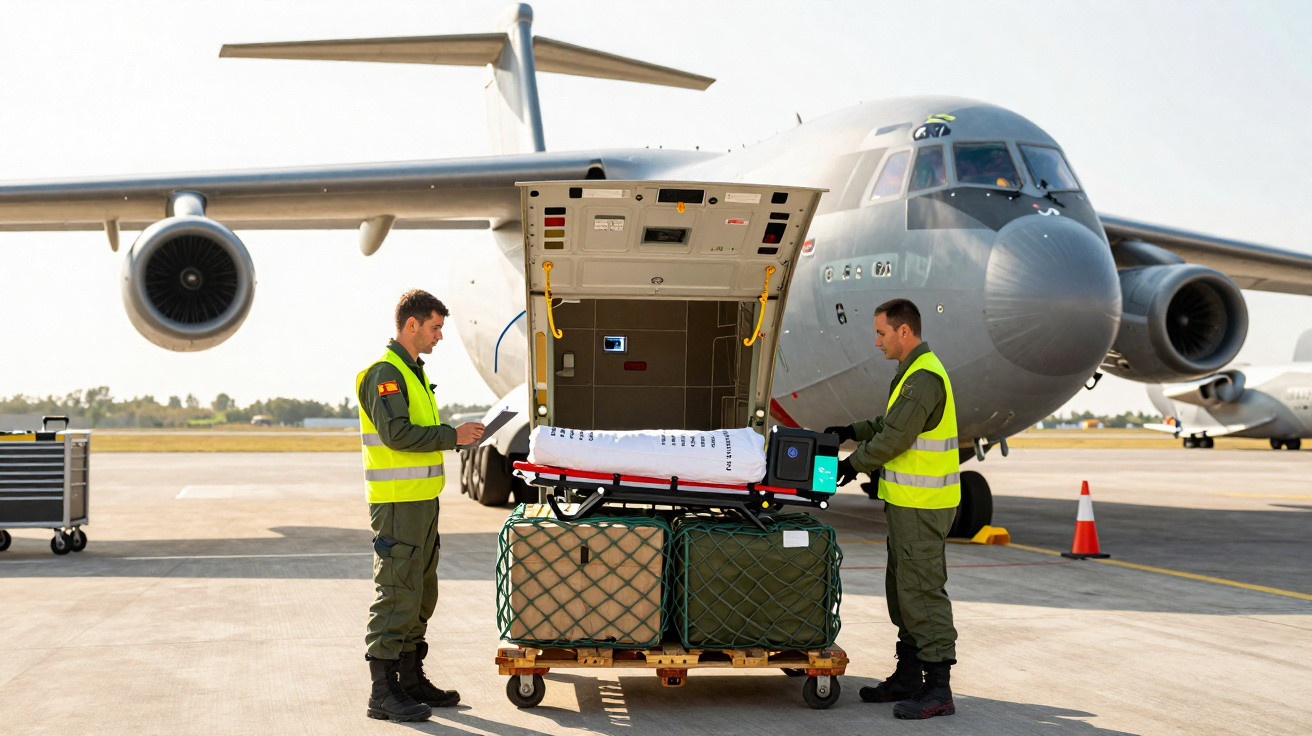
Spain has opted to retain a larger number of its Airbus A400M Atlas transport aircraft than it had previously intended, recasting its airlift capacity amid financial pressures, the war in Europe and a renewed emphasis on strategic autonomy.
Spain’s A400M story: from cuts to expansion
When the future transport aircraft (ATF) programme began in 2001 and was awarded to Airbus, Spain committed to purchasing 27 A400M airlifters. The objective was straightforward: replace ageing transport aircraft while establishing Spain as a key industrial and military partner in Europe’s air-mobility network.
The eurozone debt crisis subsequently transformed those plans. Madrid had to make major spending cuts by 2013, reducing the Spanish Air and Space Force’s, or Ejército del Aire y del Espacio’s, intended A400M fleet to only 14 aircraft. All 14 have since been delivered, with the last arriving in 2023.
However, 13 additional aircraft remained under contract, due for delivery from 2025, despite there being neither a budget nor a defined operational requirement for them.
Attempts to offload surplus aircraft
In an effort to avoid accepting aircraft it could not afford, Spain sought customers for the surplus A400Ms. South Korea featured on initial lists of potential buyers, alongside Jordan and Turkey, which is itself an A400M programme partner.
None of these discussions resulted in a binding agreement. For years, the additional airframes largely remained a paper commitment, symbolising ambitions formed before the crisis and constraints that followed it.
Instead of selling off its A400Ms, Spain is now preparing to keep more of them – and to use them in new, specialised roles.
What has changed for Madrid?
Operational experience proved decisive. Spain deployed its A400Ms extensively during evacuation operations from Afghanistan in 2021 and subsequently from Sudan. Combining range, payload capacity and the ability to operate from rough airstrips, the aircraft offered Madrid a dependable means of carrying out rapid and complex evacuations under pressure.
Defence officials recognised the significance of this. Rather than being solely an industrial obligation, the A400M had demonstrated its value as a reliable lifeline during unstable crises.
In 2023, Spain and France signed a letter of intent to accelerate deliveries of three further A400Ms. This had two aims: strengthening the fleets of both countries and helping Airbus maintain A400M assembly lines until at least the end of 2028.
A new target: 20 aircraft by 2029
Spanish specialist publication InfoDefensa reports that Madrid intends to increase its A400M fleet to 20 aircraft. Defence documents released recently indicate that the A400M programme received additional funding around the middle of 2025, quietly changing the course of Spain’s transport-aircraft plans.
The Spanish Air and Space Force is expected to operate six extra A400Ms by 2029, raising its fleet from 14 to 20 aircraft.
This still leaves uncertainty over the final seven aircraft from the original commitment of 27. Spain remains contractually committed, but could renegotiate, postpone or redirect those airframes according to political decisions and European demand.
New configurations: more than just a cargo hauler
Spain’s revived interest in the A400M is partly driven by the aircraft’s continuing development. Airbus is advancing a range of specialist modules and configurations that extend well beyond conventional troop and cargo transport.
Madrid is paying particular attention to roles that are either being developed or reaching maturity:
- Firefighting module for large-scale aerial firefighting campaigns
- Launch platform for drones and air-launched unmanned systems
- Search and rescue missions over land and sea
- Electronic warfare and signals intelligence payloads
Some of these capabilities remain under test, whereas others could be introduced as kits installed when required. For a medium-sized nation such as Spain, the option to adapt one platform to several missions is particularly attractive.
Upgraded protection: Inshield missile defence
Spain is also fitting its A400Ms with new defensive systems, especially the Inshield anti-missile system developed by Spanish technology group Indra.
Inshield is designed to identify and counter incoming missiles, increasing the aircraft’s survivability in hostile settings. This is important for evacuation operations, humanitarian flights into unstable areas and missions conducted close to active front lines.
By combining transport capacity with electronic protection, the A400M becomes not just a large cargo aircraft, but a survivable asset for high-risk operations.
The budget: from 3.4 to over 6.5 billion euros
These developments come with a substantial cost. Spain’s own budget documentation puts the original A400M programme funding allocation at approximately €3.452 billion.
Costs have now nearly doubled, exceeding €6.5 billion. The increase reflects several factors, including schedule revisions, configuration improvements, inflation and the inherent expense of extending or restructuring a major procurement programme.
| Item | Original plan | Current situation |
|---|---|---|
| Aircraft ordered | 27 A400M | 27 still on contract |
| Confirmed fleet target | 14 aircraft | 20 aircraft by 2029 |
| Programme budget | €3.452 billion | Over €6.5 billion |
France follows a similar path
Spain is not the only country reconsidering its A400M fleet numbers. France, another launch customer and major operator of the aircraft, has also altered its plans.
Paris originally ordered 50 A400Ms. France’s 2024–2030 military planning law had initially envisaged a fleet of 35 aircraft by 2035. That figure is now set to rise to 41 aircraft, indicating growing European demand for heavy and tactical air transport.
Both nations face the same challenge: reconciling budget limits with the need for robust, adaptable airlift in a security environment that is considerably less stable than it was in the early 2000s.
Why strategic airlift matters now
For those unfamiliar with defence terminology, “strategic airlift” refers simply to the ability to transport personnel, vehicles and supplies rapidly across long distances, including into areas with limited infrastructure.
Aircraft such as the A400M can:
- Evacuate citizens from crisis zones
- Deliver humanitarian aid after earthquakes, floods or fires
- Support NATO or EU deployments abroad
- Resupply isolated military contingents
Spain’s operations in Afghanistan and Sudan demonstrate this requirement. When a crisis begins, commercial airlines may be unable or unwilling to operate into dangerous areas. Governments must then depend on their own fleets to extract citizens and diplomats.
Possible future scenarios for Spain’s A400M fleet
Several outcomes appear possible for Spain’s 27-aircraft commitment:
- Retain 20 aircraft and find partner nations to acquire the remaining seven
- Phase the final deliveries and expand the fleet beyond 20 gradually if funding permits
- Assign certain airframes to specialist roles, including firefighting or electronic warfare, while retaining others in a standard transport configuration
There may also be a European dimension. As the war in Ukraine prompts EU countries to improve their readiness, surplus A400Ms could potentially serve in joint fleets or shared capabilities, allowing costs to be divided among several governments.
Key terms and risks behind the decision
The A400M occupies a position between traditional tactical transports such as the C-130 Hercules and larger strategic aircraft such as the C-17 Globemaster. It is capable of using shorter, unpaved runways while carrying heavier payloads than many older tactical aircraft. That flexibility helps explain why air forces that use it on operational missions tend to seek more aircraft rather than fewer.
The drawback is dependence. Relying heavily on one platform can expose a country to technical problems, upgrade delays or political tensions involving the manufacturer’s home states. Spain, like the other programme partners, has already experienced delivery delays and capability gaps during the A400M’s early years.
Budgetary pressure presents another risk, as A400M expenditure exceeding €6.5 billion inevitably restricts Madrid’s options in other areas, from drones and munitions to naval renewal. Spanish planners are seeking to turn that sunk cost into an advantage by assigning the aircraft as many tasks as possible, including firefighting and advanced electronic missions.
For the moment, the trajectory is evident: rather than reducing its A400M fleet, Spain is committing more firmly to it, targeting 20 aircraft by the end of the decade and preparing its air force for more frequent and varied operations far from home.





Comments
No comments yet. Be the first to comment!
Leave a Comment