
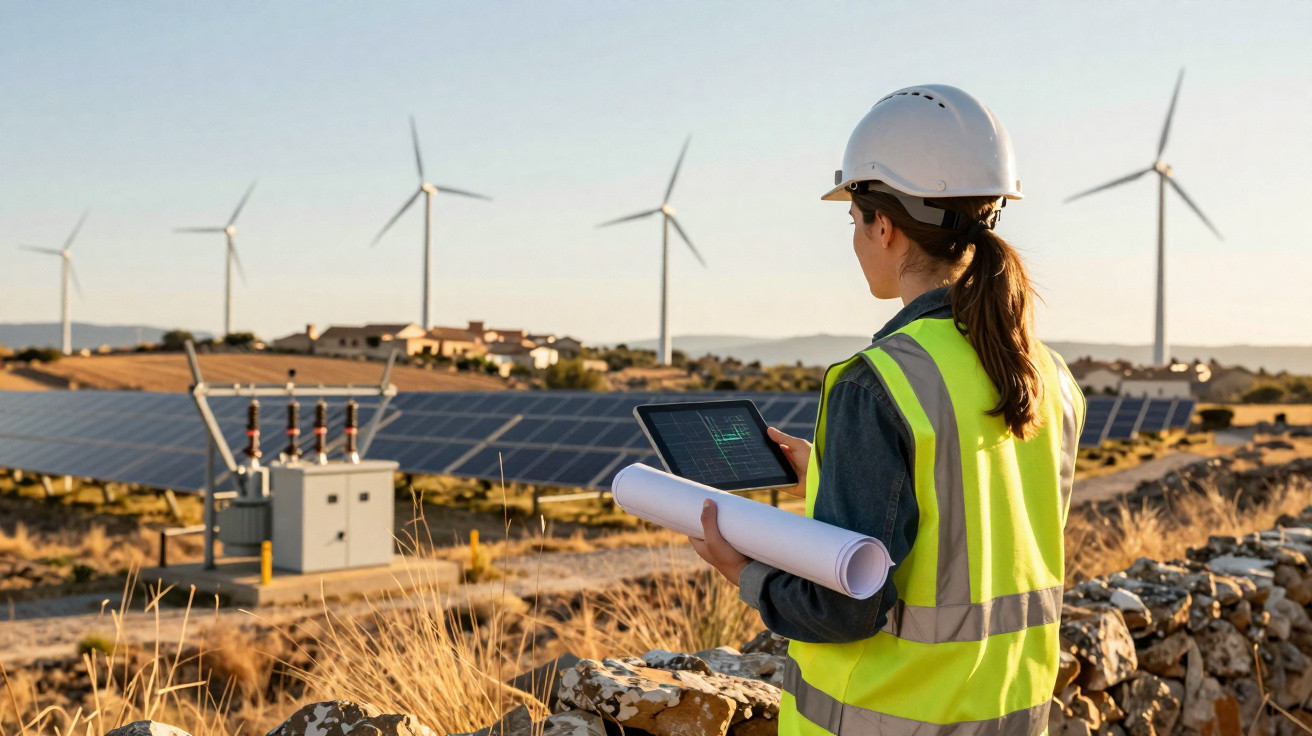
Spain’s wide, windswept plateaus and sun-drenched plains have given a major French construction group two new reasons for optimism.
Within a single day, Eiffage, one of Europe’s leading construction companies, won new renewable-energy contracts in Spain, strengthening its foothold in a market that is becoming a major proving ground for green infrastructure.
Eiffage secures €80 million in new Spanish renewable contracts
Eiffage, Europe’s fourth-largest construction group, has been awarded two contracts with a combined value of €80 million in Spain’s Castile and León region.
The agreements were signed by its Spanish subsidiary, Eiffage Energía Sistemas, with Capital Energy, a domestic developer that has been rapidly building a portfolio of wind and solar assets nationwide.
Two new projects in Castile and León strengthen Eiffage’s position as a go‑to partner for large-scale green power in Spain.
These agreements are much more than symbolic. They build on an established relationship between the French group and Spanish renewable-energy companies, showing that Eiffage is not only constructing roads and railways on the Iberian Peninsula but also connecting part of its energy transition.
Terrer: the €53 million flagship project
The larger contract, known as “Terrer”, accounts for nearly two-thirds of the overall package, at approximately €53 million.
Terrer concerns the electrical infrastructure needed to connect renewable power from three wind farms - Pedrecha, San Cristóbal and Cabezuelas - to the grid. Together, they have around 150 MW of installed capacity.
The contract includes:
- The design and construction of a new high-voltage substation
- A high-voltage overhead line linking the substation with the transmission network
- Integration of output from the three wind farms into Spain’s electricity system
Without this type of infrastructure, the turbines could continue turning in the plateau winds without being able to send their electricity anywhere. Terrer is effectively the connection that enables these wind farms to supply homes, factories and data centres across the region.
Canales Sur: 120 MW, €27 million and a complete EPC package
The second agreement is smaller but remains substantial, covering 120 MW at a site called Canales Sur for €27 million.
At this location, Eiffage Energía Sistemas has been awarded a full package running from engineering through to commissioning. Its responsibilities include:
- Electrical engineering for the substation and grid connection
- Procurement and supply of essential equipment
- Civil engineering works and construction
- Commissioning of the installation
- Construction of a high-voltage underground line
This type of turnkey assignment, commonly described as EPC - engineering, procurement and construction - is an area where major industrial groups such as Eiffage can make strong use of their scale and internal expertise.
The Terrer and Canales Sur projects together should create about 330 direct jobs through to their expected completion in 2027.
The roles will cover site construction, electrical installation, engineering, logistics and project management, while also contributing to wider employment throughout local supply chains.
Spain: a full-scale laboratory for Eiffage
Eiffage is no newcomer to Spain. The group first established operations in the country in 1979 and has steadily developed it into one of its principal international bases.
Its activities are organised through three main subsidiaries:
- Eiffage Energía Sistemas (energy and renewables)
- Eiffage Infraestructuras / Eiffage Construcción (civil engineering and buildings)
- Eiffage Metal España (steel and industrial structures)
Collectively, these businesses operate across almost every key construction and infrastructure segment:
- Renewable-energy and grid infrastructure projects
- Motorways, bridges and public works
- Railways and high-speed lines
- Urban development and public buildings
- Industrial facilities and metal structures
- Concessions and long-term maintenance
Recent flagship projects throughout Spain
During the past decade, Spain has delivered a series of prominent reference projects for Eiffage, extending well beyond wind and solar developments.
| Project | Location | Segment | Approximate value | Timeline |
|---|---|---|---|---|
| Madring Formula 1 circuit (main works) | Madrid | Urban track and sports infrastructure | €83.2 million (Eiffage share: ~€33 million) | 2024–2026 |
| Additional F1 facilities (paddock, logistics, extensions) | Madrid | Technical buildings | €68 million | 2025–2026 |
| Córdoba solar complex (300 MWc) | Córdoba | Photovoltaic power | €134 million | 2023–2025 |
| Núñez de Balboa solar plant (500 MW) | Extremadura | Utility-scale solar | ~€300–350 million | 2019–2021 |
| AVE Madrid–Galicia electrification | Spain | High-speed rail | ~€10–15 million | 2020–2023 |
In Andalusia, the Córdoba photovoltaic complex alone is projected to produce about 600,000 MWh annually from 2027. Depending on consumption patterns, this is broadly equivalent to the yearly electricity use of more than 150,000 Spanish households.
Why Spain’s renewable boom fits Eiffage
Spain benefits from some of Europe’s strongest natural conditions for renewable energy, with reliable inland winds and extensive sunshine across large areas of the country.
Since the European Union strengthened its climate objectives, Madrid has sought to speed up grid connections, storage deployment and new generation capacity. This has generated consistent demand for construction and EPC specialists able to complete projects to demanding deadlines.
Eiffage’s structure is well suited to these requirements:
- It can bring together civil engineering, electrical engineering and high-voltage expertise within one project.
- Its Spanish subsidiaries understand local regulation and permitting procedures.
- Its track record reduces the perceived risk for banks and investors financing Capital Energy and comparable developers.
For Eiffage, Spain acts like a proving ground where complex rail, road and renewable projects coexist within the same national portfolio.
This combination of reference projects can also assist the group when competing for contracts elsewhere. A successfully delivered 500 MW solar plant in Extremadura or high-speed rail electrification project in Spain may help sway an African or Latin American tender.
What 270 MW of new capacity really represents
Together, Terrer and Canales Sur add approximately 270 MW of installed renewable capacity to Spain’s development pipeline.
As a broad estimate, 1 MW of onshore wind or solar capacity can often supply between 500 and 1,500 homes in Europe over a year, depending on the technology and location.
On a cautious mid-range assumption, 270 MW could therefore correspond to the annual electricity demand of roughly 200,000 to 300,000 households. The ultimate wind-and-solar mix and final capacity factors will affect that figure, but the estimate indicates the projects’ scale.
There is a benefit for the grid as well. New substations and lines built for renewable generation generally incorporate modern control systems. These can balance intermittent generation, respond more quickly to grid incidents and support digital monitoring. In turn, this makes it possible to increase the share of renewables without destabilising the electricity system.
Key concepts: substation, EPC and capacity
For readers unfamiliar with the terminology, several concepts are important:
- Substation: A site at which electricity is converted between voltage levels and directed into separate lines. In renewable projects, it forms the connection between wind or solar farms and the national grid.
- EPC (engineering, procurement, construction): A contracting model in which a single company takes responsibility for the entire process, from design through to final delivery. It places risk with the contractor but makes the process simpler for the project owner.
- Installed capacity (MW): The maximum instantaneous power that a facility can generate. It is not the same as continuous output, as actual generation depends on sunlight, wind and operating hours.
Understanding these terms helps explain why Eiffage’s agreements in Castile and León involve more than pouring concrete or installing pylons. They position the group at the heart of how Spain’s future green electricity is connected and managed.
Risks, opportunities and what may come next
There are risks involved. Renewable schemes rely on grid access, environmental approvals and a stable regulatory environment. Delays in any of these areas can postpone revenues and increase costs for every party involved, including EPC contractors such as Eiffage.
At the same time, the combination of transport and energy work offers the group a degree of balance. If public spending on roads or metro systems declines, private investment may still flow into solar and wind projects, and vice versa. Spain’s substantial pipeline in both areas provides this type of portfolio effect.
If the Terrer and Canales Sur developments are completed on schedule and within budget, they will contribute more than additional megawatts to Eiffage’s Spanish presence. They will become reference projects for the next round of tenders, both across Iberia and in other regions seeking partners capable of delivering large-scale renewable infrastructure with the discipline of a construction giant and the precision of an energy specialist.




Comments
No comments yet. Be the first to comment!
Leave a Comment