
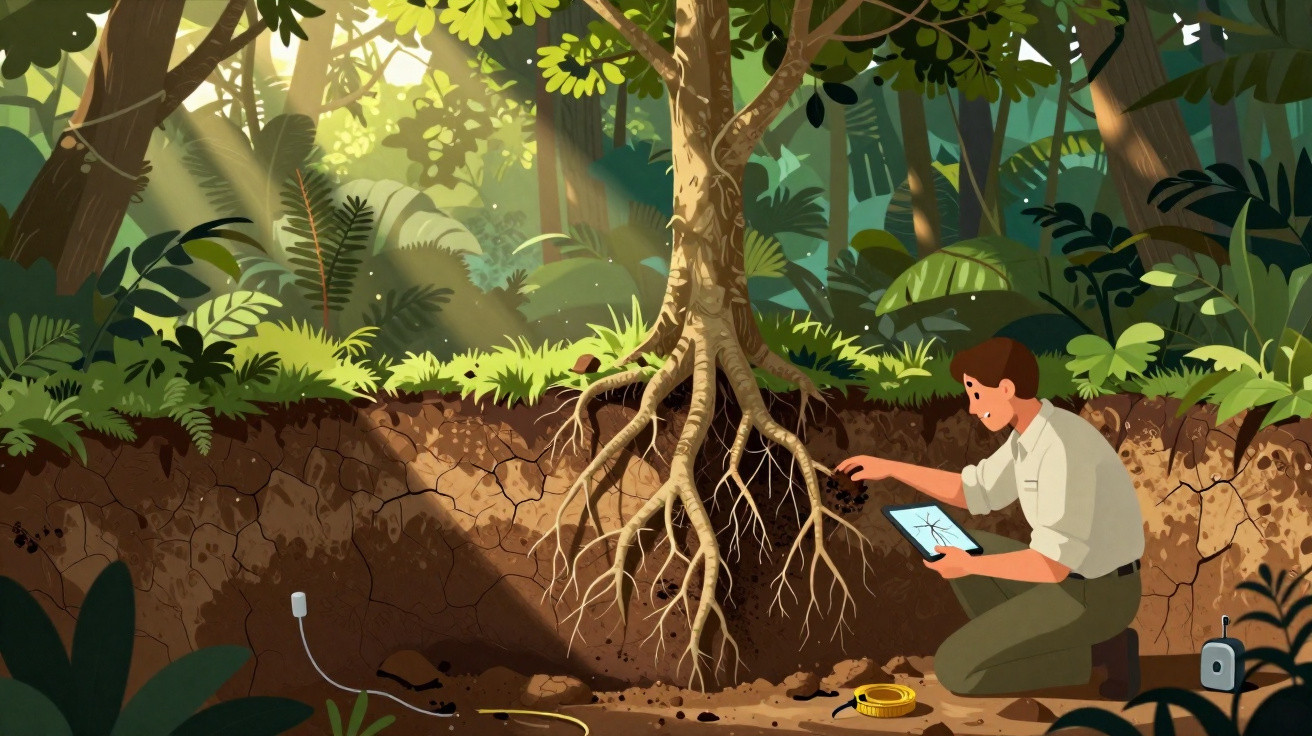
The dense green canopy may appear unchanged from the air, yet below Panama’s tropical forest soil, roots are shifting. As dry periods become longer and more severe, trees are extending their roots further down, following what researchers describe as a “rescue strategy” to reach water and remain alive.
Panama’s forests are quietly reorganising below ground
Tropical forests support over half of all land-based life and rank among the world’s largest stores of carbon. Much of this carbon is hidden underground, retained in extensive root systems and the surrounding soil.
However, these forests face increasing strain. Higher temperatures and changing rainfall are placing pressure on ecosystems that have historically depended on reasonably dependable wet seasons. Across Central America, including Panama, droughts associated with climate change and El Niño are already becoming both more common and more intense.
To examine how forests could respond, scientists established a long-term field study called Panama Rainforest Changes with Experimental Drying, or PARCHED. Its newest results indicate that trees can react rapidly, although this emergency response has clear limits.
Trees in experimental drought plots shifted growth away from shallow, surface roots and into longer, finer roots reaching deeper, wetter layers of soil.
Inside the PARCHED drought experiment
The PARCHED researchers created 32 experimental plots at four tropical forest locations in Panama. Every site differs in its tree populations, soil conditions, nutrient availability and rainfall regime. This range gave the researchers an unusual opportunity to assess how several forest types cope with the same form of stress.
How drought is simulated in a rainforest
To recreate persistent drying conditions, the team placed transparent plastic roof panels high above the ground. Looking rather like incomplete greenhouse roofs, these structures diverted around half to two-thirds of rainfall before it could reach the forest floor.
They also dug deep trenches around every plot and lined them with heavy plastic sheeting. This barrier prevented roots from drawing in water from neighbouring areas that were not exposed to drought. Within these enclosed sections, trees could use only the rainfall that passed through the panels or water already held in the soil.
- Roof panels reduced rainfall by approximately 50–70%.
- Plastic-lined trenches separated plots and prevented sideways water movement.
- The project included four distinct forest types, each with its own soils and species.
- The experiment has continued for several years, monitoring progressive drying.
Three ways of tracking root responses
Because roots operate out of view, they are especially difficult to investigate. Over five years, the PARCHED team used three complementary methods to observe underground changes:
| Method | What it measured |
|---|---|
| Soil cores | Root biomass and its distribution to roughly 20 cm beneath the surface, sampled several times annually |
| Root traps | Fresh root growth into mesh-filled columns, inspected every three months |
| Underground cameras | Detailed variation in root length and density, recorded by cameras placed in acrylic tubes 1.2 m deep |
Using these methods together allowed the scientists to identify not only the number of roots present, but also their location and the way their behaviour altered as the soil gradually became drier.
Deeper roots and fewer surface lifelines
The trend was remarkably similar across all four forests. As the plots dried, the volume of fine roots near the surface declined. Normally, these shallow roots are crucial for taking up water and nutrients during rainfall and in the period immediately afterwards.
Chronic drying triggered a clear trade-off: trees reduced shallow fine roots and invested more in deeper, moisture-hunting roots.
As water became scarcer in upper soil layers, surface roots were both less valuable and more susceptible to dying back. Trees responded by producing more fine roots deeper in the ground, where moisture remained available for longer during the dry season.
This deeper rooting supports what ecologists call “hydraulics” - the internal transport system that supplies leaves with water and enables photosynthesis to continue. Without it, prolonged drought can cause trees to wilt, lose their leaves or die.
A rescue strategy rather than a cure
Scientists refer to this change as a rescue strategy because it enables trees to keep functioning without entirely making up for the losses. Chronic drying still reduced total root biomass, and therefore the quantity of carbon retained in roots.
Put simply, trees remain alive with a smaller root system and lower stores of below-ground carbon. This is significant because tropical forests have such an important role in absorbing carbon dioxide produced by human activity.
Deeper rooting helps survival, yet does not restore the lost carbon or biomass in the upper soil layers.
Fungi help drought-stressed roots
The drought study uncovered another discreet source of support: fungi that live around tree roots. Many tropical trees have close relationships with arbuscular mycorrhizal fungi. These fungi surround root tips and send thread-like filaments into the soil, in effect expanding the area a plant can access.
During persistent drying, the smaller number of remaining surface roots had a stronger connection with these fungi. With fewer shallow roots left, the survivors appear to gain more fungal partners. In return, the fungi improve their access to water as well as limited nutrients in dry soils.
This symbiotic relationship can be important under stressful conditions. It enables trees to extract the remaining moisture and minerals from topsoil while simultaneously growing new roots downwards in search of a more reliable water source.
Can Panama’s forests adapt quickly enough?
Tropical forests do not all have the same capacity to cope with more frequent or severe drought. Some tree species in naturally dry environments have spent millennia developing drought-resistant features, including thick bark, dense timber and naturally deep root systems.
Other forests - particularly those growing in generally wet, nutrient-poor soils - are at greater risk. Trees in these places have not traditionally required robust drought-defence strategies, so abrupt climatic changes may exceed their capacity to adapt.
Scientists worry that rapid climate change could push some tropical species beyond their tolerance, leading to local declines or disappearances.
Should vulnerable species fail to adapt, the make-up of forests will probably shift. Drought-resistant trees and shrubs could spread, while species dependent on abundant water decline. Such a change would influence both forest carbon balance and the wildlife reliant on certain tree species for shelter and food.
Why root changes affect carbon and climate
When roots die, microbes can decompose them and release their stored carbon into the atmosphere. Roots at greater depths may slow this process, since carbon buried deeper in soil is generally more stable and breaks down at a slower rate.
How much carbon forests can keep storing will depend on the relationship between shallow roots lost and deep roots produced. If root systems continue to become thinner overall, tropical forests may gradually become less effective carbon sinks.
Researchers involved in PARCHED now want to establish how long this deep-rooting response can last. As droughts become stronger or occur more often, trees may reach physiological thresholds. Ongoing stress can limit growth and seed production, and weaken recovery after damage caused by pests or storms.
Key terms for understanding the study
Several technical terms used in this research are useful to explain, as they show what is at risk:
- Fine roots: The narrowest and most active roots, generally under 2 millimetres in diameter, responsible for absorbing most nutrients and water.
- Chronic drying: A sustained fall in water availability, rather than one brief and intense drought.
- Hydraulics: A tree’s internal water-transport network, which carries water from roots to leaves through xylem tissue.
- Carbon storage: Carbon retained in wood, foliage, roots and soil, keeping it outside the atmosphere.
Knowing these terms makes clear why researchers study more than trunks and leaves: the changes taking place beneath the ground also matter.
What PARCHED reveals about future forests
The PARCHED experiment points to resilience as well as danger. Trees are not merely passive victims: when surface soil dries, they alter their root structure, strengthen their relationships with fungi and draw upon deeper water reserves.
Yet these responses involve compromises, including reduced surface-root biomass, possibly lower growth and unknown long-term consequences for carbon storage. If drought becomes more extreme than the conditions created by the roof panels, some species may have no remaining options.
For policymakers and conservation planners, the findings indicate that safeguarding a broad mix of forest types may distribute risk more effectively. Forests accustomed to seasonal dryness could become increasingly valuable refuges for drought-tolerant species. Wetter forests, meanwhile, may need additional protection, including restrictions on logging and fragmentation, to limit the extra pressures created by people.
The findings from Panama also demonstrate the value of long-duration experiments. Five years represents only a short part of a tree’s lifespan, but substantial underground shifts are already visible. Continued observation over the decades ahead will show whether deeper roots are a short-term response or part of a more fundamental transformation of tropical forests in a warming climate.



Comments
No comments yet. Be the first to comment!
Leave a Comment