
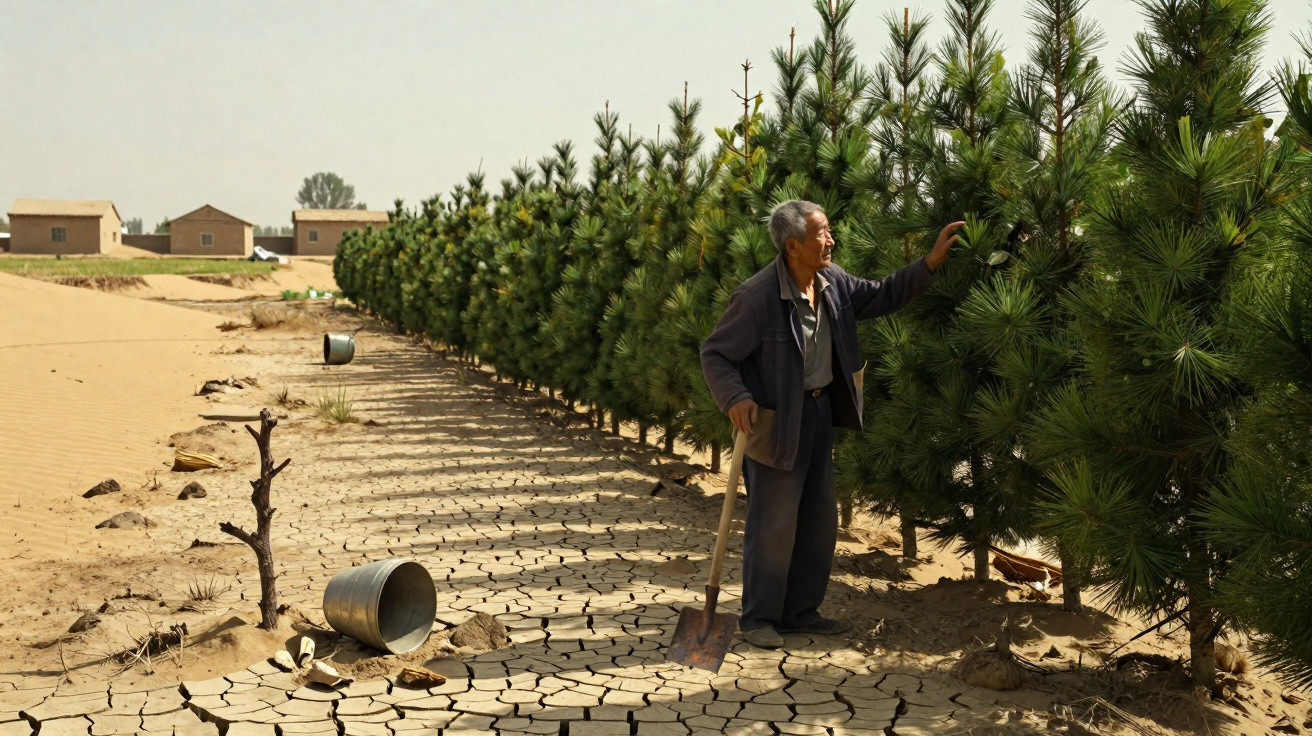
As though someone had rolled out a green carpet: straight lines of trees, squares, skewed patterns that look a little like Minecraft. On the ground, it feels very different. Farmers stand before fences, beyond which former grazing land now counts as “forest”. Water channels have dried up; the wind carries less sand, but less hope too. You hear remarks such as: “It used to be dry here, but alive. Now it is green and dead.”
China’s Great Green Wall: a dream against dust, a nightmare for villages?
At first, the vision sounds like an environmental fairy tale: China plants a “Great Green Wall”, with hundreds of millions of trees intended to hold back a desert that swallows homes, buries roads and chokes cities with dust. Officials began drafting plans as early as the 1970s. The aim was a vast green belt from Xinjiang to Manchuria, reforesting millions of hectares to create a shield against the advancing dunes of the Gobi.
Anyone who has experienced a genuine sandstorm in Beijing understands the anxiety. The sky turns yellow and the air tastes of soil, brick dust and metal. You can physically sense the northern land slowly shifting southwards. That is precisely what the programme seeks to prevent: forests as a brake. And, frankly, it looks convincing on PowerPoint slides.
Since the project began, more than a billion trees have been planted, while some sources put the total at several billion. Even the name, the “Three-North Shelter Forest Program”, sounds like a technocratic cure-all. Local authorities receive targets, and satellite images serve as proof of whether their green-cover quotas have been met. It works remarkably well in the statistics. Official figures report that China’s forest area has increased for decades.
The realities behind China’s green statistics
Yet travelling through the affected regions quickly reveals a harsher reality behind the success announcements. Monocultures of pine and poplar stand in rigid rows like soldiers. Many of these species do not belong there at all. They consume scarce water and take root in soils that are closer to dust than earth. Here, restoration often means planting anything that looks green from a distance.
One village in Inner Mongolia has become a symbol of the problem. Large herds of sheep and goats once grazed on steppe that was sparse but traditionally managed. Then officials arrived with maps and surveying equipment. Land classified as “degraded” was fenced off, farmers received modest compensation and strict restrictions were imposed. Anyone opening the fences risks a fine.
An elderly farmer says that her husband once drove the sheep into lower valleys in spring, returning to the steppe in autumn. Concrete posts now block the route. “We used to be afraid of sand; now we are afraid of the police,” she says. The flocks have shrunk, while younger people have moved to cities in search of work. To them, the new “forest” is more of an exclusion zone than a form of protection.
The effects on rivers can be measured. Studies record falling water levels in areas of intensive afforestation. Artificial forests planted with thirsty species such as poplars draw down groundwater before it can reach streams and wetlands. In some valleys, rivers now run only seasonally, if at all. What looks like a miracle from the air can feel like a slow desiccation on the ground.
Why, then, are so many trees planted in an area that has traditionally been grassland? The explanation combines political pressure, simplistic indicators and a deeply rooted assumption: trees = good, desert = bad. Authorities need measurable successes, and rows of trees make a photogenic symbol of progress. The fact that dunes and steppes are often sensitive yet stable ecosystems does not fit the narrative.
Restoring grassland is also harder to demonstrate and slower to verify. Natural grazing, wetland protection and support for native shrubs do not necessarily create vivid green images on satellite maps. A long line of trees, by contrast, is easy to count and report. Bureaucracies love simple metrics, even when ecology is brought to its knees as a result.
Water, grassland and local knowledge
For years, researchers have argued that the “Great Green Wall” is, in many places, really a “green wallpaper”. The planting strips are thin, poorly maintained and often suffer heavy losses within a few years. When rainy periods fail to arrive, thousands of trees die at once, leaving behind grey trunks and bleached roots. Part of the enormous investment simply disappears into the sand.
Anyone seeking to learn from this cycle must first accept an uncomfortable truth: not every desert is a mistake, and not every bare landscape is waiting for trees. The first step is to clarify the terms. “Restoration” should mean returning an ecosystem to a functioning state, rather than forcing vegetation upon it. In dry regions, that may mean strengthening the natural steppe instead of transforming it into a pseudo-Mediterranean forest.
In practical terms, this means looking carefully before acting. Which species naturally grow here? How have people lived with this landscape for centuries without completely destroying it? In parts of northern China, mobile herders and their shifting flocks avoided permanently trampling the soil. A modern restoration programme could build on such traditions rather than dismissing them wholesale as “backward”.
Another crucial lever is taking water budgets seriously. Every afforestation project in dry zones needs a kind of water limit grounded in real data. How much rain falls each year, and how much of it can be absorbed by roots without sacrificing rivers and wetlands? It may sound dry, but this is where grand visions often crumble. Anyone who wants to halt deserts must first learn to calculate scarcity rather than ignore it.
What many projects underestimate is the social strain involved. When fences go up without bringing village communities into the process, attitudes quickly turn. People soon recognise when “saving nature” is mainly imposed from above. We all know moments when a well-intentioned rule suddenly feels like a punishment. That is exactly how many farmers experience the new green policy. If compensation then arrives late or is far too low, trust breaks down completely.
A common mistake is to seek local knowledge only symbolically. A few village elders are invited into an office, heard for an hour and photographed - only for the original programme to proceed regardless. Let us be honest: nobody willingly attends endless participation workshops every day. But without genuine involvement, attractive plans can quickly become silent conflicts that erupt years later at great cost.
“Restoration used to be a technical term,” says a Chinese environmental researcher who prefers to remain anonymous. “Today it is a politically contested term. Who gets to define what is destroyed - and what counts as saved?”
Several key themes repeatedly emerge in this debate, and they matter even to readers far from the Gobi:
- Drought-prone regions need diversity, not monocultures
- Green satellite imagery is not proof of living ecosystems
- Local people are not the problem; they are part of the solution
- Rivers and groundwater are the hidden currency of every afforestation scheme
- Political targets without ecological limits lead to costly wrong turns
The sober truth is that China is not alone in facing these conflicts. Vast “green corridors” are now being created from Africa to Spain, often with the same contradictions. On one side is the desire to curb sandstorms and climate disruption. On the other are herders, farmers and small communities who feel that their daily lives are being crushed by a global climate discourse. Perhaps it is worth pausing in quiet unease: when do we call something “restoration” when we are really imposing only a new image of the landscape?
| Key Point | Detail | Added Value for the Reader |
|---|---|---|
| Planting trees is not automatically beneficial | Monocultures in dry zones intensify water shortages and threaten local livelihoods | Helps readers identify greenwashing and assess complex environmental projects more critically |
| Treat water as a limited resource | Afforestation without a water budget can cause rivers to dry up and wetlands to collapse | Shows why climate protection must always account for hydrology |
| People are part of the landscape | Traditional grazing systems and local knowledge can stabilise landscapes | Encourages readers to consider social justice and cultural practices in environmental debates |
FAQ:
- Question 1 How many trees has China planted under the “Great Green Wall”? Estimates suggest more than a billion trees, with some figures reaching several billion, planted over several decades across an area larger than many EU countries combined.
- Question 2 Why do rivers dry up even though more trees are growing? Many planted species, including poplars and pines, require large amounts of water. In regions that are already dry, their roots draw on groundwater that would otherwise feed streams and wetlands.
- Question 3 Is the desert itself not automatically a problem? Not necessarily. Natural deserts and steppes are ecosystems in their own right, with specialised animal and plant life. Problems arise where overuse and climate change disrupt the natural balance.
- Question 4 Do local people benefit from afforestation? Some receive jobs through planting and maintenance schemes, while others lose grazing land or access to water. The outcome varies greatly and depends heavily on local implementation.
- Question 5 What would be an alternative to afforestation alone? Approaches range from restoring natural grasslands and rotational grazing systems to water-sensitive farming and protecting traditional forms of land use, rather than banning them indiscriminately.




Comments
No comments yet. Be the first to comment!
Leave a Comment