
On the morning my pothos finally made its way across the bookshelf, the living room seemed lighter, despite every curtain still being closed.
It was neither large nor spectacular: only a green hand stretching out, a change in the atmosphere, a gentler way for the room to hold me as I drank coffee and caught up on last night’s news. I never bought plants to “fix” my mind. Like plenty of people, I bought them because a shelf felt bare, a friend had a cutting to spare, or I loved how leaves gleamed after rain. Yet they gradually changed the home itself. They gave the house a sense of pulse, and my mind no longer buzzed whenever I passed the sink. There is a reason for that, and it is far more satisfying than any wellness cliché.
When the house seemed to exhale
When my home was minimally furnished, I used to move from room to room in an effort to escape my own thoughts. Bedroom to kitchen, kitchen to sofa, sofa to desk: the same static trailed behind me like a low hum. Plants did not make it disappear in a night. They did not resolve my inbox or the news headlines. Instead, they gave each room a breath and a rhythm, something sufficiently unhurried for my mind to follow.
I recall running my thumb over a rubber plant leaf and watching its dusty surface become a rich, polished green. The scent of moist soil rose up, taking me back to childhood greenhouses and rainy mornings before school. My shoulders lowered without being told to. In that brief moment, my brain stopped being on guard. I was not meditating; I was simply present, looking at a leaf.
Friends teased me about creating an indoor jungle. They had a point. Yet it was not the number of plants that altered the climate inside my head. It was how they adjusted the character of each room. Plants are not clutter; they’re a way the room chooses to breathe. Once I had experienced that, returning to the old feeling was difficult.
The calm’s quiet biology
What happens to your body when it sees green
Look at a window box for five minutes and your heart rate will often slow. There is nothing mystical in that: our bodies respond well to natural patterns. Gentle outlines, dappled light and leaves shifting slightly in a draught signal to an ancient part of the brain that there is no immediate threat. The stress response softens. It is not woo-woo; it is wiring.
Researchers frequently describe an “attention restoration” effect. In simple terms, modern life requires your brain to point a torch beam at one thing and keep it fixed there. You know the sensation. Natural views spread that light a little, and beneficially so. You pay attention without strain, your capacity to focus is restored, and you return to a task feeling less worn down.
Focus resets that never feel like effort
Some days, concentrating feels like trying to lift wet cardboard. At those times, shifting your eyes from a screen to something alive and moving offers a subtle reset. You might see a spider plant send out a runner, or basil tilt towards steam from the kettle, and your brain receives a different kind of input. No app is required. The email you had avoided then seems more manageable, not because it has changed, but because you have become steadier.
We are drawn towards green for a good reason. It is the colour of sufficient water, growing food and spaces where you can sit without checking every direction. Your body understands this, even when you do not consciously recognise it. That is why the ficus that contributes nothing to your design scheme can transform your afternoon mood.
Small acts of care that steady the day
Watering days are hardly glamorous. Honestly, nobody truly does it every day. At times you forget, and the prayer plant becomes sulky around its brown edges. At other times you give it too much, leaving the pot weighty and cold. Even so, these minor tasks become anchors, marking the day like harbour bells.
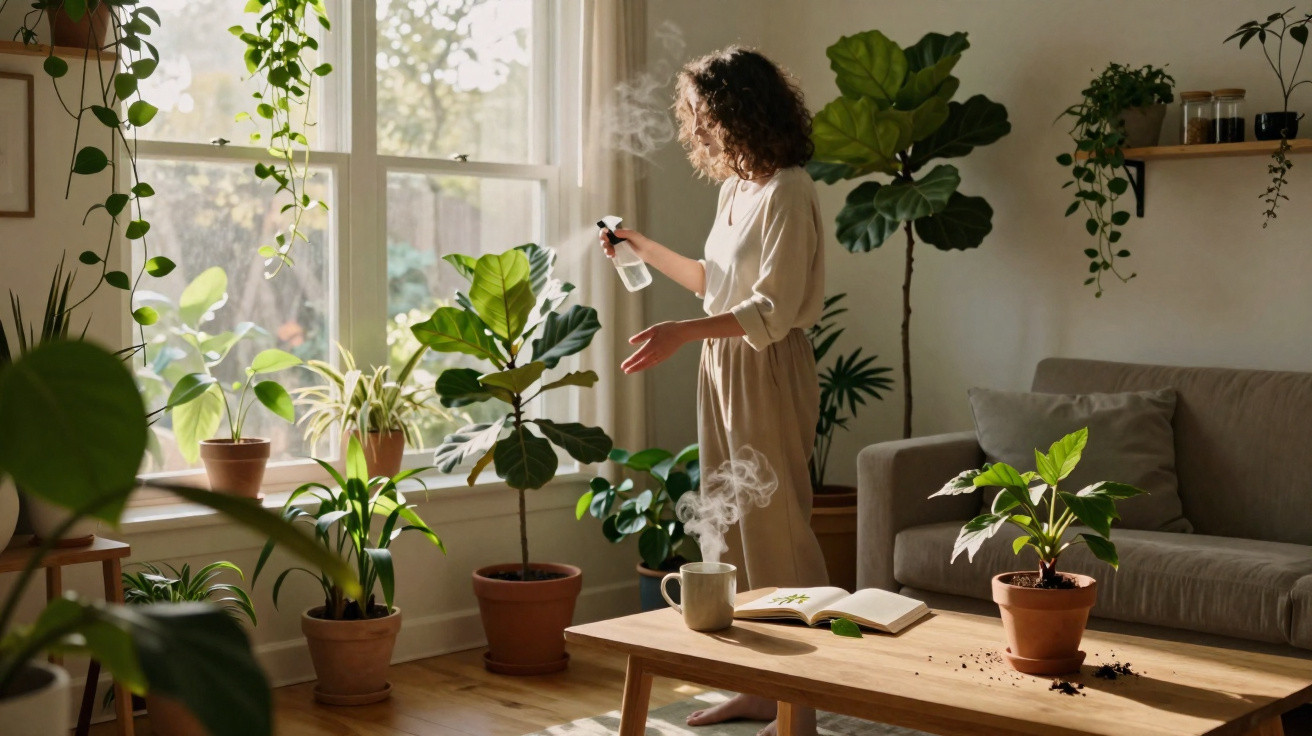
When I mist the calathea in the bathroom, I am carrying out one small task properly. Filling the jug, testing the soil and turning a pot so that a timid leaf receives more light is domestic, slightly boring and surprisingly grounding. A few seconds spent touching and observing can give your nervous system an unexpected lesson: not everything has to happen quickly. You bring that slower pace into a meeting, and it shows.
I had not understood how much my mind needed green until I moved the ficus into the kitchen. That single change meant I encountered it six times each day rather than only in the evening. It changed from an ornament into part of a daily relationship. Care became a rhythm rather than a project. This matters because routines create a subtle structure around your thoughts.
Plants in every room: a forest with a purpose
Adding one plant to one room is rather like placing one cushion on a sofa. It works, but you cannot really sink into it. Each room affects your mind differently, and plants can heighten that effect. Bathroom steam suits ferns, while the sound of running water provides a rain-like soundtrack. Bedrooms call for calm and low light; a resilient snake plant can offer company without taking over.
Kitchen herbs offer the simplest lesson in paying attention. Snip rosemary and its scent lifts from the pan. Watch mint recover after a merciless cut and feel a modest rush of abundance. Those small cycles of growing and regrowing steer the brain towards optimism. It is difficult to catastrophise while fresh leaves are unfolding.
In a hallway, a robust ZZ plant puts up with neglect and welcomes you without fuss. Near a desk, a trailing pothos or palm softens the rigid geometry of screens and cables. A living room can handle something more dramatic: a monstera splitting its leaves like an open hand, or a rubber tree whose colour shifts through the seasons. Every position acts as a cue, telling your brain what a particular space is for.
There is science in this, but there is vibe too. If a room suits your nervous system, you choose to use it deliberately. You sit in the chair to read because it feels pleasant, not because you ought to. That is the distinction between a house and a habitat.
Light, shade and how your eyes recover
We have all experienced the moment when a screen goes dark and our eyes hurt as though we have stared into the sun. People were not designed to focus at one distance for hours at a time. Plants direct your gaze across layers: leaves in the foreground, stems across the room and the window beyond. This natural depth gives the small muscles in your eyes an opportunity to extend and relax. Your brain appreciates that variation.
I place a small philodendron to the left of my monitor, where it sits just within peripheral vision. When the window is open, it shifts almost too slightly to notice. That movement is soft and without purpose. It is the reverse of a notification. The effect is strange but welcome: fewer imagined pings in my head and fewer repeated thoughts about unfinished tasks.
Light also gives shape to time. By late afternoon, the way a geranium on a shelf leans lets me know the day is turning. On dark winter mornings, light catching glossy foliage can be enough to ease the sensation of being shut inside a box. The mind tracks these changes and finds stability in them.
Making the messy parts useful
Let us address the things nobody posts about: fungus gnats, crisp leaf edges and the plant you adored that did not enjoy your flat. Failure is built into the process. During a difficult week, it can feel like guilt covered in soil. But plants quietly teach you that imperfection can be lived with. They demonstrate how to continue after minor losses.
Failure as information rather than a judgement
A dead fern is not a test of your personality. It is a message: perhaps the bathroom lacked enough light, or the heating was too fierce. You make changes and learn. That cycle develops cognitive flexibility, the same quality needed at work when a plan shifts. You become someone who can put small things right without spiralling.
There is a slightly comic relief in inspecting a leaf and saying, “Not today.” You do not have to save every plant. Nor do you need to act out success. Keep what brings you calm, and release the rest. That is as much mental hygiene as it is housekeeping.
Work brain and home brain share the same head
People often treat plants as weekend possessions, yet they can be career tools too. A desk containing something alive feels less like a workstation and more like somewhere to think. The tangible presence of plants takes the sharpest edge off stress, helping your prefrontal cortex - the part that solves problems - stay engaged. You retain more when your body is not permanently tensed.
In my home office, a peace lily sulks if I miss a watering, then recovers within an hour after a generous drink. That petty drama is useful. It provides feedback that is not contained in a spreadsheet. Between calls, I turn its pot by a quarter and the action says: pause, check, adjust. That phrase has saved more projects than any productivity hack.
Plants are not decor; they’re co-workers with leaves. They will not submit expense forms or give a quarterly presentation, but they can encourage better habits. Get up. Look away from the screen. Draw a breath all the way into your ribs. None of it costs more than a pot and soil, and the benefit is noticeable that very day.
A modest green social life
Once you have several plants spread through the home, something unexpected begins to happen. You exchange cuttings. A spider plant baby is wrapped in damp kitchen roll and carried to a neighbour’s windowsill. A friend sends a photograph of a drooping orchid as though it were a family emergency. You laugh, then spend ten minutes discussing angles of light. That is connection, and it matters.
We are built to thrive among groups, even very small ones. Plant conversations are wonderfully low stakes; nobody will argue about mint as they do about politics. You learn to request help, offer advice with care and celebrate small successes. These brief social exchanges support mental health in quiet, cumulative ways.
There is a shared sense of time, too. “Look at the new leaf” messages arrive like postcards from the future. Your phone pings with green progress rather than dread. It is difficult to quantify what this does to your mood across a year, but you notice it around the edges: less loneliness and more tenderness.
Being practical without ruining the vibe
My happiest experiences with plants began when I stopped treating them as homework. Place the thirstier ones together and water them in the sink. Choose two days that already follow a routine - perhaps the same mornings you put a wash on - and inspect the pots then. If you forget, the world will not end. You can put it right next time.
There is no need to pursue rare plants if you would rather not. A pothos is forgiving, and a monstera will accommodate your learning curve. Keep an inexpensive mister beside the bathroom mirror and you will genuinely use it. Use the nursery light label as guidance, then disregard it if your room tells a different story. Plants reveal what they need in a language you already understand: droop, curl, perk, bloom.
Consider scenes rather than specimens. A trailing plant easing the edge of a shelf. A large-leaved presence grounding a corner. Herbs by the kettle, where your hands remember to pinch and smell them. When a room resembles a place lived in by a real person, with breakfast dishes and a slightly uneven pile of books, your mind settles into it. You are not staging a lifestyle; you are making one.
The house that gives something back
We purchase plants because they look beautiful, then find ourselves with a gentler mind. The exchange almost seems unfair. A handful of pots and a little patient neglect can stop rooms from barking instructions at you. Instead, they begin to hum. That hum is where attention can grow back after a day spent being divided into thin slices.
Not every plant will survive. Not every room will look perfect. Some mornings, the peace lily will decline to recover and your coffee will turn cold as you stand at the window, wondering whether the weather has something against you. You will get through that as well. Later, when a new leaf appears without warning, you may even laugh about it.
Start with one, then let the rooms ask for more. Put it somewhere you will genuinely meet its gaze. Occasionally touch a leaf. Listen for the small sounds - the kettle, rainfall, a bus in the distance - and notice how green helps them feel as though they belong. That is the real reason to fill a home with plants: not to curate an aesthetic, but to make a life your mind is glad to inhabit.






Comments
No comments yet. Be the first to comment!
Leave a Comment