
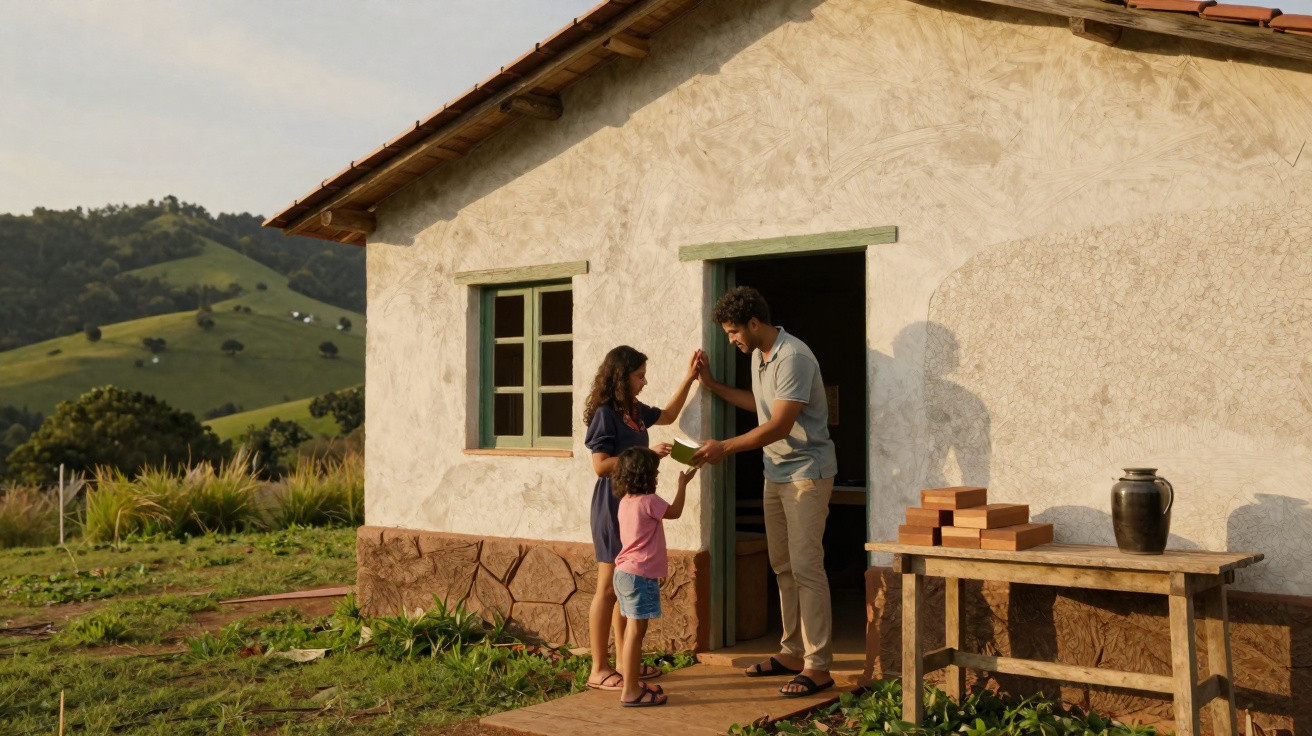
In Portugal’s Alentejo hills, one family has quietly taken a different approach: clay walls, a cork outer layer and rooms that remain composed in hot weather. Rather than resisting the climate, their home works with it.
Daybreak arrives in a gentle quiet. A breeze moves through the cork oaks, passes the lime-washed entrance and reaches a living room that holds a constant, almost gentle coolness. It is already 31°C outdoors. Indoors, the kitchen-side wall is warm beneath the hand rather than scorching, seeming to return warmth remembered from the previous night. Children race over a clay floor that stays quiet under their feet. Coffee begins to brew, with its toasted-bean scent mingling with the subtle leafy smell of cork cladding. A cicada starts its mechanical call somewhere nearby. The house remains unfazed, without a thermostat in sight.
A cork-and-clay house that breathes with the hills
Seen from the road, the building appears almost deceptively plain: low forms, thick walls bleached by the sun and a roof with a softly rounded cork finish. Yet that plainness conceals a considered system. Clay supplies thermal mass, cork provides the insulating coat, and together they regulate the indoor climate with remarkable steadiness. When the afternoon reaches 38°C, the corridor remains at 23–24°C, as though somebody carefully set the temperature and walked away. They created comfort rather than relying on gadgets.
During three consecutive 42°C days in the Alentejo last August, the family followed their usual routine: windows open overnight, then closed by ten in the morning. Inside, temperatures shifted by scarcely two degrees. That month’s electricity use covered only lighting, a compact fridge and the well pump; there was no air conditioning. Portugal supplies roughly half of the world’s cork, and that local geography can be felt in these walls, where the landscape itself helps keep heat outside.
The physics behind it operates unobtrusively. As a natural insulator with low thermal conductivity, cork gives summer heat little opportunity to enter and prevents warmth escaping rapidly in winter. Clay behaves like a slow-breathing lung, absorbing heat during the day before releasing it into cooler evenings; this delayed response evens out temperature swings. Deep overhangs, a ventilated roof and windows positioned for the sun’s route complete a restrained design that feels like architecture with impeccable manners.
How they built the cork-and-clay home - and what you can borrow
They began with the outer shell. Using local earth stabilised with straw and a small amount of lime, they formed 40 cm clay walls, then added 10–12 cm expanded cork boards around the exterior. A lime plaster finish protected the structure while allowing it to breathe. Wooden shades let south-facing windows take in winter sun, while north-facing openings encourage cross-breezes that flush the rooms overnight. The roof also includes cork insulation, meaning heat striking it at midday arrives indoors well after bedtime, if it arrives at all.
Passive-house living has its own pattern: open up at dusk, close down in late morning and allow the materials to perform. In truth, no one follows such a routine perfectly every day. The family therefore designed for lapses: fixed shading where it is most needed, a vestibule that tempers hot air on awkward afternoons and deep window seats that become small thermal moorings for people and plants. A home that accommodates an overlooked step is a home that functions in real life.
They gained knowledge through experience, including an understanding of what to avoid.
“The first night we slept with the windows open and no hum of machines, we could hear the cork roof ping softly as it cooled,” the father told me. “It sounded like the building was exhaling.”
Two summers on, the unexpected details are still modest and deeply human.
- Rain landing on cork sounds like a soft, muffled drum.
- The lime finish changes colour across the seasons and never has a plastic feel.
- Visitors remark on the quiet before they talk about the temperature.
What a cork-and-clay house can offer the rest of us
There is no miracle involved, simply sound materials and everyday patience. Cork offers insulation without fossil-derived products; clay delivers thermal mass without the carbon burden; and both materials are forgiving when repairs are needed. Everyone knows the moment when afternoon heat presses through the blinds and the air-conditioning remote is reached for automatically. This family exchanged that reflex for a routine supported by materials that make it easier to maintain. It feels contemporary precisely because it feels peaceful.
| Key point | Detail | Why it matters to the reader |
|---|---|---|
| Cork + clay envelope | Low-conductivity cork on the exterior, high-mass clay within, finished with lime | More stable indoor temperatures with fewer mechanical systems |
| Passive cooling measures | Night purging, deep eaves, cross-ventilation and shaded south-facing openings | Practical actions you can put into practice today |
| Local and low-carbon | Portuguese cork, on-site soil, minimal cement and repairable finishes | Reduced embodied carbon and a home that matures gracefully |
FAQ:
- Does a cork-and-clay house really stay cool in a heatwave? Yes. In practice, indoor temperatures tend to remain within a narrow 20–26°C range when you ventilate at night and provide shade during the day. The materials do most of the work.
- Is cork sustainable to harvest? Portugal’s cork is taken from cork-oak bark every 9–12 years without cutting down the tree. Properly managed montado forests store carbon and sustain biodiversity.
- What about fire risk? Cork forms a char layer and self-extinguishes, while clay is non-combustible. Careful detailing is still essential: keep vegetation clear around the house and protect eaves and vents.
- Is this more expensive than a regular build? The materials may be competitively priced, although skilled labour and precise detailing require extra time. Many owners balance costs by using simpler forms and reducing mechanical systems.
- Can I retrofit a conventional house with cork? Yes. Cork boards can provide external insulation beneath breathable renders. Combine them with shading, night ventilation and air sealing for the best outcome.






Comments
No comments yet. Be the first to comment!
Leave a Comment