
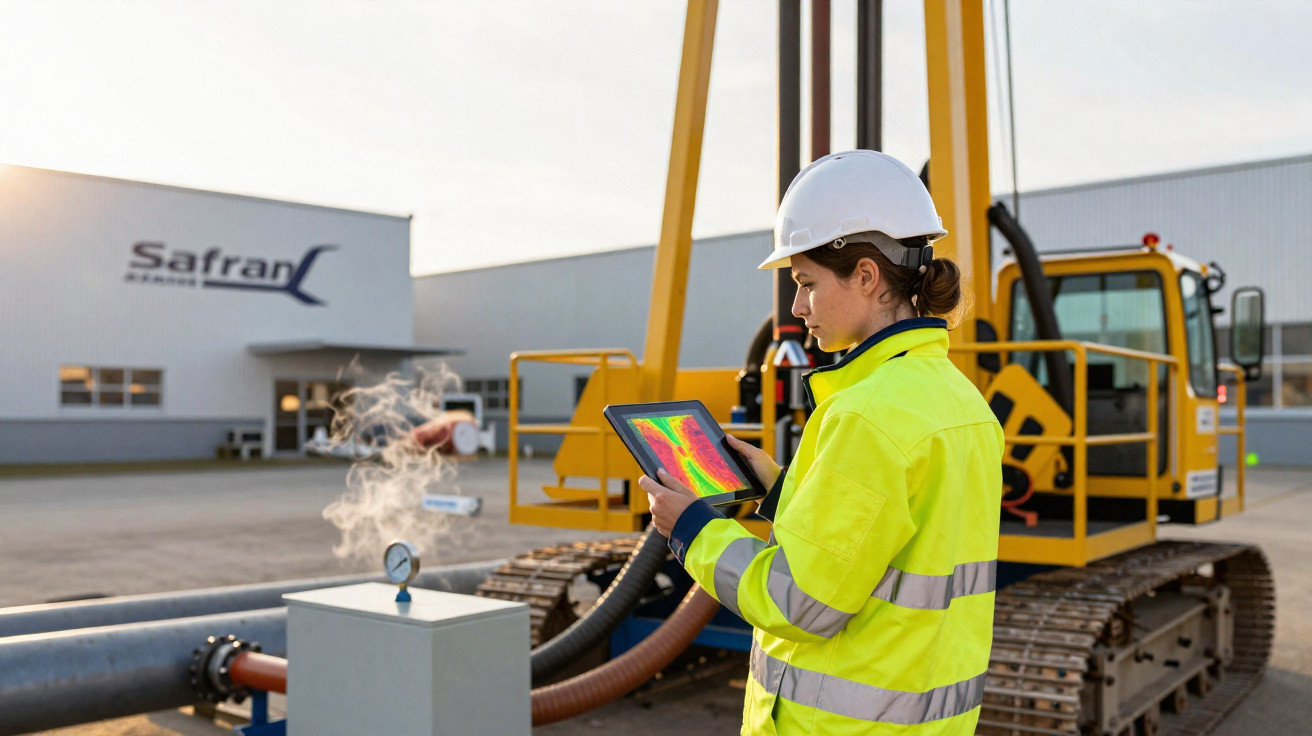
On the eastern edge of Paris, a vast aviation plant is discreetly gearing up for a fundamental change in the way it provides light and heat.
At Villaroche, Safran Aircraft Engines is transforming its largest industrial facility into a real-world laboratory for low-carbon heat. The company has started work on a deep geothermal plant which, once in service, is set to reduce its reliance on fossil gas while securing long-term energy costs in bedrock rather than volatile markets.
A low-carbon future for an aviation mini-city
Safran’s Villaroche facility in Seine-et-Marne is far more than a conventional factory. Some 6,500 employees work across its workshops, offices, test halls and even its company museum. The site develops and manufactures engines for Airbus and Boeing aircraft, alongside the Rafale fighter jet.
Only a few dozen metres from the drilling rig, preparations are under way for a huge test facility for RISE, the next-generation engine demonstrator being developed with GE Aerospace. While engineers above ground pursue in-flight fuel reductions, the business is also reshaping the way its innovation campus is heated beneath the surface.
Safran is celebrating 80 years of engine-building at Villaroche by rewiring the ground beneath it into a long-term heat source.
Safran is developing the scheme with Dalkia, EDF’s energy-services subsidiary, and Arverne Group, the deep-drilling operator. Their objective is to demonstrate that European heavy industry can base part of its energy transition on local geology instead of imported gas.
How the Safran Villaroche geothermal station will operate
Drilling 1,650 metres into the Dogger aquifer
The development relies on a geological formation that is already familiar to French energy planners: the Dogger aquifer. This extensive limestone layer sits around 1,600 to 2,000 metres beneath the Paris region and holds water heated naturally by the Earth’s internal energy.
At Villaroche, the first production well has now been drilled to a depth of approximately 1,650 metres. At that point, the water is around 75°C, sufficiently hot to supply substantial heating after passing through heat exchangers. A second well, now nearing completion, will create what engineers refer to as a “doublet”: one well draws up the water, while the other returns it underground once cooled.
The installation will function as a closed-loop system:
- hot water is pumped from the deep aquifer;
- heat from the water is transferred to the site’s heating network through exchangers;
- the cooled water is reinjected into the same geological formation.
Nothing is consumed in the traditional sense: the plant borrows the heat, not the water, and returns the fluid to its original reservoir.
This approach reduces the impact on groundwater levels and is intended to maintain the aquifer’s long-term equilibrium. The Dogger has supplied district heating systems in Paris’s suburbs for decades, giving engineers considerable experience of operating at comparable depths and temperatures.
Replacing gas boilers with dependable clean heat
For a single industrial site, the change is substantial. Safran states that, once fully commissioned, the geothermal station will meet roughly 84% of Villaroche’s heating needs, enabling the existing gas boilers to be removed from regular use or retained solely as back-up.
This should reduce the site’s heating-related greenhouse-gas emissions by 75%, preventing around 6,500 tonnes of CO₂ each year. Such figures are more commonly linked with large municipal networks than with the premises of one company.
Within Safran, the project forms one of the central elements of a broader low-carbon strategy. The group has committed to halving its direct operational emissions by 2030 against 2018 levels. As industrial heat accounts for a significant proportion of factory emissions, securing low-carbon heating for decades is an important strategic tool.
A €30 million investment in long-term certainty
The Villaroche geothermal station involves investment of about €30 million. In industrial heating, this represents a sizeable upfront commitment to a technology whose operating costs are comparatively modest afterwards.
From a financial perspective, the model depends on a long timeframe. Deep geothermal developments generally require between ten and fifteen years of operation to recover the costs of drilling, underground surveys, surface installations and connection to a site’s heating network.
Many industrial businesses are reluctant to make commitments under contracts of this duration, particularly in sectors where factories, production lines or entire divisions may rapidly change ownership. For precisely this reason, several French geothermal proposals have previously been abandoned: no major customer was willing to enter into a long-term heat-purchase agreement.
By going ahead, Safran is trading short-term flexibility for predictable energy bills nearly independent from gas prices and geopolitics.
After the wells have been drilled and the station is operational, the heat itself is effectively free. Maintenance, electricity for pumping and monitoring make up the principal continuing costs. Underground temperatures are unaffected by global crises, exchange-rate movements or shipping constraints.
For an energy-intensive facility expected to remain operational for decades, that certainty may be as compelling as the reduction in emissions.
A rare French precedent for heavy industry
A technology rooted in district heating
Geothermal heating is already established in France, particularly across the wider Paris area. A number of towns north and south of the capital draw on the Dogger aquifer:
- Chevilly-Larue, in Val-de-Marne, operates one of the long-standing geothermal district heating networks, extracting hot water from depths of between 1,700 and 2,000 metres.
- Villepinte, in Seine-Saint-Denis, uses a modern doublet to supply its local network.
- Bagneux, in Hauts-de-Seine, has introduced a more recent scheme to raise the proportion of renewable heat in its urban energy mix.
In these examples, geothermal energy mainly serves homes and public buildings throughout entire districts. Its use in heavy industry remains less common.
From agro-industry to aviation
One of France’s limited existing industrial examples is located in Rittershoffen, in Bas-Rhin. Since 2016, a deep geothermal plant has delivered heat from more than 2,500 metres underground to Roquette, a major agro-industrial facility.
Other businesses remain at the planning stage. Michelin, for example, is examining a Clermont-Ferrand project that would decarbonise its process heat using deep geothermal resources.
Villaroche stands out because of both its location and economic significance. It is a key European site for civil and military aviation, employing thousands of highly skilled people and housing strategically important test facilities. Introducing industrial-scale geothermal energy in this environment represents a further stage in the role of the technology within France’s decarbonisation effort.
The plant, expected to be operational in October 2026, will be the first deep industrial geothermal station of its kind in the Paris region.
What geothermal energy means in practice for a factory
Essential terms without the jargon
For those less familiar with geothermal energy, several definitions clarify the Villaroche project:
- Deep geothermal: Heat recovered from several kilometres underground, or from depths of at least 1,000 metres, where water is naturally far hotter than at the surface.
- Aquifer: A permeable layer of rock that contains water. Here, the Dogger is a limestone formation filled with hot water.
- Doublet: Two wells working together, with one producing water and the other reinjecting it, in order to preserve the hydraulic balance of the underground reservoir.
- Heat exchanger: Equipment that transfers heat between two fluids without allowing them to mix; in this case, between geothermal water and the factory’s heating network.
The Villaroche facility will not use geothermal energy to produce electricity. Its purpose is instead to replace the gas-fired boilers that currently warm buildings, workshops and offices, as well as potentially supplying process equipment that does not require very high temperatures.
Risks, advantages and the possible next steps
As with any deep-drilling development, geothermal energy presents technical risks. Wells may encounter less permeable zones than forecast, reducing water flow. Temperatures may also be a few degrees below those predicted by models, which would affect overall output. At depth, equipment can be exposed to corrosion and scaling, requiring ongoing management.
These challenges are generally managed through comprehensive subsurface analysis, cautious design allowances and long-term monitoring. The extensive Dogger experience held by district-heating operators in the Paris region is a valuable benefit for Safran and its partners.
Geothermal heat is particularly suited to sites with stable year-round demand. A large industrial campus employing 6,500 people and containing laboratories, test cells and offices is close to an ideal customer. Its consistent requirement enables operators to run the station at high load factors, strengthening the economics.
Comparable projects could eventually combine geothermal energy with other low-carbon technologies. Heat pumps, for instance, can raise medium-temperature geothermal heat to higher temperatures for selected processes. Solar thermal installations could contribute additional summer capacity while geothermal provides the winter baseload. Thermal storage tanks could help even out daily demand peaks.
For factories located in appropriate geological areas, this combination could progressively make gas boilers a back-up resource rather than the standard option. At Villaroche, where future aircraft engines are tested within a stone’s throw of a deep geothermal well, the change is already becoming tangible.




Comments
No comments yet. Be the first to comment!
Leave a Comment