
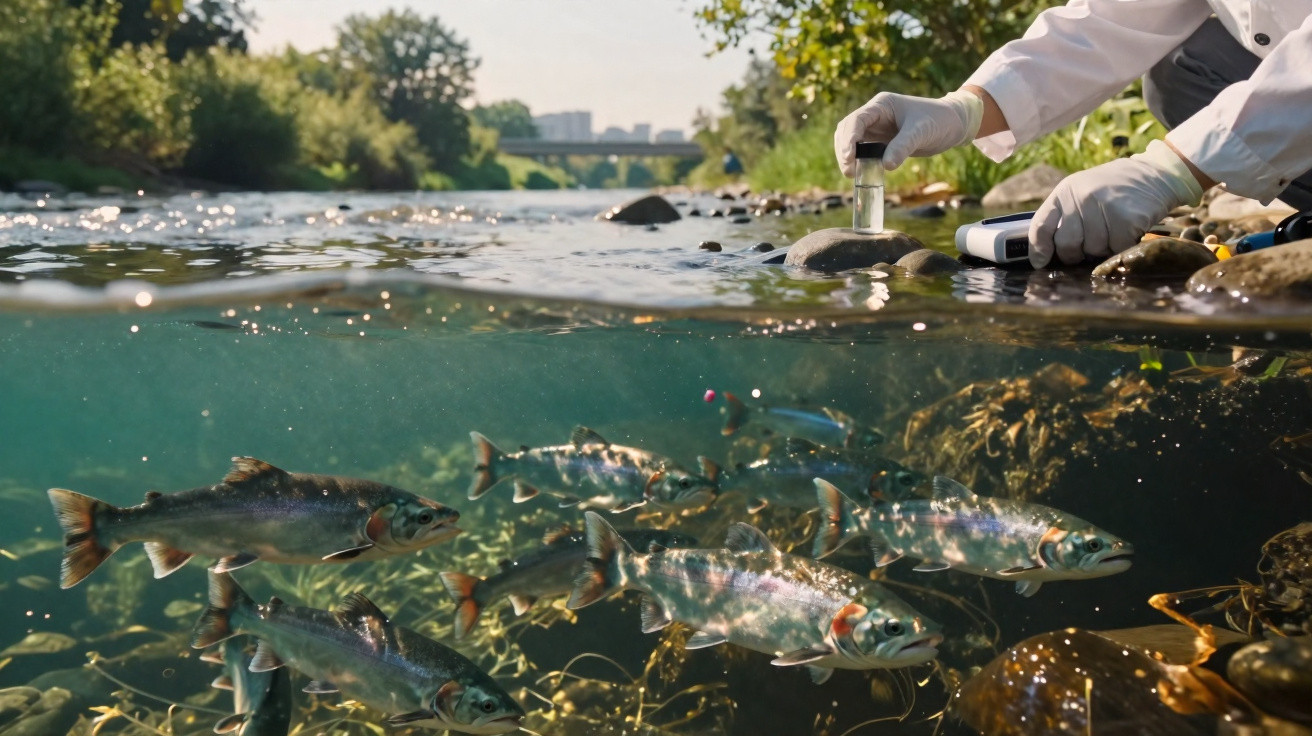
Water transports more than nutrients and sediment. It also carries traces of human activity, including residues from illicit drugs. These substances pass through wastewater networks and can reach rivers and lakes without attracting attention.
Scientists had already established that such chemicals can affect aquatic animals in laboratory tanks. Natural ecosystems, however, are far more complex. Until now, what happens under wild conditions has remained largely unclear.
A new field study from Sweden offers fresh evidence. By monitoring Atlantic salmon in a large natural lake, researchers identified a striking effect.
Cocaine pollution can alter how these fish travel and disperse within their surroundings.
Illicit drugs entering rivers
Illicit drugs do not disappear once they have been consumed. They are excreted from the body and enter wastewater systems. Although treatment works remove numerous pollutants, they do not eliminate every substance.
Consequently, compounds including cocaine and its primary metabolite, benzoylecgonine, enter natural waters worldwide.
Even in small concentrations, these chemicals can disrupt biological processes. They influence brain chemistry, particularly the systems associated with movement and behaviour.
Laboratory research has found that fish may swim more quickly, behave more boldly and alter their feeding. Yet laboratory tanks cannot reproduce the complexity of an actual lake.
Tracking Atlantic salmon in their natural habitat
To look beyond laboratory conditions, scientists conducted a large-scale field trial in Lake Vättern. They tagged juvenile Atlantic salmon and monitored them while they swam freely around the lake.
Some of the salmon received slow-release implants containing cocaine or its metabolite, while others remained unexposed.
The lake then served as the test setting. An array of underwater receivers logged every movement, creating a detailed record of where the fish travelled and the distances they covered.
It provided an unusual opportunity to observe pollution influencing behaviour as it happened within a real ecosystem.
Fish begin ranging more widely
The trend emerged quickly. Salmon exposed to the cocaine metabolite started moving more than the other fish.
During the later weeks, the contrast became difficult to overlook. Those fish were travelling up to 1.9 times farther each week.
Initially, every fish was highly active, as is typical after release into an unfamiliar environment. As time went on, however, the control group became settled. Their movements slowed, they remained nearer to the same areas and their behaviour became more predictable.
The cocaine-exposed fish showed no such pattern. They continued to travel and investigate their surroundings.
How movement influences survival
“Where fish go determines what they eat, what eats them, and how populations are structured,” said Dr Marcus Michelangeli.
“If pollution is changing these patterns, it has the potential to affect ecosystems in ways we are only beginning to understand.”
The change developed gradually rather than appearing immediately. The full chemical effects only became apparent after the fish had adapted to their environment.
Movement involves more than the distance travelled. It affects survival by determining which fish locate food, evade predators and survive long enough to breed.
When movement patterns shift, every process linked to them can shift as well.
The results indicate that low-level pollution may subtly alter these patterns without producing clear warning signs.
Salmon travel considerably farther
The findings become more revealing when considering the locations reached by the fish.
The exposed salmon did more than increase their activity: they also dispersed. As the study continued, they ranged farther across the lake, particularly into northern areas.
By the study's conclusion, some had travelled more than 12 kilometres beyond the area used by control fish. Such a change is significant because movement determines how species occupy space.
It influences feeding areas, encounters with predators and breeding sites. Alter movement, and the ecosystem starts changing alongside it.
One finding was particularly notable. The metabolite benzoylecgonine produced a stronger effect than cocaine itself. This matters because environmental research often concentrates on the original compound rather than the substance into which it later changes.
Ripple effects across ecosystems
These results indicate a wider concern. Pollution is not always obvious or dramatic. It can act quietly, causing subtle behavioural changes that accumulate over time.
For species such as Atlantic salmon, already under pressure from climate change and habitat loss, this represents an additional difficulty.
The study also underlines how much remains unknown. Only a limited proportion of research has examined how illicit drugs influence wildlife behaviour, despite these substances now being widespread in aquatic environments.
“The idea of cocaine affecting fish might seem surprising, but the reality is that wildlife is already being exposed to a wide range of human-derived drugs every day,” said Dr. Marcus Michelangeli.
“The unusual part is not the experiment, it’s what’s already happening in our waterways.”
Wider implications of the research
The results do not indicate a risk to people who eat fish. The concentrations reflect levels already found in polluted water, and the compounds degrade over time.
However, the ecological message is clear: human activity creates a chemical footprint that extends farther than might be expected.
Future studies will need to assess how widespread these effects may be, identify the species most affected and determine whether altered movement influences survival and reproduction in the long term.
The central message is straightforward. What humans release into the environment does not vanish. It travels, disperses and can, at times, alter the way life itself moves.





Comments
No comments yet. Be the first to comment!
Leave a Comment