
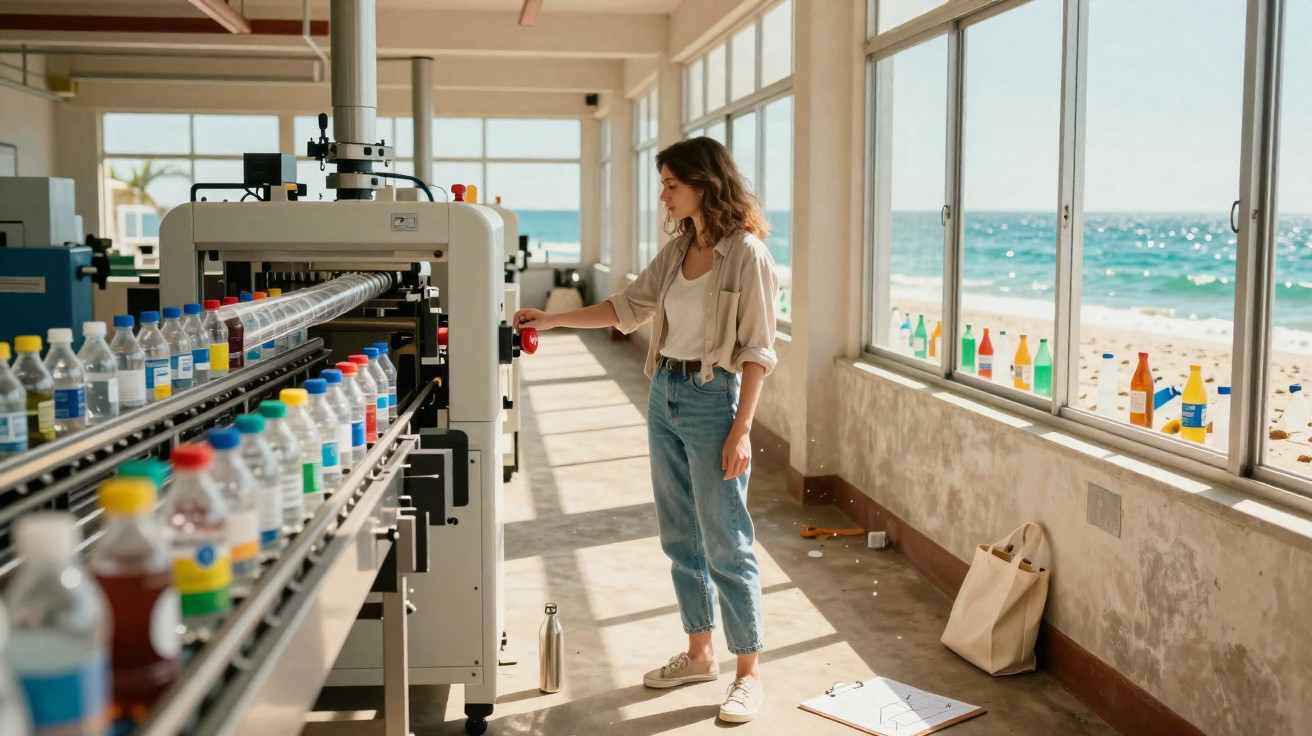
Over the 20 years leading up to 2019, worldwide plastic output doubled. By 2040, making and processing plastic may account for up to 20 per cent of global oil production and consume 15 per cent of the yearly carbon-emissions budget.
The majority of plastic produced ultimately becomes rubbish. As manufacturers raise output, increasing quantities will reach landfill sites, rivers and seas. Plastic waste is projected to treble by 2060.
Manufacturers frequently shift responsibility to consumers, presenting recycling programmes as the answer to plastic pollution. If plastics are recycled, surely the amount produced is irrelevant – isn’t it?
It is not that simple. The crucial issue is the strength of the link between plastic production and pollution. Our recent research found a direct connection: a 1 per cent rise in plastic production produces a 1 per cent rise in plastic pollution – unmanaged waste including bottles in rivers and plastic floating at sea.
More than half of branded plastic pollution is also associated with only 56 companies globally. The Coca-Cola Company is responsible for 11 per cent of branded waste, while PepsiCo accounts for 5 per cent. Effective plans by these firms to cut plastic could deliver a measurable fall in plastic entering the environment.
The issue will become still more pressing. Experts calculate that, by the end of this decade, a further 53 million tonnes could enter the oceans each year. That is harmful to people and to other species.
Plastic can seriously harm human health, with our earliest exposure beginning in the womb. At sea, it can suffocate turtles and seabirds; on land, it can contaminate groundwater. Plastic pollution now carries social and economic costs of roughly A$3.8 trillion annually.
This week, negotiators in Canada are meeting to continue work on a legally binding global plastics treaty.
Plastic fantastic?
During the 1960s and 1970s, plastic was regarded as a modern marvel. It soon became widespread, then unavoidable. Single-use plastics emerged everywhere, and items discarded by roadsides or into rivers can eventually reach the sea.
Around 36 per cent of all plastic pollution worldwide now comes from packaging, largely as single-use plastics.
To investigate the effect of plastic production on waste, we examined worldwide litter-audit data – surveys recording waste found in the environment. These audits help reveal shifts in the types and quantities of plastic waste. We analysed five years of data from over 1,500 audits in 84 countries. They found that 48 per cent of litter displayed a brand name, while 52 per cent had no branding.
For production volumes, we used figures supplied by large plastics companies to a circular-economy organisation, then compared these with levels of branded plastic pollution.
We anticipated that greater production would result in more waste, but not such a precise relationship. The 1:1 ratio is striking. In practical terms, when companies producing plastic packaging expand their operations, they directly add more waste to the environment.
Our analysis showed that only 13 companies each contributed 1 per cent or more of all branded plastic recorded. Every one produces food, drink or tobacco goods, generally sold in single-use plastic packaging.
Products from The Coca-Cola Company were the leading source of branded plastic pollution, accounting for 11 per cent of all branded litter.
At present, companies can market products in single-use plastic, while consumers are expected to recycle or dispose of the packaging. This places substantial costs on local authorities, which operate waste services, alongside the cost of environmental degradation borne by everyone.
Many large companies have voluntarily pledged to reduce their plastic use. Yet many are failing to meet those goals, indicating that voluntary action is not proving effective.
Producer responsibility for plastic packaging
A stronger option is producer-responsibility schemes, which could move costs and accountability from consumers back to producers. This follows the "polluter pays" principle: businesses whose products become waste are responsible for ensuring that waste is properly managed.
In places where such schemes operate, including the European Union, companies commonly alter the way their products are packaged. When there is a financial cost, they act.
The problem of single-use plastics
Even after collection, single-use plastics are challenging to manage because they have little or no value for recycling. They are sometimes burned as fuel in cement kilns or processed in waste-to-energy plants.
Recycling itself can generate a surprisingly significant amount of microplastic, since mechanical processes grind bottles into very small fragments.
Recycling is also not a closed loop, despite what the familiar symbol may imply. Each time plastic is recycled, its quality deteriorates further. In the end, it becomes waste.
To stop plastic waste, stop making more plastic
When recycling and landfill can achieve only so much, the missing part of the solution is a cap on plastic production.
What might this involve?
Manufacturers would need to progressively reduce the plastic used in their products and switch to safe, sustainable alternatives as these become available.
Countries could:
- establish measurable targets to phase out non-essential, hazardous and unsustainable single-use items, including takeaway containers, plastic cutlery and single-use plastic bags
- develop safe and sustainable products that reduce worldwide demand for new plastic while expanding reuse, refilling, repair and recycling
- invest in non-plastic alternatives and substitutes with stronger social, economic and environmental outcomes, including traditional reusable items.
And what of the 52 per cent of unbranded plastic waste? Addressing it demands improved data and accountability, for example through an international open-access database of plastic producers or international standards for packaging branding. Australia is moving in this direction through its planned packaging reforms.
One point is clear: present trends point to ever more plastic, and more plastic results in more plastic pollution.
Kathryn Willis, Postdoctoral Researcher, CSIRO; Britta Denise Hardesty, Senior Principal Research Scientist, Oceans and Atmosphere, CSIRO; Katie Conlon, PhD, Researcher, Portland State University; and Win Cowger, Research Director, Moore Institute for Plastic Pollution Research, University of California, Riverside
This article is republished from The Conversation under a Creative Commons licence. Read the original article.




Comments
No comments yet. Be the first to comment!
Leave a Comment