
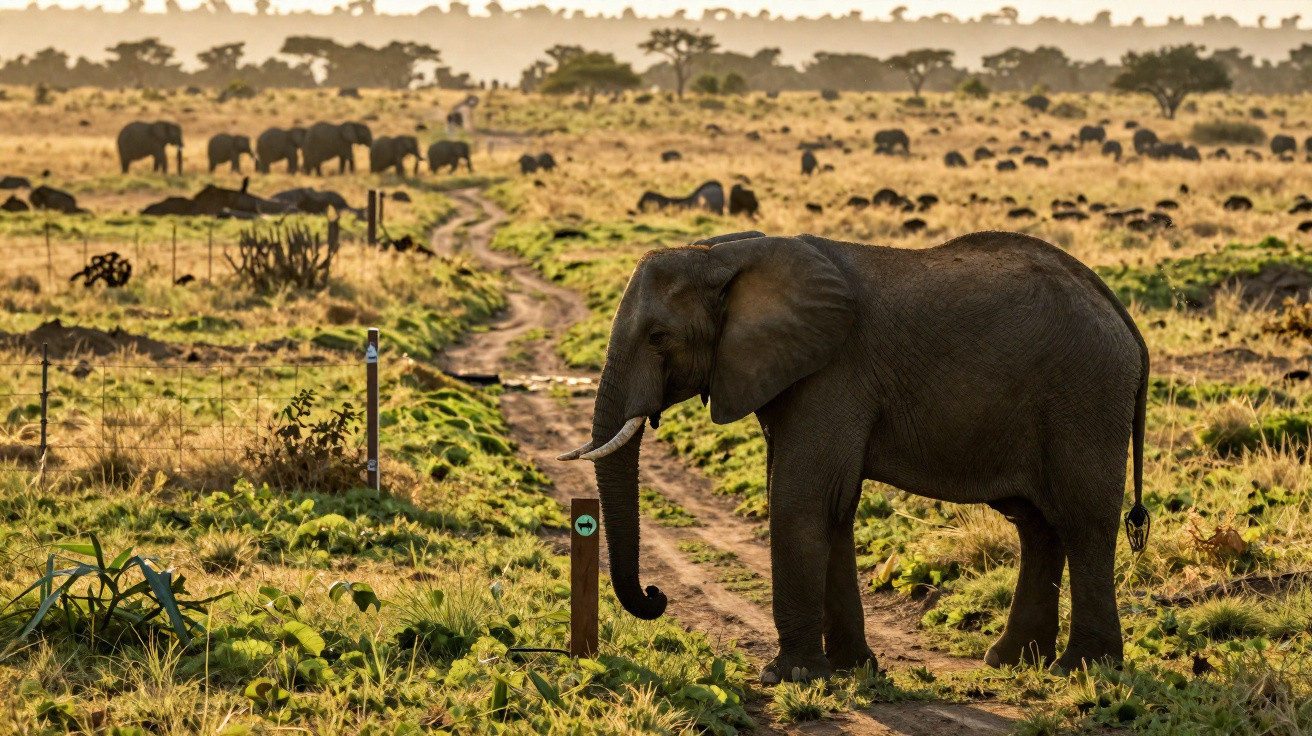
For thousands of years, Africa’s elephants were defined by movement. They travelled across enormous areas of the continent, encountered far-off herds and maintained genetically robust populations.
A significant new study reveals that this historic freedom is disappearing, with the effects already apparent in elephant DNA in certain areas.
An international research team examined 232 complete genomes from savanna and forest elephants in 17 African countries.
It is the biggest genomic investigation of African elephants to date, as well as the first continent-wide study on this scale.
A history of movement
The findings portray elephants as animals with profound connections. Rather than existing in separate pockets, their past involved long-distance travel and recurring gene flow among populations.
As elephants ranged widely and encountered other herds, their genes were shared over huge distances. This process supported genetic diversity and resilience over time.
“Our study shows that until recently, elephants have been connected across vast distances. This freedom of movement has created genetic robustness because the populations have intermingled,” said study lead author Patrícia Pečnerová from the University of Copenhagen and Lund University.
“Today, the picture is different. Elephants are living in a world where space is more and more restricted and some populations are becoming isolated.”
This change stems from a familiar combination of threats. Hunting, growing human populations, agriculture, roads and other infrastructure have fragmented landscapes through which elephants previously travelled more freely.
Consequently, some elephant populations across the continent are now separated from each other, bringing distinct genetic effects.
Isolation leaves a mark
The clearest cases were identified in north-eastern Africa. Researchers found that small, highly isolated elephant populations in Eritrea and Ethiopia live more than 400 kilometres from the nearest other herds.
Human settlements and farmland surround these elephants. Their genomes reveal substantial inbreeding, limited genetic diversity and an accumulation of mildly damaging mutations.
Such a combination can reduce a population’s capacity to deal with disease or environmental shifts. Although a small isolated group may persist for a while, it becomes increasingly vulnerable.
A comparable, yet more complex, situation emerged in West Africa. Elephant populations there have also declined and become isolated over time, in part owing to dense human settlement and the long-standing ivory trade.
Yet savanna elephants in west-central Africa had not lost genetic diversity to the same extent as those in Eritrea and Ethiopia, despite also being inbred.
The likely explanation is that genes from forest elephants entered these groups through hybridisation, helping to conceal some genetic losses.
This result supports one of the study’s more unexpected conclusions. Savanna and forest elephants are known to hybridise in a small number of places where their habitats overlap, but the research detected forest elephant ancestry in savanna elephants living well beyond present-day hybrid zones.
Two species, different histories
However, the study emphasises that hybridisation should not be viewed romantically as an easy conservation solution.
The scientists note that forest and savanna elephants have taken very different evolutionary routes for millions of years.
“By reconstructing their genomic history, we found that savanna and forest elephants followed very different population trajectories over the last four million years, with over 85% of overall elephant genetic variation due to the differences between them,” said study senior author Alfred Roca from the University of Illinois Urbana-Champaign.
“Given this history, gene flow between the species is unlikely to be beneficial, and hybrid elephants should be avoided for translocations.”
“Among savanna elephant populations, historically high connectivity across their range limited regional differentiation. However, there were sufficient genetic differences across southern, eastern, and west-central Africa to suggest that translocations across regions should be avoided.”
This warning is important because translocation is frequently considered a wildlife conservation measure.
Moving elephants is risky
Relocating animals can sometimes support struggling populations, but the study indicates that ignoring deep genetic history when doing so could introduce fresh difficulties.
The researchers established that savanna elephant populations in southern, eastern and west-central Africa were connected for long enough to avoid pronounced regional divisions, although important differences still arose.
These distinctions mean that moving elephants between regions should not be undertaken casually.
Forest elephants, meanwhile, seem to possess greater genetic variation and fewer potentially harmful mutations than savanna elephants.
Their sharply declining numbers in recent years mean this does not resolve their crisis, but it indicates that their genetic condition may provide some resilience in the short term.
Why elephant corridors matter
The study’s central message is that elephant conservation cannot be limited to safeguarding animals in isolated reserves. Their genetic prospects rely on their continued ability to move across the wider landscape.
The Kavango–Zambezi Transfrontier Conservation Area in southern Africa is one location where this still appears achievable. The vast KAZA region spans five countries.
Elephant populations there remain genetically diverse because they continue to be connected and can exchange genes.
“Elephants are extremely intelligent animals that can live close to humans and adapt. But one of the most important forces for their evolution is that genes can move between populations,” Pečnerová said.
“In southern Africa, the landscape still allows movement between protected areas, and here we see that the genetic health of the elephants remains relatively intact.”
Without these connections, even populations that appear secure now could gradually lose genetic strength.
Wider implications of the study
The historic routes that enabled elephants to travel, encounter one another and interbreed are vanishing. The scientists suggest this loss may be among the least visible yet most serious threats facing them.
Study co-author Chris Thouless is Director of Conservation at Save the Elephants and Director of the Elephant Crisis Fund.
“This study reminds us that we cannot understand or conserve elephants without knowing their history, and that they have always been in flux, especially in response to human impacts and climate change,” said Thouless.
“The finding that recent and ancient hybridization between the two species extends over such a large part of both species’ range is particularly interesting.”
“The evidence of inbreeding in isolated and depleted savanna elephant populations is a matter of concern, especially since the samples on which this study is based date from before the recent period of intense poaching for ivory.”





Comments
No comments yet. Be the first to comment!
Leave a Comment