
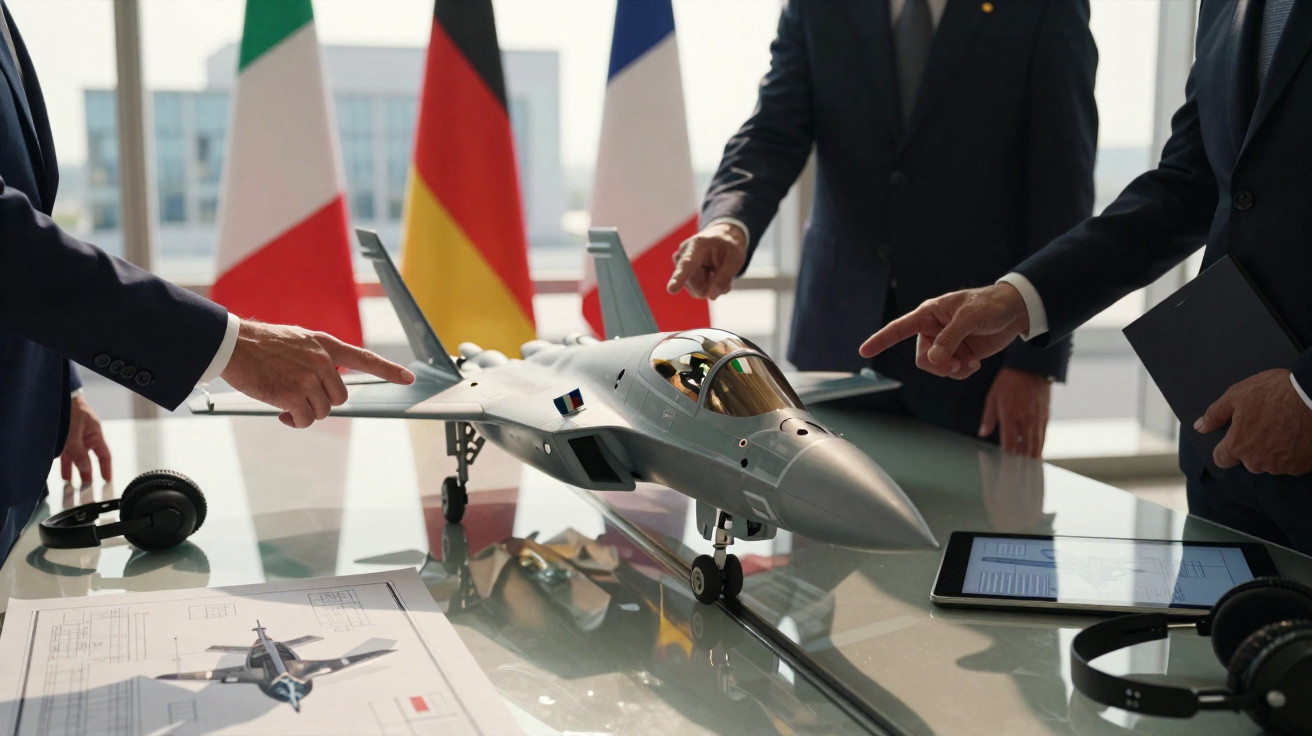
Italy has opened the door to Germany potentially joining the Global Combat Air Programme (GCAP), the joint project Rome is advancing with the United Kingdom and Japan to develop a sixth-generation fighter aircraft by 2035. The move comes amid mounting tensions between Berlin and Paris over the parallel European Future Combat Air System (FCAS) programme.
During a parliamentary hearing, Italian Defence Minister Guido Crosetto said that several countries had expressed an interest in joining GCAP. “Germany could probably join this project in the future,” he said. He also noted that Australia, Saudi Arabia and Canada had made enquiries.
Germany's possible role in the Global Combat Air Programme (GCAP)
GCAP is headed by Mitsubishi Heavy Industries in Japan, BAE Systems in the United Kingdom and Leonardo in Italy. The programme envisages a stealth fighter operating alongside drones and collaborative combat systems. Crosetto stressed that the three founding countries had agreed to cooperate on equal terms. “The more countries that join, the greater the critical mass available for investment, the more intellectual capability can be brought together, the greater the economic return and the less it will cost us,” the minister said.
A backdrop of the Franco-German FCAS dispute
Italy’s interest in bringing in additional partners coincides with tensions affecting FCAS, the European project launched in 2017 and valued at €100 billion. Led by France, Germany and Spain, with Dassault Aviation, Airbus Defence & Space and Indra participating, the programme is intended to replace the Rafale and Eurofighter Typhoon by 2040.
However, disagreements between Paris and Berlin have become more acute. According to sources close to the negotiations, the German Defence Ministry recently considered possible alternatives with Airbus due to the lack of progress. The areas of dispute include the allocation of work and technological leadership within the Next-Generation Weapon System (NGWS), which includes the future crewed New Generation Fighter (NGF) and several associated systems.
In July, reports indicated that Dassault had proposed taking on up to 80% of NGWS work, prompting opposition in Berlin. French officials denied that figure, although the debate further exposed the absence of consensus.
German MP Andreas Schwarz warned in comments to Politico: “At some point the [German] Parliament will have to say: ‘Do we need this aircraft or do we not need it?’” He highlighted both the delays and the risks confronting the project.
Options under consideration in Germany
Against this backdrop, Germany is examining several possible courses of action. These include strengthening cooperation with Spain, bringing in Sweden through Saab, or exploring a convergence with the United Kingdom, which leads GCAP. The latter option raises questions over a potential conflict of interest, as BAE Systems leads development of the Tempest fighter within the same programme.
Sweden is regarded as a technically viable option because of Saab’s role in designing the Gripen and its expertise in avionics, sensors and lightweight structures.
The issue has also been addressed at political level. German Chancellor Friedrich Merz said in Madrid, alongside Spanish Prime Minister Pedro Sánchez: “We share the assessment that the current situation is unsatisfactory. We are not making progress with this project. We are both speaking with the French government and want a solution as soon as possible.”
Meanwhile, German government spokesperson Stefan Kornelius said: “The distribution of burdens and work in this armaments project must be carried out in accordance with the contract,” adding that coordination with Madrid was under way.
Italy's case for new GCAP partners
While tensions within FCAS remain unresolved, Italy argues that new GCAP members could strengthen the programme’s industrial, technological and financial viability. Crosetto’s remarks suggest that Rome is seeking to position itself as a player able to attract partners in a strategic sector for European and Indo-Pacific defence. Should Germany reconsider its role in FCAS, any eventual move towards GCAP would alter the balance of power in both programmes and in the continent’s future air combat architecture.






Comments
No comments yet. Be the first to comment!
Leave a Comment