
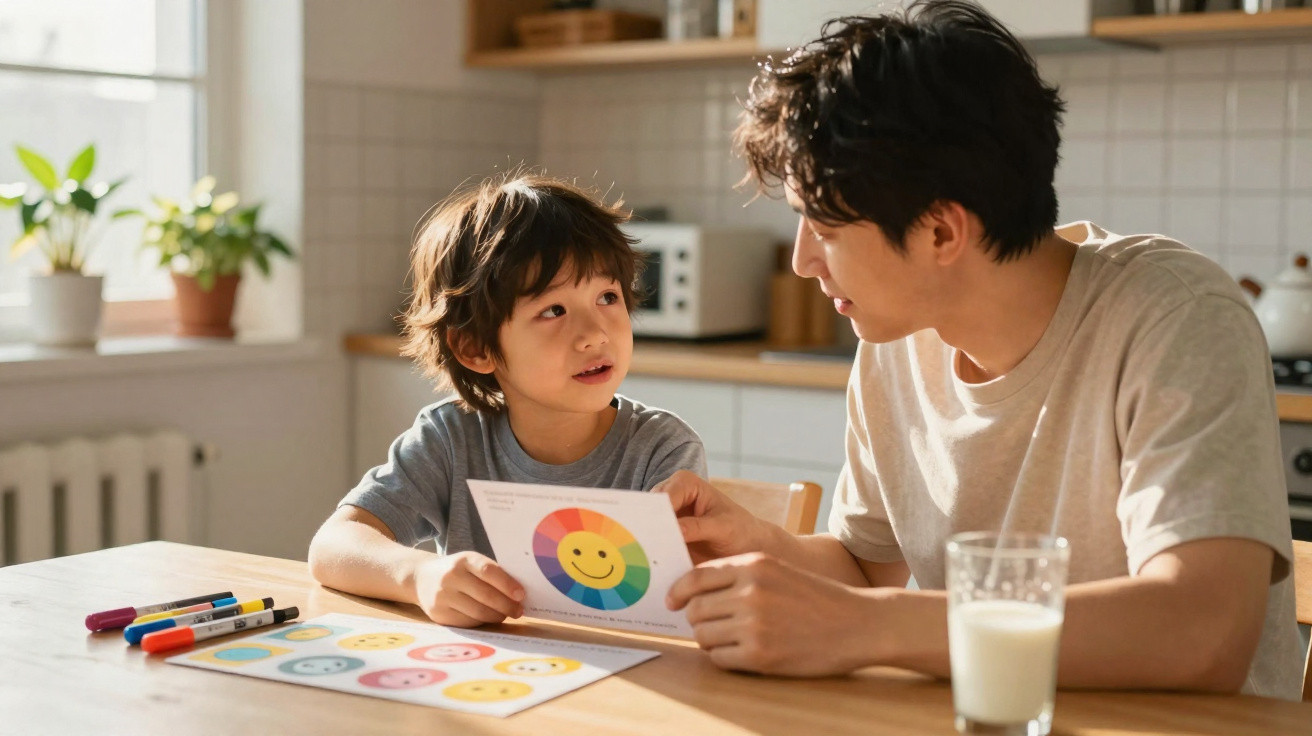
Some parents do things differently at precisely this point.
In a growing number of families, another issue is becoming as important as school grades: how well children handle their own emotions and those of other people. Specialists call this emotional intelligence, and regard it as a vital foundation for happiness, friendships and future professional success. Six recurring behaviours are particularly common among parents whose children are noticeably more advanced in this area than their peers.
Why emotional intelligence matters so much today
For a long time, the traditional intelligence quotient was seen as the main measure of ability. Research now indicates that social and emotional skills are at least as significant in predicting how successfully someone will navigate life later on – whether they can resolve conflicts, sustain relationships and cope with stress.
Children with well-developed emotional intelligence find it easier to make friends, deal better with disappointment and are less likely to experience mental health problems.
The encouraging part is that these abilities are not an inborn luxury talent; they are learned over time. Parents, grandparents and carers all have a key part to play. Anyone who understands which everyday influences they can adjust equips children with valuable inner tools.
1. Giving feelings clear names
The starting point is that children need to understand what is happening inside them at all. At first, emotions are simply a confusing collection of physical sensations – a racing heart, tears or butterflies in the stomach.
Parents raising emotionally resilient children often speak about feelings very specifically in daily life. Rather than simply saying, “It’s nothing”, they might say:
- “You seem very sad because your friend is not here today.”
- “I can see that you are clenching your fists – are you feeling angry?”
- “You are absolutely beaming; are you proud of your picture?”
This helps children connect their internal experiences with terms such as sadness, anger, shame, disappointment, pride and joy. Over time, they can use those words themselves instead of only screaming or hitting.
2. Taking feelings seriously rather than brushing them aside
A familiar response in stressful moments is: “Don’t make such a fuss” or “It’s not that bad”. These phrases may be intended to comfort, but they often have the opposite effect. The child learns: my feelings are annoying, so I should hide them.
Parents of emotionally competent children respond differently. They acknowledge what the child is feeling without approving every action. Common wording includes:
- “I understand that you are disappointed because the game has finished.”
- “You are really angry – I can see that.”
- “Being scared of the dark feels very unpleasant; I will stay with you.”
Feelings are accepted, while actions still have limits – that is the heart of an empathetic approach.
This builds trust: children are allowed to feel what they feel. At the same time, they learn that rules still apply. Anger is allowed – hitting is not.
3. Parents model how to deal with emotions
Children rarely follow advice alone, but they notice every slight expression on their parents’ faces. Someone who loses their temper at the smallest stressor unconsciously communicates that anger simply explodes. Someone who keeps everything bottled up shows that feelings have no place here.
Parents who take their own emotional competence seriously also talk about their inner state without placing a burden on their children. For example:
- “I am feeling irritated because it has been a demanding day. I am going to take two minutes to calm down.”
- “I am so pleased that you hugged me; it makes me feel good.”
The message becomes clear: feelings are normal, they can be named, and people can actively help themselves become calmer again. Everyday family life becomes a learning environment, without any lecturing.
4. Practising strategies for difficult moments
Knowing what feelings are is not enough. Children also need tools to manage intense emotions. Many families create small rituals for this purpose.
The more often a child experiences, “I can calm myself down”, the safer they feel – including in unfamiliar situations.
Practical support for children
Examples that have proved helpful include:
- Breathing games: breathing out slowly together “like a soap bubble”, “blowing out” candles or inflating imaginary balloons.
- A place to retreat: a designated cushion, a cosy corner or a “calm tent” where the child may withdraw briefly.
- A small calming kit: a colouring book, coloured pencils, headphones with quiet music, or a familiar soft toy.
Parents can explain that powerful emotions pass again. In time, the child makes the connection: first the wave arrives, then I use my strategies, and afterwards I feel better.
5. Supporting children instead of solving their problems for them
Emotional intelligence is also evident in the way children settle conflicts. Parents who always make decisions on their behalf remove the opportunity to practise this ability.
Rather than stepping in immediately, many parents ask questions such as:
- “What could you do so that both of you can play together again?”
- “What options can you think of if you cannot sit next to her tomorrow?”
- “What would be a solution that is reasonably okay for both of you?”
In this situation, parents are more like coaches than firefighters: they guide rather than putting out every fire themselves.
Together, they can then discuss which option is most likely to work well and where the risks lie. This lets children experience self-efficacy: I can influence my situation. It strengthens self-confidence and reduces later overthinking.
6. Making feelings an ongoing part of everyday life
Emotionally resilient children rarely grow up in families where feelings are discussed once a year. The subject comes up continually – casually, in a child-friendly way and often through fictional characters too.
Using everyday situations thoughtfully
Even simple moments can work surprisingly well, for example:
- While reading aloud: “How do you think the character feels now?”
- After an argument: “What happened just before you became so angry?”
- Following a success: “How can you tell that you are proud?”
Mistakes and outbursts are not treated as a parenting failure, but as material for a calm conversation once everyone has settled down. This creates a continuous learning process that begins in nursery and continues into adolescence.
What the term “emotional intelligence” means
Many parents are unsure about what emotional intelligence actually involves. It does not mean “always nice and harmonious”, but a combination of four areas:
| Area | What children learn |
|---|---|
| Self-awareness | Recognising and naming their own feelings |
| Self-regulation | Managing powerful feelings without hurting themselves or others |
| Empathy | Noticing other people’s feelings and perspectives |
| Social competence | Resolving conflicts, building relationships and finding compromises |
The more often children gain experience in these areas, the more robust the corresponding “emotional muscles” in the brain become.
Practical everyday tips for parents
Parents do not need to transform their entire family life to put the six principles into practice. Even three small changes can make a considerable difference:
- One feelings moment each day: A brief question such as “What was nice today, and what was rubbish?” is enough to get started.
- Checking your own reactions: Before saying, “That is enough now”, pause briefly and first put into words what the child is feeling.
- Establishing rituals: A breathing exercise before bedtime, a quiet minute after nursery or a shared reflection after an argument.
Over time, this creates a family culture in which feelings do not get in the way but are simply part of life. Children learn to understand themselves, take others seriously and not fear conflict. Nobody can take this inner foundation away from them – not even in a noisy, hectic world.






Comments
No comments yet. Be the first to comment!
Leave a Comment