
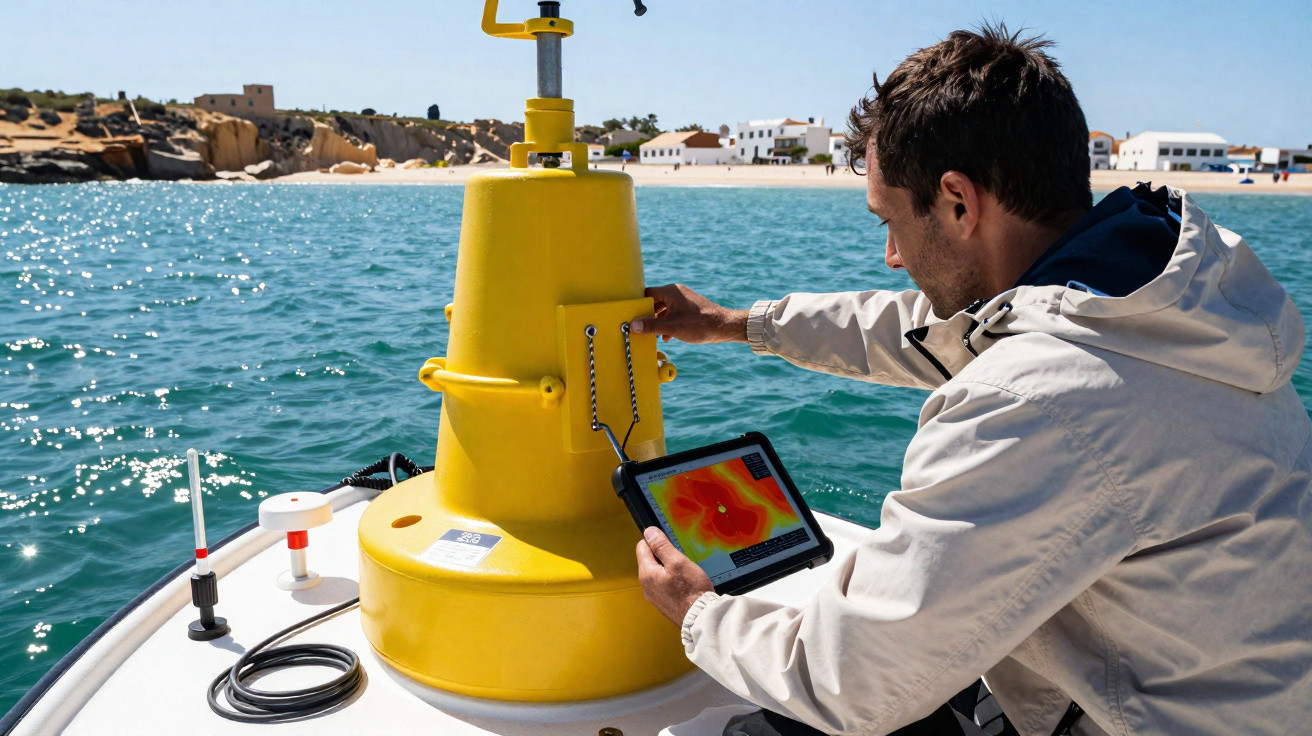
The Portuguese Navy’s coastal monitoring buoy recorded sea temperatures that remained above normal for the time of year.
Algarve sea surface temperature reaches 26.1 °C
In recent days, the Algarve’s sea surface reached temperatures of up to 26.1 °C, an anomaly that has become increasingly frequent and intense. Its effects on Portuguese marine ecosystems will be investigated.
According to the Portuguese Navy, between 15 June and yesterday, the Faro buoy-part of the Hydrographic Institute’s national coastal monitoring network, MoniZEE-identified two marine heatwaves and recorded a peak of 26.1 °C, demonstrating the "scale of the observed warming".
Mário Marques, a climate change specialist, said that sea-water temperature anomalies have occurred in Portugal before. More recently, he noted, there was "above-average warming, a positive anomaly of around 4 °C, between Sines and Troia".
He added that the rise in sea-surface temperatures in the Algarve is not a direct result of the heat that affected the country at the beginning of the month. Such events are driven by a combination of factors, including the movement of air masses and ocean currents, while global climate change also plays a role. In the Algarve’s case, "southerly flows promote an increase in sea-surface water temperature".
The specialist stressed that there has been an increasing "number of days with anomalies", including during winter, when "temperatures have not fallen as much as was normal". He warned that anomalies are expected to occur "more frequently, given the warming of the planet".
Environmental monitoring
The Portuguese Navy says the information is "relevant to environmental monitoring, understanding thermal variability in the ocean and supporting activities that depend on sea conditions".
Francisco Leitão, from the University of Algarve’s Centre for Marine Sciences (CCMAR), told JN that research into the "consequences for marine fauna" of these situations along the Portuguese coast is only now getting under way. Several projects are beginning at the university to establish how marine heatwaves will affect fish and, consequently, "fishers and society", he explained.
More to know
Two heatwaves
The first of the two marine heatwaves was moderate, reaching a daily maximum of 23.3 °C (1.5 °C above the threshold for that date). The second was strong, with a daily high of 24.8 °C (2.2 °C above).
They last several days
Marine heatwaves are periods of at least five consecutive days during which the sea-surface temperature remains above the usual values for that time of year in that area.
Europe was also affected
Anomalies have also occurred elsewhere in Europe. The Bay of Biscay and south-western Great Britain recorded temperatures 3 °C above what is normal for this time of year.
Heatwaves have doubled
According to the UK’s National Oceanography Centre, one of the world’s leading research centres in this field, the number of marine heatwaves has doubled since 1982. Recent cases have occurred in the North Atlantic, near Antarctica and in the Mediterranean.





Comments
No comments yet. Be the first to comment!
Leave a Comment