
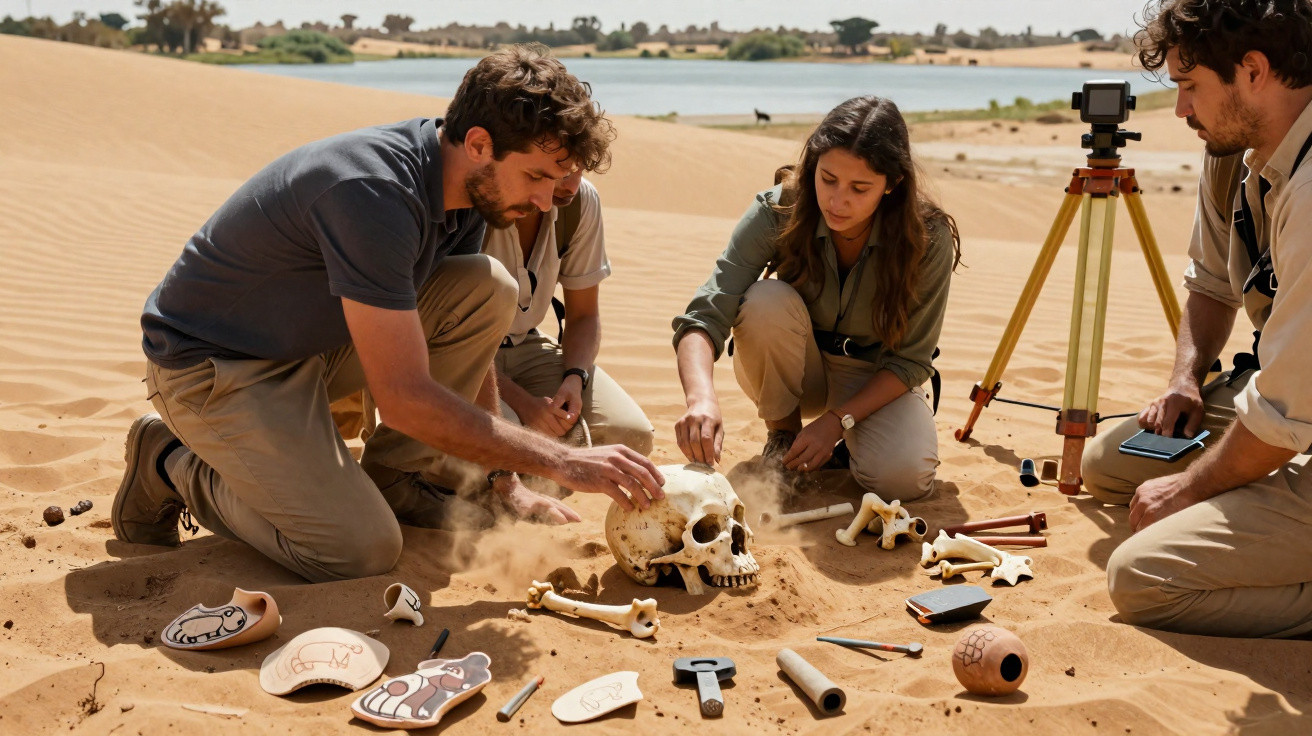
Anyone thinking of the Sahara is likely to picture limitless dunes, searing heat and an empty landscape hostile to life. Yet thousands of years ago, northern Niger contained a water-rich environment of lakes, marshes and river networks. An archaeological site in this now restricted region reveals how people once lived there, buried their dead and were ultimately engulfed by the returning desert sands.
When the “green Sahara” supported hippos and giraffes
Around 12,000 years ago, North Africa’s climate was completely unlike that of today. A slight shift in the Earth’s axis moved the tropical belt northwards. This brought far heavier monsoon rainfall, transforming large areas of what is now desert into savannah.
Satellite imagery has identified former river channels, broad basins and the precursor to an enormous ancient Lake Chad. Rock engravings in Algeria, Libya and Niger depict giraffes, elephants and hippopotamuses-animals that can thrive only in water-rich habitats. Together, these pieces of evidence point to a consistently humid climate that attracted both people and wildlife.
“Where sandstorms rage today, there were once shorelines, fishing camps and grazing herds-a completely different Sahara world.”
It was during this period that a site emerged on the shore of a lake in what is now the Ténéré. It would later be described as Africa’s largest known Stone Age cemetery: Gobero.
Gobero: a Stone Age cemetery in the heart of the “Desert of Dread”
The discovery itself was largely accidental. In 2000, palaeontologist Paul Sereno and his team were crossing the area in search of dinosaur fossils. Among the dunes, he noticed bones and stone tools lying on the surface-but they belonged not to prehistoric reptiles, but to humans.
Subsequent investigations uncovered an entire network of burial mounds. Researchers found around 200 human skeletons across several sandy rises. Radiocarbon dating places the earliest burials at roughly 8000 BCE. This means that people were already using this lakeshore as a long-term settlement and burial site soon after the wet climatic phase began.
One grave is especially striking: it contains a woman and two children. Their bodies were carefully arranged, with their limbs laid across one another as if the three were embracing. Pollen analysis suggests that the woman and children rested on a bed of flowers. Details such as these portray a community that took great care in saying farewell to its dead.
What grave goods reveal about everyday life
The skeletons were not buried in sand alone. Many of the dead were interred with objects that offer direct clues to their way of life:
- Bone harpoons and fishing hooks
- Beads made from ostrich eggshell
- Jewellery fashioned from hippopotamus ivory
- Animal bones from fish, crocodiles and turtles
These discoveries show that the lake supplied plentiful food for thousands of years. Fishing was central to life, supplemented by hunting and gathering. The elaborate ornaments indicate social structures in which status, belonging and ritual held a clearly defined place.
“Gobero cemetery is not a site of mere survival, but the product of a relatively stable way of life shaped by prosperity beside the water.”
Bone studies suggest that the people were well nourished and generally powerfully built. Evidence of violence is rare. Competition over resources apparently proved less severe than it would become during later, drier phases of North Africa’s climate.
Two peoples, one lake-and a gradual departure from the water
Gobero is particularly compelling because it does not represent just one community. Bioarchaeological research distinguishes two clearly separate populations that lived successively at the same location.
The Kiffians: robust fishers of the first wet phase
The earliest group, known to researchers as the Kiffians, occupied the region at the start of the “green” Sahara phase. Their skeletons indicate tall, exceptionally robust bodies. They used heavy harpoons, hunted large fish and probably lived in seasonal camps around the lake.
Between roughly 6200 and 5200 BCE, however, the wet phase collapsed. A prolonged dry period lowered water levels and reduced vegetation. The Kiffian group appears gradually to have left the region, and the cemetery fell silent.
The Ténéréans: a lighter build and a new strategy
When rainfall returned, a changed environment took shape and a second group appears in the archaeological record: the Ténéréans. They were more slight and lighter in build, used different tool styles and probably followed adapted dietary strategies.
Significantly, the Ténéréans placed their graves among the older Kiffian burials without disturbing them. This suggests that the site’s former importance endured in cultural memory-perhaps as a sacred place, perhaps as a landmark invested with mythical meaning.
Isotope analysis of teeth points to a largely local way of life. Rather than moving frantically from oasis to oasis, people remained in the same region for much of their lives. The lake’s surroundings evidently provided enough food to make this settled existence possible.
How climate change buried the Sahara lake beneath sand
Around 5000 years ago, the system shifted again. Monsoon rains retreated further south and the Sahara’s “green” belt dried out. The lake at Gobero shrank, its shore zones died away, and sand swept across the areas that had once been settled.
For the inhabitants of the time, this change must have been brutal. Water sources dried up, fish populations collapsed and wild animals migrated elsewhere. People were forced to seek new habitats-probably along the remaining rivers or in the early fringe zones of the Nile system.
“Today’s desert is not merely a natural landscape, but an archive of abrupt climate crises that forced entire cultures to move on.”
Gobero was left behind, buried beneath dunes and far from any settlement route. That isolation protected the graves for thousands of years and is precisely what makes the discovery so exceptional for research.
What Gobero changes in our understanding of the Sahara
The idea of the Sahara as an eternal, unchanging dry desert does not withstand scientific scrutiny. Gobero vividly demonstrates how dynamically this region responds when the Earth’s axis, ocean currents and temperature belts change.
Such sites provide comparative data for climate research: how greatly can rainfall fluctuate? How quickly can ecosystems change? And how do human communities respond? At a time when climate change is once again putting entire regions under pressure, these Stone Age traces take on renewed relevance.
Gobero also opens new possibilities for the archaeology of North Africa. The discovery suggests that more unrecognised sites may exist along former lakes and river systems-perhaps even entire settlement landscapes still concealed beneath dunes. Expeditions, however, must overcome immense logistical obstacles, security concerns and extreme environmental conditions.
Terms, context and a look at the risks
What the term “green Sahara” means
Researchers use “green Sahara” to describe periods when today’s desert belt became savannah, scrubland and wetlands. Such phases occurred repeatedly over the past tens of thousands of years, driven by variations in Earth’s orbital parameters. Rain belts shifted north, rivers formed vast networks and large lakes filled deep depressions.
For people, this meant not only new hunting grounds but also risks: every shift back towards a drier regime forced migration or major adaptation, much as coastal populations today must respond to rising sea levels.
Modern expeditions in prohibited zones
Many of these historical locations now lie in military exclusion zones, difficult-to-reach desert regions or politically unstable countries. Expeditions therefore face several risks at once:
- Extreme temperatures and sandstorms that strain people and equipment
- Vast distances without infrastructure, making water and fuel planning difficult
- Security conditions that may require sudden evacuations
- Ongoing issues involving looting and the illegal trade in artefacts
Despite all these obstacles, researchers believe that Sahara sand still conceals many such “forgotten oases”. Gobero is regarded as a key laboratory: the site shows how closely climate, landscape and culture are interwoven-and how far back the stories of adaptation, loss and departure truly begin.





Comments
No comments yet. Be the first to comment!
Leave a Comment