
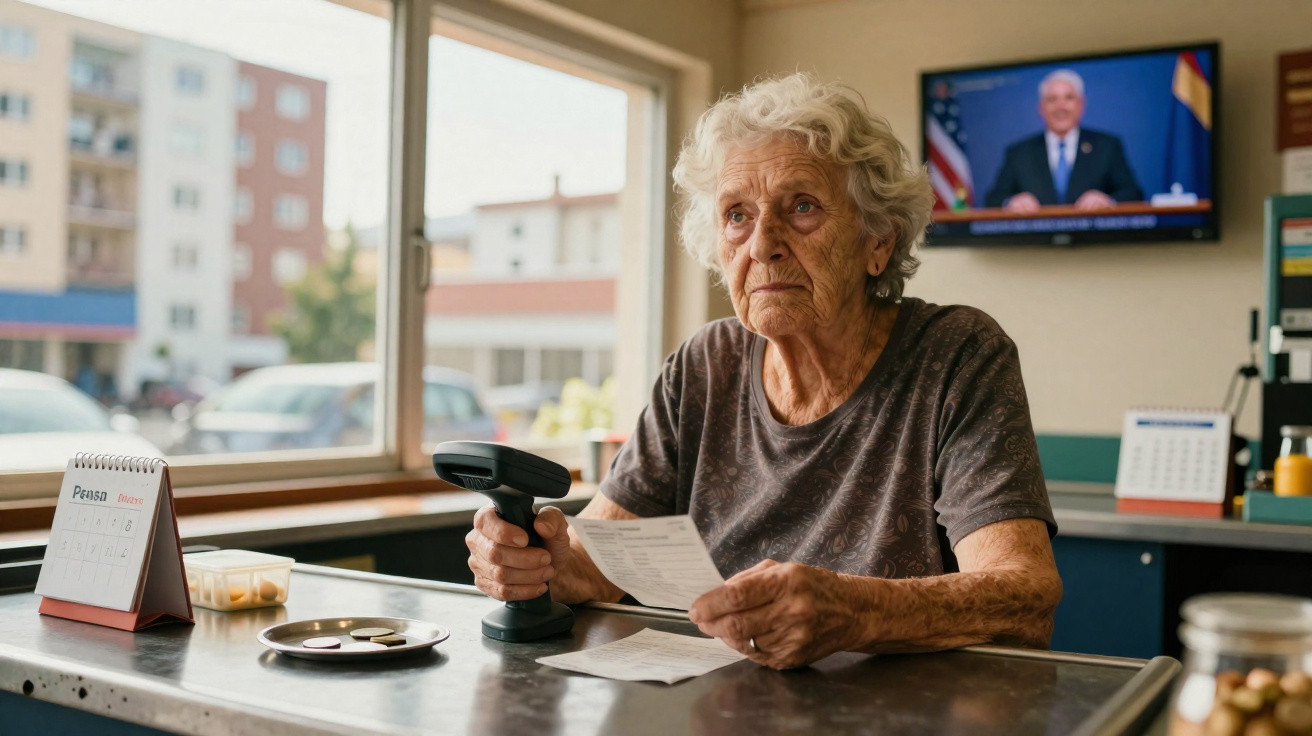
On a bleak Tuesday morning, the supermarket’s doors glide apart, and the first person at a till is not a student. She is a woman old enough to be your grandmother. Her hands work at speed, yet her shoulders sag as she strains to keep her eyes open beneath the fluorescent lights. Once the queue eases, she discreetly stretches her back, with the weariness of someone exhausted for years rather than merely hours.
From the radio above, a minister praises himself for “historic progress for retirees”.
She scans another packet of pasta, offers a smile to a sobbing toddler and checks the time. She has another two hours before she can return home, eat inexpensive soup and once again work out how long her savings might hold out.
Her name is Marie. She is 71.
She works because the alternative is poverty.
When retirement no longer covers the rent
At ground level, the so-called “golden years” resemble a second shift far more than a postcard.
You see it once you begin to look.
There is the man replenishing shelves in the evening, his hair completely white, pausing to draw breath before lifting yet another box.
There is the former teacher driving for a ride-hailing app, carefully repositioning her glasses so she can read the satnav after dark.
These older people did not abruptly develop an enthusiasm for poorly paid work at 68.
They remain in the labour market because the sums on their bank statements bear little resemblance to the assurances they heard on television.
For every prominent announcement about pension reform, there is a quiet army of older workers doing little more than holding on.
Consider James, 74, who once ran a small plumbing business.
After his wife became ill, the money intended for their retirement was swallowed by medical costs and the steady drain of day-to-day spending.
His state pension pays the rent and household bills, but leaves little beyond that.
Three mornings each week, he stands at the entrance to a DIY shop in a branded gilet, welcoming customers and pointing them towards the correct aisle.
He laughs when someone says he “looks great for his age”.
In reality, stopping work would mean he could not afford his wife’s medication or the additional heating she requires during winter.
That is what “choice” means when the sums do not work.
The explanation is both harsh and straightforward.
People are living longer, costs are increasing more quickly than pensions, and working lives are no longer as uninterrupted or secure as they once were.
Interrupted careers, part-time roles and extended periods spent caring for others all leave gaps that, years later, become lower monthly pension payments.
Politicians are fond of citing the average pension, but averages conceal almost everything.
They obscure the cleaner who spent 40 years working without a contract.
They obscure the single mother who combined three jobs yet had little recorded officially.
As a result, the “model retiree” presented in election speeches scarcely reflects those pushing trolleys at daybreak.
How older people survive - and where the system fails them
Under this pressure, many older adults adopt a discreet and carefully planned approach to survival.
Early each morning, they look through job adverts for posts that avoid heavy lifting and night work.
Some work as receptionists, lollipop people, babysitters, private tutors or dog walkers.
Others let out a room, sell belongings online or piece together small freelance assignments.
There is a certain determined dignity in this.
It is a refusal to vanish, a wish to contribute, retain a routine and continue feeling useful.
Yet beneath it lies an unending calculation: “How many hours do I need this month so I don’t go into the red?”
The problem emerges when financial need meets exhaustion.
Bodies that have spent decades carrying children, boxes, patients or machinery do not suddenly recover at 65.
Many older people take jobs that are underpaid, physically demanding or plainly unsuitable because they believe there is no alternative.
They work the shifts younger employees reject.
They agree when they probably ought to refuse.
In truth, no one studies the small print of “flexible contracts” when the fridge is half-empty.
When they eventually break down through a fall, burnout or a stay in hospital, the system frequently rebukes them for failing to “plan better”, as though life always followed a spreadsheet.
Meanwhile, political debate can seem almost unreal from where they stand.
On television, leaders exchange statistics and congratulate themselves for “safeguarding the system”.
On discussion programmes, it becomes a generational boxing match: “Boomers versus youth”, as though nobody were giving anything up.
“Sometimes I watch them debate the retirement age,” sighs Elena, 69, who cleans offices at night.
“And I wonder if any of them have ever scrubbed a toilet at 3 a.m. with arthritis in their hands.”
The simple reality is that a pension that does not meet basic needs is not truly a pension - it is a warning sign.
The divide between official speeches and the reality of supermarket aisles is growing, while trust is fading.
- Rising prices, frozen pensions - Grocery costs, rent and energy bills rise sharply while benefits hardly increase.
- Invisible careers, invisible rights - Caring responsibilities, informal work and lengthy breaks are seldom fully recognised in pension calculations.
- Health versus income - Each additional year in work may look positive on a spreadsheet, but it affects real bodies, real exhaustion and real pain.
A future affecting everyone, not only “the old”
The uncomfortable reality is that this discussion concerns more than current retirees.
It reflects all of us back to ourselves.
What kind of later life are we building together if a lifetime of work ends with someone scanning barcodes at 72 so they can buy fruit and heating oil?
What does it reveal about our priorities when politicians take pride in balanced budgets while people balance bags of food at the entrance to a food bank?
We have all experienced that instant when an older worker catches our attention and we feel an acute mixture of respect, sadness and fear.
Their story seems to ask us one question directly:
Will I be next?
| Key point | Detail | Value for the reader |
|---|---|---|
| Hidden reality of “working retirees” | An increasing number of older people stay in low-paid jobs because their pensions do not meet essential costs | Helps readers identify a social trend that could affect their own future |
| Gap between speeches and daily life | Political claims about “solid pensions” conflict with clear accounts of financial hardship | Places public debates that can sound abstract into context |
| Shared responsibility | Today’s decisions on pay, housing, health and care determine tomorrow’s old age | Encourages readers to consider preparation, solidarity and political pressure |
FAQ:
- Question 1 Why are more older people working beyond retirement age?
- Question 2 Does working after retirement always indicate poverty?
- Question 3 Which jobs do retirees commonly take to top up their pension?
- Question 4 How do political pension reforms affect retirees’ daily lives?
- Question 5 What can I do now to avoid having to work in old age?





Comments
No comments yet. Be the first to comment!
Leave a Comment