
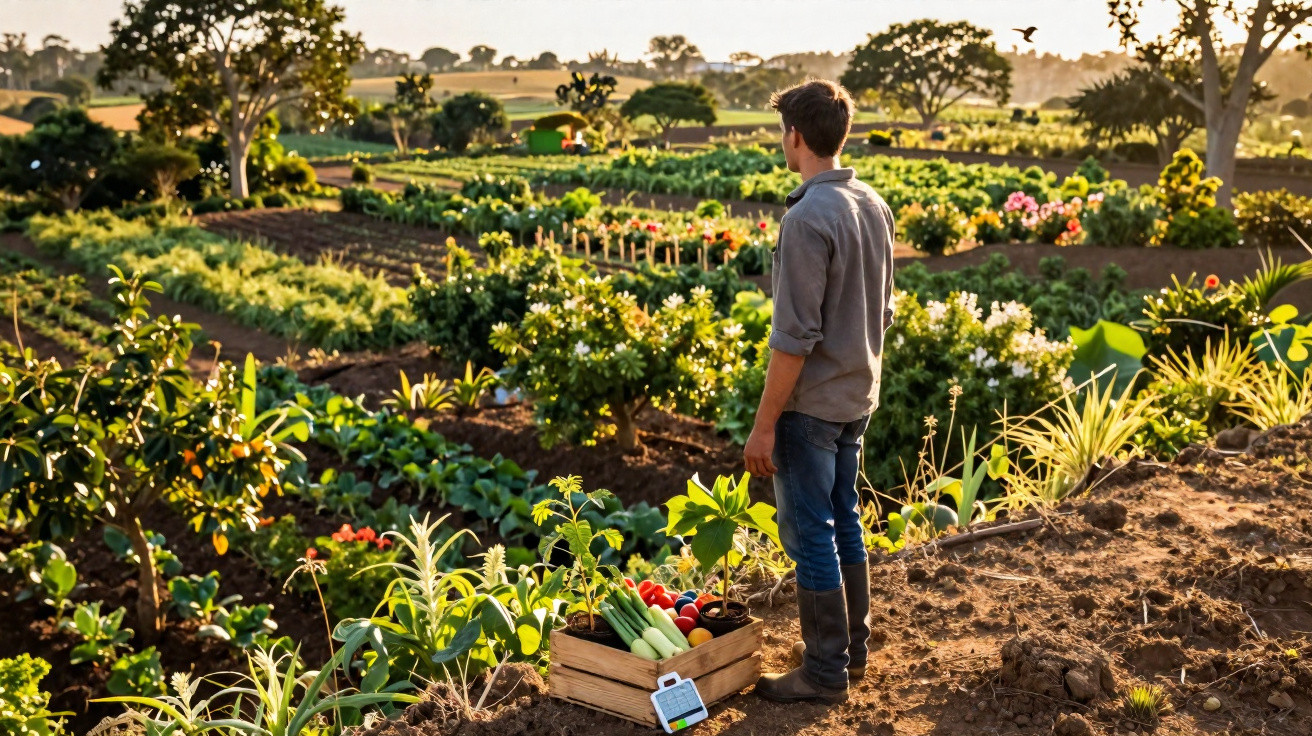
Tall shade trees, coffee bushes, cassava, bananas and bean patches form an interwoven green mosaic. Children dart among the trunks carrying mangoes and avocado leaves, while a chicken, apparently affronted, rushes through the undergrowth. Two decades ago, this hillside in eastern Uganda was nearly stripped bare by drought and misfortune. Today it belongs to a quiet global revival: more than 22,000 agroforestry systems have been restored, replanted and brought back to life.
The scent of damp earth mingles with woodsmoke. John, a local farmer, gestures towards a row of trees sheltering the land from the wind and remarks almost offhandedly, “That’s my insurance.” He does not mean a bank policy.
Somewhere among the tree roots and maize stalks, a different sort of safety net is taking shape.
From exhausted fields to living mosaics
Step into a restored agroforestry plot and your feet register the change before your eyes do. The ground has a soft, springy feel, closer to a woodland floor than the hard-baked surface common in fields scorched by the sun. Birds absent for years begin calling from the canopy. When farmers describe the return of these 22,000 systems, yields and charts are seldom their starting point. Instead, they mention sound, shade and the first occasion when rain soaked into the soil rather than disappearing in a muddy torrent.
These are not research plots or experimental laboratories. They are productive farms, where trees, crops and sometimes livestock are combined like a patchwork quilt that has finally started keeping out the cold.
That patchwork is expanding more quickly than many people might think.
In northern Nicaragua, a long-established coffee cooperative once removed shade trees after being told that “full sun” would produce more beans. It has since replanted thousands of Inga, guava and native hardwood trees. Per-hectare yields fell for a few years, before rising above their former level as the soil recovered. Farmers speak as readily about frogs returning as they do about renewed earnings. One woman records bird species seen in her cacao grove in a faded notebook; she gave up counting after reaching 60.
Comparable changes are taking place across Africa, Asia and Latin America. The World Agroforestry Centre, working with local partners, has supported the restoration and mapping of more than 22,000 agroforestry systems that were degraded or abandoned. Some take the form of traditional home gardens behind rural homes. Others are extensive windbreaks of nitrogen-fixing trees, now protecting maize and millet from fierce winds. Many are located in places where climate shocks have shifted from occasional events to a harsh regular pattern.
These previously declining systems are becoming strategic resources across whole landscapes.
Agroforestry succeeds because it avoids the misleading choice between forest and farmland. Trees with deep roots draw moisture and nutrients from below crop root zones, then replenish topsoil through fallen leaves and organic litter. When species are selected carefully, their shade cools the soil enough to reduce evaporation without depriving crops of essential light. Their roots bind the ground, preventing heavy rainfall from washing it away. This structure also creates shelter for biodiversity: insects, fungi, birds, bats and pollinators that provide the quiet services on which every field relies.
Food systems also become more robust. A household harvesting fruit, nuts, timber, firewood and animal fodder from one area of land can weather falling prices or a failed maize crop with greater security. Agroforestry seldom makes people wealthy overnight. What it can do, more radically, is make hunger less unavoidable when weather patterns become unpredictable.
How farmers are redesigning agroforestry land
The return of these 22,000 systems did not begin with polished reports. It often started with one practical act: planting a single line of trees where a field was suffering most. That might be a degraded hillside, a wind-exposed boundary or a stream that once flowed throughout the year. Farmers who previously cleared trees to enlarge crop areas are now selectively restoring species that serve useful purposes – fixing nitrogen, supplying fodder and shedding leaves at the appropriate time. The most effective actions are rarely spectacular; they require patience and a measure of quiet determination.
A Kenyan agroforestry trainer encourages farmers to begin with three questions: Where does the water run? Where is the wind most damaging? Where does the sun scorch first? Their answers determine the first tree lines.
At its heart, agroforestry means planning shade and root systems with the same care given to crop rows and harvest dates.
A mango-based agroforestry farm in southern India illustrates this through both figures and daily life. Ten years ago, the family grew almost entirely cotton and purchased vegetables from the market. Each dry season, soil blew away and the wells dropped low. They then replanted with mango, moringa, pigeon pea and fodder trees, while retaining strips for seasonal crops. During the first three years, they were concerned: growth was gradual and cotton yields declined. Neighbours talked.
Now, the farm sells mangoes, drumstick pods, vegetables and a small amount of timber. The household eats a more varied diet and sells excess greens beside the road. During an intense heatwave, surrounding monoculture fields withered, but their shaded plots held onto moisture. On a fiercely hot afternoon, cows can be seen moving beneath the trees, followed by children spreading their homework across fallen leaves. Their income variance is lower on paper; in everyday life, the strain shows less deeply.
Let us be honest: nobody really does this every day with flawless plans and immaculate Excel spreadsheets. These systems generally emerge from untidy real-world trials – seeing what survives, what fails and what Grandma always said grew well near the house.
The understated strength of agroforestry lies in how it layers functions across space and time. One row of Gliricidia or Leucaena can feed goats, fix nitrogen, supply fuel for a cookstove and reduce wind exposure. A canopy tree can support epiphytes, birds and beneficial insects that consume crop pests, lowering pesticide requirements without a single awareness campaign. As thousands of these decisions are made throughout a region, biodiversity does not simply “recover”; it reorganises. Pollinators gain corridors, while soil microbes rebuild their networks. Food systems rooted in this living web become less reactive whenever the climate behaves unpredictably.
Agroforestry is not a miracle solution. It is another way of considering boundaries, combinations and long-term timescales.
Making agroforestry practical – and relevant to your plate
For farmers wishing to make a first attempt, the most effective approach is remarkably restrained: begin with micro-zones rather than redesigning the whole farm. Choose one section where yields are declining or erosion is obvious. Start by planting two or three multipurpose tree species there. Many practitioners favour nitrogen-fixing trees such as Inga, Sesbania or Leucaena, alongside a fruit tree and perhaps a timber species. Spacing matters more than achieving perfection. Plant too densely and crops suffer in the shade; plant too widely and wind and heat retain their force.
One straightforward guideline used by some extension workers is that, even after the canopy has closed, a small wheelbarrow should pass between tree rows without the person pushing it having to duck or scrape their shoulders. It is a low-tech measure, but a surprisingly useful one.
From a distance, successful agroforestry can look slightly chaotic, but at ground level it feels carefully arranged.
Many unsuccessful agroforestry projects follow familiar patterns: planting quick-growing exotic trees everywhere simply because seedlings were free; overlooking women’s understanding of species that feed goats or provide easy stove fuel; or expecting immediate increases in income and abandoning the effort after two difficult seasons. At a human level, the greatest challenge is not putting trees in the ground, but getting through the awkward middle stage, when fields look untidy and neighbours are sceptical.
More personally, we have all experienced a long-term change that seems admirable in principle yet draining in reality. Restoring agroforestry systems requires precisely that kind of endurance. Farmers who persist usually share one trait: they speak with one another frequently. They exchange seedlings, experiences and small victories. Where projects separate people through top-down blueprints, interest soon fades.
Where they encourage local curiosity, plots begin to multiply quietly.
“Trees are my savings account, my fridge and my shade,” laughs a Rwandan farmer involved in reviving old coffee agroforests. “If coffee fails, bananas feed us. If bananas fail, the trees still stand.”
A handful of simple practices helps these systems remain resilient over the years. Prune lightly but consistently so that branches do not overwhelm crops. Keep some dead wood and leaf litter for insects and fungi instead of clearing fields obsessively until they resemble lawns. Observe which volunteer species emerge and, at times, allow them to remain rather than removing every plant that was not part of the initial design. None of this is glamorous.
- Begin with one troublesome area rather than the entire farm.
- Select at least one tree that nourishes the soil, not only your income.
- Ask neighbours what truly withstands drought and pests.
- Anticipate two to three years of an “ugly” transition.
- Judge success by fewer months of hunger, not solely by market prices.
Written down, these may seem like minor suggestions. Applied over ten years, they can mark the difference between a fragile field and a landscape that bends before recovering.
Why 22,000 restored agroforestry systems are only the start
When standing in a regenerated agroforestry plot, it is difficult not to sense that the story extends beyond any individual farm. Every one of those 22,000 revived systems offers a local response to a worldwide concern: how can we feed ourselves without destroying the planet? They demonstrate something quietly challenging – biodiversity and food security need not be opposing goals. In these living mosaics, more birds can often mean more beans; more shade, more cassava; and more roots, more resilience.
Some readers may never plant a tree themselves. Even so, their choices influence these landscapes. Shade-grown coffee, cocoa from agroforests and fruit from mixed orchards all send modest market signals that may strengthen or weaken this movement. Policies and corporate commitments favour broad terms such as “regenerative” and “nature-positive”. These 22,000 systems show what those slogans look like at 6 am, as someone sharpens a machete beneath a wet, green canopy.
The picture is far from neat. There are land disputes, failed projects and even scams packaged in the language of tree planting. Yet as climate shocks turn headlines into an indistinct stream of losses, agroforestry’s steady expansion provides another kind of news: gradual, deeply rooted and persistently hopeful. It asks uncomfortable questions about what we eat, finance and celebrate. It also offers one simple possibility: perhaps the future of food will feel less like a factory and more like a forest through which you can walk, touch the bark and listen for frogs.
| Key point | Detail | Why it matters to the reader |
|---|---|---|
| Agroforestry increases biodiversity | More than 22,000 restored systems support richer soils and greater numbers of birds, insects and plant species. | It shows how food choices can support living ecosystems, rather than yields alone. |
| Trees stabilise food systems | Mixed tree-crop farms provide varied harvests and greater resilience to droughts and floods. | It explains why shade-grown coffee, cocoa or fruit may be a climate-smart choice. |
| Change begins on a small scale | Most successful systems started with one piece of land and a few carefully selected species. | It makes supporting or trying agroforestry feel tangible and achievable. |
FAQ:
- What exactly is an agroforestry system? It is a land-management approach in which trees, crops and sometimes animals occupy the same area, arranged to support rather than compete with one another.
- How do restored systems increase biodiversity? They provide layers of habitat – canopy, shrubs, ground cover and soil – allowing birds, insects, fungi and microbes to thrive again.
- Do farmers really earn more through agroforestry? Many do in time, though not always because one crop yields more; diverse products and fewer losses during poor years are often the reason.
- Can this work outside the tropics? Yes. Temperate farms can combine hedgerows, fruit trees, timber belts and pasture in climate-appropriate layouts that provide similar benefits.
- What can consumers do to support these systems? Seek shade-grown or agroforestry-certified products, support farmer-led cooperatives and examine how brands describe – and demonstrate – their sourcing.





Comments
No comments yet. Be the first to comment!
Leave a Comment