
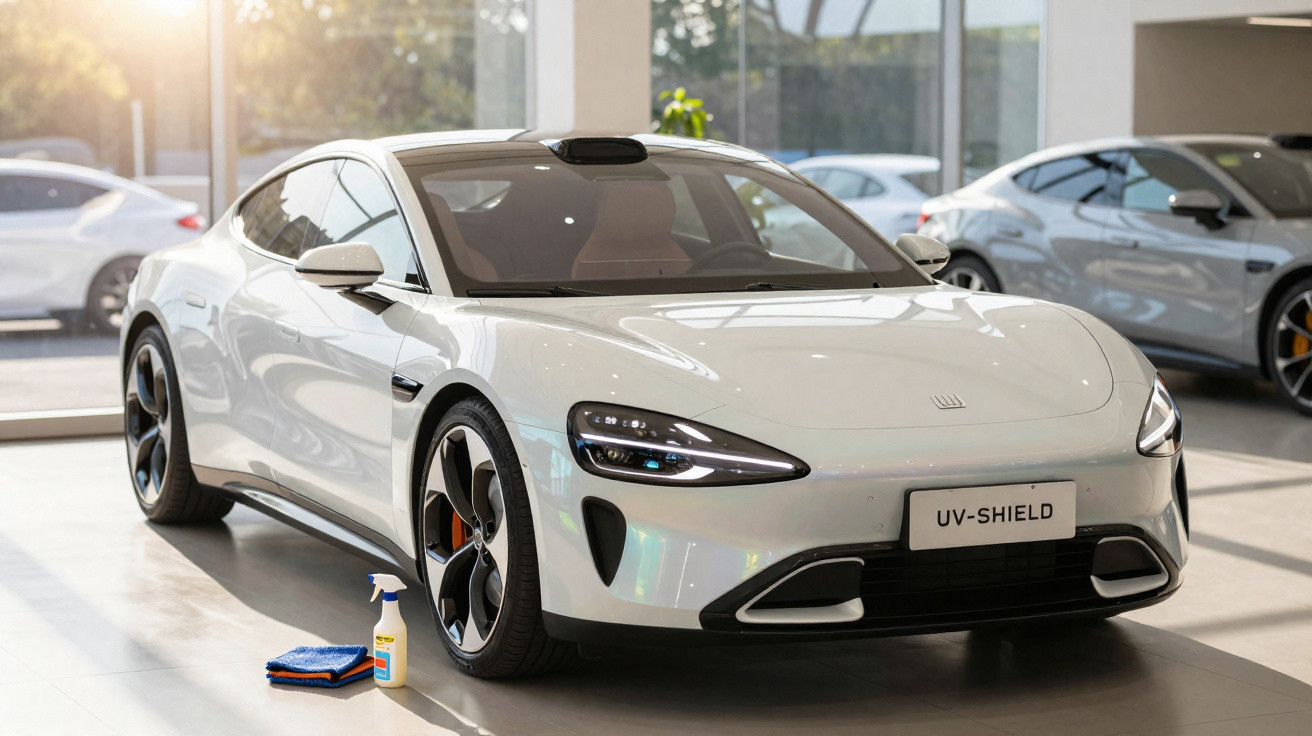
You do not first notice the mileage.
You notice the door handle: once black, now a weary shade of grey. You notice the dashboard too, which once had a rich, deep texture but now feels dry and slightly sticky beneath your fingertips.
You brush your hand over the plastic trim and think: “Huh, this car is getting old.” Yet the engine still purrs, the gearbox changes smoothly and the suspension remains taut.
Meanwhile, outside, sunlight keeps working away, silently burning through the clear coat and plastics every day. The car may still drive like new, but visually it is telling a different story.
When sunshine quietly ages your car from the inside out
Plastic fading is one of those gradual problems that tends to go unnoticed until it is already advanced. The dashboard can look perfectly acceptable one day, then suddenly, a week later, you realise its deep black finish has become uneven charcoal.
Door pillars, mirror caps, bumper inserts and wiper cowls all spend their lives exposed to the outdoors. They do not complain, squeak or rattle. Instead, they steadily lose their colour, texture and “new” appearance long before the mechanical parts begin to reveal their age.
Walk around a car park in a sunny area and a vehicle’s plastic trim can almost reveal its history. You may see two identical models from the same year: one with pale, chalky plastics, the other still looking dark and sharp.
The reason is often no more complicated than where each car spends the night. The first may live on the street, facing south, with the dashboard and wiper cowl receiving the full force of UV exposure. The second may sleep in a garage, then sit beneath office trees or in a covered parking bay during the day.
At a microscopic level, UV radiation attacks the polymers used in automotive plastics. The molecular chains that provide strength and flexibility slowly break down, releasing tiny fragments and altering the chemistry of the surface.
Pigments become less vivid, the material grows more porous and dust adheres more readily. The familiar signs then appear: fading, streaked discolouration, a dry or chalky texture, and even fine hairline cracks. By the time you notice it as “old plastic,” the sun has already done years of invisible work.
Small habits that save your plastics from early retirement
The easiest and least exciting solution remains the most effective: limit the amount of sunlight your plastics receive. You do not need to eliminate it completely; simply reducing it helps.
Parking in shade, even for only part of the day, can significantly slow UV deterioration. An inexpensive folding windscreen sunshade can lower the dashboard’s surface temperature by dozens of degrees. That small, lazy action when locking the car can preserve the interior’s appearance for years longer.
Cleaning also matters. Most motorists only wipe down the cabin when the dust becomes irritating, often using whichever wipe happens to be close at hand.
Aggressive household cleaners and wipes containing high levels of alcohol can remove the protective layer from plastic surfaces. That leaves them exposed to the sun. Let’s be honest: nobody really reads the tiny label on the bottle in the trunk.
Using a gentle, pH-balanced interior cleaner with a soft microfibre cloth may sound overly careful. However, it can be the difference between plastics ageing quietly and plastics losing the battle after five summers.
Proper plastic care is less about “shining things up” and more about building a thin, invisible shield between the sun and the surface.
- Select a UV-protective interior dressing with a non-greasy satin finish.
- Apply it every 2–3 months to a clean, dry surface.
- Use a foam applicator to ensure even coverage, then buff gently.
- Do not use thick, glossy coatings, as they collect dust and can feel sticky.
- For exterior plastics, choose products specifically rated for outdoor UV exposure.
Why UV damage makes car plastics look older than the car drives
Modern cars present an odd contrast: mechanically, they have never lasted longer, but cosmetically many look worn out by their fifth year. We keep cars for ten, twelve and sometimes fifteen years, yet their plastics are designed for the dealership showroom rather than a decade of midsummer sun.
Once you become aware of it, you spot the pattern everywhere. Hire cars in seaside towns can have dashboards faded after just two seasons. Family SUVs may still feel solid on the road while their door handles have turned grey and their bumper trim looks brittle.
The difference between how a car drives and how it appears also affects our relationship with it. A cabin may still smell fresh and feel well-built, but if it visibly shouts “old”, some owners begin considering replacement long before the mechanical life of the car is finished.
Conversely, a growing number of owners are turning to restoration detailers to revive chalky plastics with dye-based treatments. The vehicle does not drive better the following day, but its owner sees it differently. Suddenly, it feels worth retaining, maintaining and parking with pride again.
We have all experienced that moment in an older car that has been quietly cared for and protected, when it earns a small surge of respect. The steering wheel is not slick, the dashboard has no cracks and the exterior trim has retained its colour.
That result is not magic. It comes from small, mildly boring routines maintained over years. And yes, it can come from the humble choice to park beneath a tree instead of in direct sun when possible, even when that means walking for an extra 30 seconds.
| Key point | Detail | Value for the reader |
|---|---|---|
| UV damage is mostly invisible at first | Plastics start degrading long before cracks and chalkiness appear | Encourages early, preventive care instead of waiting for visible damage |
| Parking and shade habits matter | Orientation, garage use, sunshades and trees greatly slow fading | Offers low-cost daily actions that extend the “new look” of the car |
| Gentle care beats harsh cleaning | pH-balanced products and UV dressings protect plastic structure | Helps avoid unintentional damage from wrong products and methods |
FAQ:
- Question 1 How quickly can UV begin damaging car plastics?
- Answer 1 Damage begins in the first months of regular sun exposure, particularly in hot, bright climates. You might not notice visible changes for 1–2 years, but the plastic’s chemical bonds are already weakening below the surface.
- Question 2 Are older cars more resistant than newer ones?
- Answer 2 Not necessarily. Certain older models used thicker, more heavily textured plastics that age more gracefully in visual terms, but they still sustain UV damage. Modern cars frequently use lighter, more cost-optimised plastics, which can show fading more quickly without protection.
- Question 3 Do tinted windows protect interior plastics?
- Answer 3 Yes, high-quality window tint with UV filtering can greatly reduce UV exposure inside the car, especially on dashboards and upper door trims. It does not eliminate heat entirely, but it slows discolouration and cracking very effectively.
- Question 4 Can faded exterior plastics genuinely be restored?
- Answer 4 Mild to moderate fading often responds well to dedicated plastic restorers or trim dyes. Plastics that are severely degraded, chalky or cracked may only look better temporarily before reverting, and replacement is sometimes the only lasting answer.
- Question 5 Is shiny silicone spray a good option for protection?
- Answer 5 Those super-glossy sprays may look appealing for a day, but they can attract dust, feel greasy and, in some cases, speed up drying as they evaporate. Choose modern, water-based dressings with UV filters and a natural, satin finish instead.






Comments
No comments yet. Be the first to comment!
Leave a Comment